Fake it ‘til you Make it… Or just Fake?
There are phrases that begin life as rough practical wisdom and end as slogans for an entire age. “Fake it ’til you make it” is one of them.
As someone who’s done more than their fair share of sales training in stuffy rooms back in the day, it was always presented as something modest and recognisable. It meant showing confidence before confidence came naturally. It meant entering rooms that intimidated you and refusing, at least outwardly, to shrink. It meant sounding more assured than you felt while you learned, by degrees, to become the person the moment required. In business, and especially in sales, that instinct has long had a use. Sometimes it was the only way through the door.
But like so many fragments of ordinary advice, the phrase seems to have metastasised into something more sinister thanks to the internet and more specifically social media. What was once a technique for surviving uncertainty has become, in some quarters, an ethic of performance so total that it often borders on fraud. What once meant projecting belief while building competence now often means projecting success while building very little at all. What once required courage now requires props.
The difference matters, because a great many people, young people especially, are being trained not to see it. That there is no fakery and that these bros (and it is usually men) have just gone from nothing to millionaires simply by following their “programme,” available to you at a reasonable price.
There is an honourable version of “fake it ’til you make it”, and it should not be sneered at. No one begins fully formed. No founder arrives polished. No salesperson delivers a first pitch with the calm authority of a veteran. Much of adult life consists of acting before mastery arrives: suppressing nerves, borrowing poise, speaking more steadily than you feel, imitating the habits of people who seem to know what they are doing until, eventually, you do know. Confidence often follows the performance of confidence, rather than preceding it. There is nothing shameful in that. It is often simply how growth works.
But there is another version of the phrase, and it is far uglier. This is the version that flourishes in low-trust, high-ego environments. Here bluff is marketed as ambition, exaggeration sold as vision, and deception repackaged as mindset. It is the founder inflating traction, the property guru renting status by the hour, the content creator filming himself in the back seat of a Roller he does not own, the twenty-year-old “mentor” selling freedom through business models he barely understands. In this register, “fake it ’til you make it” no longer means growing into competence. It means simulating outcomes in order to hijack trust.
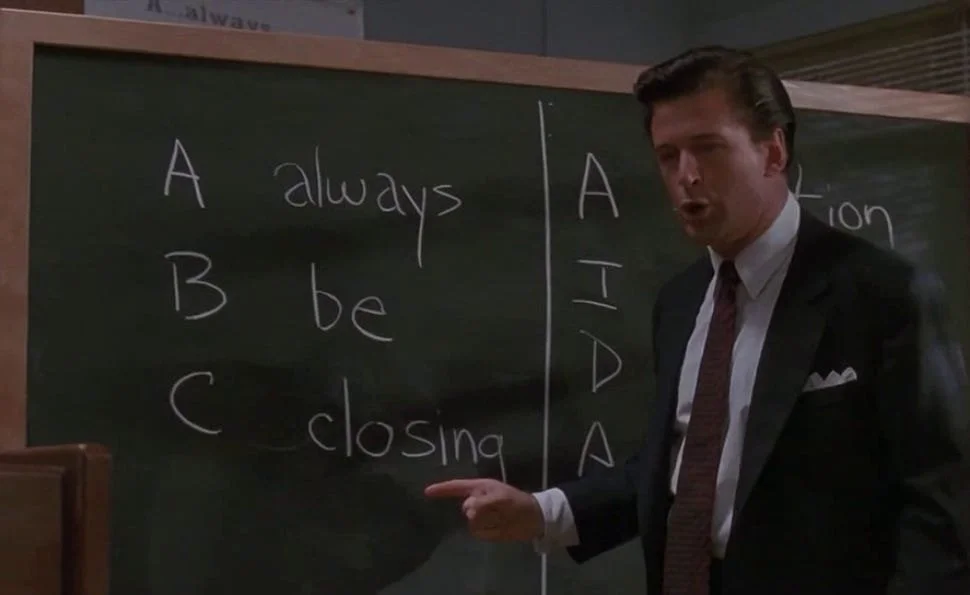
That world did not begin with TikTok. Sales culture has always had a weakness for theatre. “ABC — always be closing.” “Telling’s not selling.” Every generation of high-pressure commerce produces its own little catechism of aggression, slogans that flatter appetite and call it discipline. On one level, they capture something real. Sales does require nerve. It does require resilience, timing, focus, the ability to withstand rejection without dissolving into self-pity. Customers do not buy lectures; they buy clarity, confidence and solutions they can recognise as their own. Good salespeople understand this.
But sales culture has always had a darker edge too. It has always risked confusing persuasion with manipulation, presence with integrity, style with substance. The mythology of the sales floor glorifies a certain type of man: controlled, hungry, verbally agile, incapable of visible doubt. He can dominate a room, steer a conversation, force a deal over the line by sheer force of certainty. Popular culture has spent decades making him look glamorous. Films such as Glengarry Glen Ross, Boiler Room and The Wolf of Wall Street did not invent the type, but they preserved him in cinematic amber: the sharp suit, the hard pitch, the lust for status, the manic excess, the rot beneath it all. They were meant, at least in part, as critiques. But critique and seduction are uneasy companions. A generation of viewers took away the atmosphere and missed the warning thanks to iconic performances from Alec Baldwin, Leonardo DiCaprio and others. These films are now cult viewing for the sales community.
Back in those days though, a lot of sales were done over the telephone, often simply by picking names out of the phone book (ask your parents) and giving them a call; “congratulations, you have been successfully selected…”
That atmosphere did not vanish. It migrated.
Social media inherited not the craft of sales but its swagger. It took the oldest temptation in business, to look successful before you are successful and turned it into a form of mass entertainment. This is partly because real business is rarely picturesque. Real business is contracts, spreadsheets, tax liabilities, hiring headaches, cash flow crises, delayed shipments, insurance, compliance, customer complaints, boring meetings and repeated failure. It is process. It is attrition. It is often deeply unglamorous.
A Lamborghini, by contrast, is extremely glamorous. So is a skyline flat, a Rolex Day Date, a rented desk in a glass-walled co-working space, a screenshot of one day’s revenue stripped of all context, or a solemn young man in a fitted black T-shirt explaining that everyone with a salary has chosen slavery. This is the visual grammar of the hustle economy. It takes the visible leftovers of business; the symbols, trophies and surfaces and passes them off as business itself.
The internet is now thick with boys playing tycoon. They posture beside cars they do not own, preach discipline they do not practise, and sell certainty they have not earned. Some are making money, certainly. But many are making money mainly by telling other people how to make money. Around them swirls a haze of borrowed luxury, inflated revenue claims, bought followers, massaged engagement figures, doctored screenshots, carefully lit routines, and an endless churn of recycled rhetoric about “mindset”, “escaping the matrix”, “abundance”, “leverage” and “freedom”. It is capitalism as cosplay: commerce emptied of substance and reassembled as a lifestyle shoot.
AI is already exacerbating the problem, you don’t even need to rent the Ferrari or the swanky backdrop anymore or even write your own sales patter.
The audience for all this is not stupid. But it is vulnerable and at times naïve.
Young people are especially exposed because social media collapses the distance between aspiration and imitation. Once, fantasies of high-status business masculinity arrived through films (some mentioned above but I’ll also add in Wall Street and maybe even American Psycho), magazines or the occasional local salesman who seemed, to a child, larger than life. Now the performance is in your hand from morning to night, algorithmically tailored and relentlessly repeated. A teenager can absorb an entire philosophy of wealth, domination and contempt for ordinary life before he has learned the difference between turnover and profit.
And that philosophy is not merely financial. It is sexual, social and moral. It has, increasingly, become a script for masculinity.
As The Guardian noted in a recent analysis of the “sigma male” phenomenon, much of this online economy revolves around “the celebration of a particular type of male wealth, characterised by hard work, self-discipline, fitness and grooming”. That seems right. The hustle fantasy is not just investment advice with some expensive props. It is a total aesthetic of male worth. The body, the car, the watch, the apartment, the morning routine, the protein-heavy breakfast, the cold plunge, the unblinking stare, the cultivated contempt for softness; these are sold as one package. Wealth appears not as comfort or security but as proof of rank. There’s definitely a bit of Patrick Bateman about all this.
The same Guardian analysis observed that “the optimised morning routine has become a near-mythical ideal for young people”. Of course it has. Discipline now has to be staged. Waking at 5 a.m. is not enough; it must be filmed. Working hard is not enough; it must be aesthetic. Self-improvement, once a private and often humiliating struggle, has become a public performance conducted under ring lights. Elsewhere, The Guardian described content urging men to “hustle and grind to meet an austere, success-obsessed brand of individualism”. There is something almost theological in that phrase. An austere brand of individualism: one in which the self is both project and prison, eternally optimised and eternally insecure.
The overlap with the manosphere is too obvious to ignore. Not every young man who talks about money online is a misogynist, and not every self-styled entrepreneur belongs to some anti-feminist subculture. But parts of hustle culture sit very close to that world. The emotional grammar is familiar: status anxiety, fear of weakness, contempt for dependence, and the promise that money will restore masculine authority. As the Canadian Museum for Human Rights puts it, “The ‘hustle bro’ approach to life turns other men into opponents and women into objects.” The museum also notes that “pick-up artists have given way to ‘hustle bros’ in recent years” and that such influencers “combine misogynist relationship advice with get-rich-quick schemes.” Research highlighted by the Australian National University makes a similar point, observing that “many men and boys buying into this content have been raised on neoliberal ideas of winners and losers, hustle culture and individual choice,” while manosphere “thought leaders” grow their audiences by tapping into anxieties about “looks, economic futures and ability to attract women”.
Laura Bates, in Men Who Hate Women, captures the human cost of this far better than most institutional language can. “Those most powerfully reinforcing rigid and patriarchal gender stereotypes,” she writes, “are suffocating those who most need to escape them.” That is precisely the paradox of the hustle-manosphere overlap. It presents itself as liberation for alienated young men, but in practice it traps them inside a brittle, joyless and punitive vision of masculinity, in which wealth must be displayed, emotion must be suppressed, and other people exist chiefly as rivals, judges or prizes. What is being sold, then, is not merely a business strategy. It is a worldview.
As another Guardian analysis put it, “These influencers aren’t just showing off their wealth, they claim to offer you, the viewer, the chance to join them.” Exactly so. The display is the sales pitch. The lifestyle is the funnel. The visible wealth may be inflated, rented, selective or entirely notional, but that scarcely matters if it converts. The point is not merely to be admired. The point is to monetise admiration and envy before either has time to curdle into scrutiny.
That is why so much hustle content feels like a cross between revivalist religion, multilevel marketing and soft-focus extortion. The creator performs abundance. The viewer feels lack. Then comes the offer: buy the course, join the private group, subscribe to the mentorship programme, learn the method, access the system, change your life. Louis Theroux captured this pretty well on his recent Netflix documentary on the Manosphere and as The Guardian drily noted, “With hard work and insights (provided by the influencer) you too can succeed, they promise.” The phrase “provided by the influencer” contains the whole racket in miniature. Hope itself has become a subscription product.
Even the more respectable corners of the university world, usually too decorous by half, have begun to say something similar. The UC Davis Graduate School of Management warns that “The dynamism and boldness which startup culture celebrates can be dangerous.” More sharply, it suggests that “fake it till you make it” can become “a license for bad behavior.” That is an admirably calm way of stating the obvious. Once a culture begins to excuse hype as leadership and misrepresentation as vision, it will naturally attract people who are brilliant at seeming and much less interested in being.
And social media is an almost perfect machine for rewarding them.
The platforms do not ask whether someone has built a durable company, mastered operations, treated customers decently, or understands a balance sheet. They ask only whether he can hold attention. Attention favours certainty. Certainty favours simplification. Simplification favours liars. “Here is exactly how I made £10,000 in a week” will always outperform “Here are the tedious, low-margin realities of building a stable business over five years.” The algorithm has no special affection for truth. It has an affection for retention.
The damage here is intellectual as much as financial. A whole generation is being taught to mistake proximity to business content for business knowledge. They acquire the accent of entrepreneurship without its substance. They learn to say “value”, “scale”, “systems”, “distribution” and “leverage” before they understand what any of those words actually mean. They begin to think branding is competence, performance is evidence and confidence is proof.
It is not.
Business is not a vibe. It is not a montage. It is not a collection of luxury cars and aggressive one-liners. It is not a teenager in sunglasses telling exhausted adults that employment is for the weak. Real entrepreneurship is usually much less glamorous and far more demanding than its online evangelists admit. It requires patience, numeracy, stamina, boring skill, delayed gratification and a willingness to do unphotogenic work for a very long time. The hustle economy despises this because none of it clips well.
Meanwhile, startup culture has supplied the whole circus with a moral alibi. In founder mythology, exaggeration is often excused as visionary confidence. Sell the future. Tell the story. Project scale. Back conviction. Up to a point, fair enough. Every enterprise requires some faith in what does not yet exist. But this slides very easily into nonsense, and nonsense, once rewarded, quickly becomes a norm. The New York Times recently captured the absurdity with one excellent phrase, asking which beneficiaries of the AI boom would prove to be “true billionaires and not just paper billionaires”. There, in two words, is the pathology of the age: paper success. Wealth vividly experienced in the public imagination and only uncertainly in reality.
That phrase belongs far beyond Silicon Valley. Much of the online business world now runs on paper status: audiences that do not convert, revenues with no context, valuations with no durability, brands with no depth, confidence with no competence. The image comes first; the audit rarely follows. And once people begin living off the image, the pressure to keep pretending becomes intense.
Patrick Radden Keefe’s account of Zac Brettler in London Falling offers a more tragic version of the same logic. Brettler, a London teenager who died after falling from a luxury apartment building in 2019, had been living what Keefe describes as a fantasy life, posing as the son of a wealthy Russian oligarch. His favourite film was reportedly The Wolf of Wall Street, which feels grimly apt: another tale in which wealth, theatre and self-invention curdle into something darker. Brettler’s case was singular, and should not be flattened into a slogan. Even so, it reads like “fake it till you make it” taken to a tragic extreme: identity itself remade in the image of money, status and belonging. What makes the story so haunting is not merely the deception, but the pressure beneath it. In a culture that treats elite appearance as power, the temptation is no longer only to look successful, but to become, or pretend to become, someone else entirely.
The UC Davis Graduate School of Management makes the structural point with characteristic restraint: “The greater the potential, the more investment, and the heavier the pressure on entrepreneurs and their ventures to live up to their own hype. And this can create a lack of oversight.” Quite. Hype does not merely distort perception. It weakens restraint. If your income depends on the appearance of unstoppable ascent, honesty starts to look like a luxury. If your followers are there for the fantasy, reality becomes a commercial threat.
This is why the phrase “fake it ’til you make it” is now too flattering for much of what it describes. A good deal of it is not faking confidence while learning. It is faking evidence while selling. It is not ambition in costume. It is misrepresentation with flattering lighting.
Still, there is no point falling into the opposite stupidity and pretending that business can function without confidence, narrative or self-invention. Of course it cannot. Many decent people have had to present themselves boldly before they felt ready. Many successful founders have pitched a larger future than current circumstances justified. Many excellent salespeople learned poise by imitating poise. The problem is not confidence. The problem is counterfeit credibility.
That distinction ought to be straightforward, yet our culture keeps blurring it because we remain helpless before surface. We still believe, too readily, in the old visual grammar of success: the suit, the watch, the room, the body, the certainty, the speed. We still want visible wealth to signal visible worth and therefore success. Social media has merely weaponised that weakness and distributed it at industrial scale.
The cost is not confined to the customer who buys a worthless course, though there are many such customers. It is also paid by the young person whose understanding of work is warped before work has properly begun. It is paid by the competent operator drowned out by louder frauds. It is paid by business culture itself, which becomes steadily more cynical as more people conclude, not unreasonably, that enterprise is merely showbiz for narcissists.
And perhaps that is the ugliest consequence. When fakery becomes the dominant style of aspiration, it does not simply mislead. It degrades. It teaches the young to admire the wrong things: not competence but optics, not endurance but display, not service but flexing, not judgement but bravado. It turns enterprise into a branch of personal branding and masculinity into a showroom.
A healthier business culture would not sneer at confidence. It would insist that confidence answer to reality. It would teach people to sell, certainly, but also to build; to present, but also to understand; to be ambitious, but also to be exact. It would remind the young that reading a balance sheet matters more than filming a morning routine, that customer retention matters more than follower count, and that knowing what you are doing matters more than looking as if you do.
There is still a respectable version of “fake it ’til you make it”, and it is worth defending. It is the version in which a nervous beginner straightens his back, does the work and grows into the role. It is the version in which confidence is provisional but effort is real. It is the version in which polish functions as a bridge to competence rather than a substitute for it.
But that is not the version social media has made fashionable.
What it has made fashionable is a culture of props, posturing and monetised illusion: a world in which boys with ring lights play mogul for an audience of the anxious; in which discipline is aestheticised, wealth eroticised, masculinity hardened into ideology, and lying rebranded as vision; a world in which the performance of success has become, for many, more profitable than success itself.
If that sounds harsh, good! It should!
Too much commentary on this subject still speaks as though the problem were only vanity, vulgarity or bad taste. It is not. The problem is moral as well as cultural. A society that teaches the young to confuse image with achievement will produce more frauds, more suckers and fewer serious builders. It will produce people fluent in ambition and illiterate in craft.
So by all means, be bold before you feel bold. Speak clearly before you feel secure. Step into rooms that intimidate you. That is how many people grow, it is certainly how I grew.
But if your entrepreneurship begins with hired luxury, inflated claims, staged authority and a plan to monetise strangers before you have learned anything worth teaching, then you are not faking it till you make it.
You are just faking it.
Beyond “Work/Life” Balance

Why this Anachronistic Language Has Failed Us
A few days ago, I posted an Instagram story featuring a photo of my youngest son and a few lines about why I dislike the term “work/life balance.” I received a huge number of supportive DMs in response so thought I’d do a deep dive on precisely what is wrong with this hackneyed phrase and how (if at all) we can replace it with something that better reflects individuality and the true complexities of life. It seems only fair that the photo accompanying this article is of my elder son.
There are phrases that survive in management culture not because they are precise, or positive or even that helpful but because they are convenient. “work/life balance” is one of them. It appears everywhere: in recruitment campaigns, leadership speeches, HR frameworks, employee surveys, wellbeing policies, conference panels, consultancy decks and the self-congratulatory messaging of organisations eager to signal modernity and care. It has become one of those expressions that sounds so obviously right that many people stop listening to what it actually says.
I have for a long time disliked the term, not because I want to keep people chained to their desks, but because I think a balance of work and everything else in life is too important to be trapped inside such an awful pithy phrase which really does give off the vibe that “you’re lucky to be working here because we let you see your family.” “Work/life balance” is reductive. It sounds faintly bureaucratic, dated, as though it emerged fully formed from an HR away day sometime in the late 1990s, where a group of people in name badges decided that the unruly problem of human flourishing could be contained in a phrase that would sit neatly on a slide. The expression carries all the marks of late-managerial language: tidy, plausible, abstract, and faintly patronising. It sounds humane while flattening the humanity it claims to respect.
My objection is not semantic fussiness. Language matters because language shapes thought, and thought shapes policy, and policy shapes the daily texture of human lives. If we talk about “work” and “life” as though they are two separate, rival substances that must be held in correct proportion, then we are already thinking badly. We are imagining the human person as a set of competing compartments rather than as a whole. We are assuming that “work” is one thing and “life” is another, when in reality work is part of life, and life consists of far more than the residue left over when we finally leave work for the day.
This asymmetry is the first and most obvious problem with the phrase: it collapses nearly everything of value into a single catch-all category called “life.” Love, friendship, marriage, sex, parenthood, grief, reading, travel, exercise, reflection, conversation, music, food, laughter, beauty, solitude, art, play, learning, sport, exercise, memory, joy, sorrow, healing, community, growth, adventure and rest are all bundled together as though they were one homogeneous thing.
All human beings are unique, complex characters. Human adults are the product of many factors; geography, culture, family, personal experience, religion, health, wealth, politics, education, peer group; I could go on and there are plenty of studies you can easily find, along with your own life experience, to illustrate this. My personal life experience, priorities, aspirations, likes and dislikes are unique to me as they are to the people living next door or on the other side of the world.
The concept of two competing elements for all human employees of a particular organisation is therefore absurd. On one side: work. On the other: everything else that makes existence worth inhabiting.
Even before one gets to the empirical research, the phrase fails as a description of the human condition. Human beings do not live bifurcated lives in which the hours spent working somehow cease to count as life. Those hours are lived hours. They shape mood, health, relationships, identity, status, self-respect and one’s sense of meaning. Work can be depleting, exploitative and deadening, yes. But it can also be absorbing, dignifying, creative, socially connective and morally serious. Work is not the opposite of life. It is one of the places in which life happens.
“Balance” is also an unconvincing ideal. The image invoked is usually that of scales: work on one side, life on the other, with the good life consisting in some stable equilibrium between them. But flourishing is not a still point. Lives are lived in seasons. There are times when professional commitment properly intensifies, times when family does, times when illness or bereavement reorders everything, times for travel, times for study, times for caregiving, times for risk, times for maintenance, times for solitude, times for exuberance. Very little of this resembles a balancing act. It resembles movement, responsiveness, judgement and adaptation.
My problem with “work/life balance”, then, is not only that it is vague. It is that it frames the question clumsily. It encourages us to think in binaries where a richer moral, psychological and social vocabulary is required.
This criticism is supported by the scholarly literature itself. Researchers have repeatedly noted that the term lacks conceptual clarity. One review observed that there is “no widely accepted definition or measure of work-life balance currently” and that this absence hinders both theory and practical application. Another line of academic work has pointed out that assumptions about what counts as balance vary dramatically between individuals, occupations, genders and life stages. Some people understand balance as equal time allocation; others as subjective satisfaction; others as low conflict between roles; others as autonomy over when and where work is done. Once a concept can mean all these things, it begins to lose explanatory force.
A chapter titled “Questioning the balance of work and life: some philosophical observations” makes the essential point crisply: “A basic assumption that underlies the work-life interface is the balance between work and life.” The power of that observation lies in its simplicity. The assumption has become invisible precisely because it is so widely repeated. Yet assumptions are where serious inquiry must begin. Why should “balance” be the governing metaphor? Why should work and life be conceptualised as separate domains in the first place? What moral vision of the person is smuggled into that language? And whose interests are served by maintaining it?
To answer those questions, it helps to widen the lens beyond management literature and into philosophy, psychology, sociology and organisational studies. The term “work/life balance” appears neutral, but it is not. It reflects a particular historical moment and a particular way of organising economic and personal life. It belongs to a world in which work became increasingly mobile, increasingly professionalised, increasingly cognitive for some classes of worker, yet also increasingly demanding and invasive. It emerged as a managerial response to strains that modern organisations themselves had helped produce. As such, the phrase was always both critique and containment: a recognition that things had gone too far, and a way of addressing the problem without challenging too many underlying assumptions.
There is no need to deny that the phrase once did useful work. In the late twentieth and early twenty-first centuries, it gave legitimacy to concerns that had often been dismissed. It helped make visible the incompatibility between rigid employment structures and the realities of family life. It allowed employees to ask for flexibility without appearing unserious. It gave organisations a framework, however limited, for discussing reduced hours, job shares, part-time roles and home working. In that sense, it represented a real improvement over cruder models of employment in which workers were expected simply to absorb every demand. I’d be wrong to overlook that achievement.
But concepts can be historically useful and conceptually exhausted at the same time. The phrase has reached that point. In 2026, we know too much about human wellbeing, occupational stress, social inequality, care responsibilities, identity formation and digital working life to continue relying on such a blunt instrument. We need language that is more exacting, more humane and more honest about what modern work asks of people.
Philosophy helps here because it reminds us that the point of a life is not simply to manage competing inputs efficiently. Aristotle’s notion of eudaimonia, usually translated as flourishing, is a far better starting point than “balance”. Flourishing does not mean dividing one’s days correctly between an office and whatever lies beyond it. It means living well in the fullest sense: cultivating virtues, exercising capacities, forming sound relationships, participating in community and ordering one’s activities towards a good life as a whole. This is a vision of human existence as integrated rather than partitioned. Aristotle would have understood that work matters because it forms part of a life, but he would not have mistaken the regulation of hours for the substance of flourishing.
The same is true, in a different register, of John Stuart Mill’s defence of “experiments in living”. Mill’s importance here lies in his resistance to standardisation. The good life cannot be reduced to one model and issued as a policy template. Individuals differ in temperament, aspiration, obligation, energy, vocation and circumstance. One person may be nourished by professional intensity, another by their deep local roots, another by artistic practice, another by family-centred domesticity, another by public service, another by enterprise and risk. The phrase “work/life balance” obscures this pluralism by pretending to offer a universal ideal while remaining frustratingly underspecified.
Hannah Arendt’s distinctions between labour, work and action are also illuminating. Her categories were not designed to solve managerial dilemmas, but they expose the inadequacies of current terminology. For Arendt, labour refers to the cyclical activities necessary for biological survival; work to the fabrication of a more durable human world; action to the realm of speech, plurality and public life. Whether or not one follows her scheme in full, it becomes difficult after reading her to treat all productive activity as one blob called “work”, opposed to another blob called “life”. Human existence consists of many modes of doing, making, caring and appearing. To flatten that complexity into a binary is intellectually lazy.
Simone de Beauvoir adds another critical dimension. Her analyses of freedom and social constraint, and her focus on the ways in which women’s lives are organised by structures they did not choose, make it impossible to discuss “work/life balance” innocently. The category of “life” has historically contained vast quantities of unpaid domestic labour and emotional management, much of it performed by women and much of it going uncounted for. The phrase can therefore function ideologically, disguising inequalities under a neutral-sounding formulation. If one partner’s “life” consists partly of being available to absorb the practical burdens that enable the other partner’s career, balance may look very different depending on where one stands.
Modern writers on vulnerability and wholeness help extend this critique into the organisational sphere. Brené Brown’s work has had unusual influence because it gave a broad professional readership language for ideas that had long been marginal in corporate settings: vulnerability, courage, shame, trust, belonging, wholeheartedness. However one judges the academic depth of parts of her work, her impact is undeniable. She helped normalise the idea that human beings cannot indefinitely separate professional identity from emotional reality without cost. If leaders talk seriously about trust, psychological safety and courage, then they are already conceding that the self at work is not a detachable instrument. The person who enters a workplace brings their fears, history, dignity, longing and need for connection with them. The old binary becomes impossible to sustain.
This is one reason why so many people have sought alternatives such as “work-life integration”, “work-life fit” or “work-life harmony”. These alternatives are attempts to move away from the image of two opposed weights on a scale. One popular critique of the term, “Why I Hate the Phrase ‘Work Life Balance’”, expresses this vividly by objecting to the image of “a balance scale with two weights on it”. Its proposed alternative, “work life harmony”, is attractive because harmony allows for plurality, movement and changing emphasis. One does not need equal volume from every instrument at every moment to produce a good piece of music.
Even these alternatives need scrutiny and I think there’s still an echo of the hackneyed, old phrase present in all of them. “Integration” can easily become a euphemism for work’s annexation of the rest of life. If integration means the office in the kitchen, email in the playground, and permanent availability carried in one’s pocket, then it is not a liberation from the old framework but a further victory for work’s expansion. Harmony, too, can sound too soft and too smooth. Real lives contain friction, contradiction and tragedy. Sometimes domains do conflict. Sometimes values collide. Sometimes there is no elegant synthesis, only difficult choice. The challenge is not to find a perfect replacement slogan, but to step outside the anachronistic conceptual frame altogether.
Psychology provides some of the strongest reasons for doing so. The impact of overworking on human beings is not speculative. It has been studied extensively across occupational health, organisational psychology, psychiatry and public health. We know that chronic overwork can produce emotional exhaustion, impaired concentration, anxiety, depression, sleep disturbance, irritability, strained relationships and diminished capacity for joy. We know that it is associated, in some contexts, with substance misuse, cardiovascular risk and increased mortality. We know that people are not endlessly elastic.
Christina Maslach’s work on burnout remains foundational. Burnout is commonly defined through three dimensions: emotional exhaustion, depersonalisation or cynicism, and a reduced sense of personal accomplishment. What matters here is that burnout is not simply tiredness, nor is it merely the result of an individual’s failure to rest sufficiently. It often arises from prolonged exposure to chronic workplace stressors: overload, low control, insufficient reward, breakdown of community, unfairness and value conflict. Those categories are crucial because they move us away from the fantasy that a person can solve a structurally induced crisis by “balancing” better. The problem is often not time management. It is a mismatch between human needs and institutional conditions.
The World Health Organization and the International Labour Organization have jointly highlighted the dangers of long working hours, linking them to increased risk of stroke and ischaemic heart disease. The significance of this research is moral as well as medical. It tells us that what is often discussed in polite corporate language as a matter of balance or flexibility is, in some cases, an issue of bodily harm. Chronic overwork does not simply produce a less pretty lifestyle. It can damage minds, bodies and relationships in enduring ways.
Robert Karasek’s Job Demand-Control model and its later developments are also instructive. The model suggests that high job demands become especially stressful when combined with low control. Social support later emerged as another critical variable. This matters enormously for any serious conversation about work and life because it shows that not all effort is experienced equally. Two people may work long hours, yet one experiences the work as meaningful, autonomous and socially supported, while the other experiences it as coercive, monitored and isolating. A crude “balance” framework risks treating them as equivalent because it focuses on the quantity of time rather than the quality of the working experience.
Self-Determination Theory, developed by Edward Deci and Richard Ryan, sharpens the point. Human beings, on this account, have basic psychological needs for autonomy, competence and relatedness. When these are supported, work can be energising and growth-promoting. When they are frustrated, work can become deadening and distressing. This is a profound challenge to the common assumption that the problem is simply too much work crowding out life. Sometimes the problem is indeed excess. But sometimes the problem is alienation: work organised in ways that deny agency, deny mastery and thin out human connection. The solution is therefore not only to protect more time away from work, but to make work itself more consonant with human flourishing.
This is where the management literature becomes particularly revealing. Organisations often speak as though the work/life question is one of boundary management: how can employees better separate or combine professional and personal demands? That is part of it, but only part. A much harder question is whether work is being designed and led in a way that respects human beings as ends rather than means. Jeffrey Pfeffer of Stanford has been especially forceful in arguing that many workplace practices are bad for human health. Long hours, job insecurity, lack of control, inadequate social support and toxic managerial cultures are not unfortunate side effects. They are often built into systems of organising. When that is the case, work/life programmes can become decorative rather than substantive.
Research from leading universities and business schools in the UK and USA has repeatedly pointed in the same direction. Studies from Harvard, Stanford, LSE, Oxford, Cambridge and elsewhere have explored the links between autonomy, workload, job quality, flexibility, mental health and retention. One recurring insight is that flexibility, while valuable, is not enough if cultures punish those who use it. Another is that the norm of the “ideal worker” still exerts extraordinary force. This ideal worker is always available, unencumbered by caring obligations, willing to travel, quick to reply, ready to stretch and visibly devoted. It is an image built on outdated assumptions about gender, class and domestic support. It is also deeply corrosive.
In many professional settings, overwork is not merely required; it is performed. People signal importance by being busy, committed by being exhausted, valuable by being unavailable for everything except work. The sociologist Erin Reid and others have shown how workplaces often reward the appearance of constant devotion, even when actual productivity gains are marginal or imaginary. This helps explain why so many “work/life balance” policies exist in companies where employees remain afraid to use them. The formal policy says one thing; the prestige system says another. In such contexts, the phrase “work/life balance” can operate as a kind of institutional alibi.
That is why the question of management failure matters. Is the persistence of such reductive language merely lazy habit, or does it reveal something more troubling about how organisations think? I suspect it reveals both. At one level, it is just cliché: a phrase repeated because everyone recognises it. But at a deeper level, it reflects a managerial preference for simplified, administrable categories. “Balance” sounds measurable. It sounds like something that can be surveyed, benchmarked and improved through interventions. It translates existential complexity into a programme.
There is an understandable temptation here. Managers need frameworks. Organisations cannot operate entirely in poetry. Yet when a framework becomes too crude, it ceases to illuminate and begins to distort. Worse still, it can disguise where responsibility truly lies. If an employee is depleted, conflicted, disconnected from their children, unable to care for an ageing parent, and quietly unravelling under impossible demands, it is very convenient for the organisation to frame this as a balance issue. The implication is that the employee must rebalance. But rebalance what, exactly, if the workload is structurally unreasonable, the staffing model inadequate, the expectations unspoken but severe, and the culture rewarding permanent responsiveness?
This is where the critique broadens into power. The language of “work/life balance” can sometimes conceal a desire not simply to support employees, but to regulate them.
Once life becomes a factor in productivity, organisations develop an interest in managing it. Wellness initiatives, resilience training, mindfulness programmes, sleep advice, nutrition seminars and digital detox campaigns may all be beneficial in themselves, though in my experience are simply there to protect a business when work and life are so unbalanced that an employee’s health is severely damaged. But they can also participate in a wider logic in which the worker is expected to optimise their entire existence in service of sustained performance. Michel Foucault’s work on discipline and self-regulation hovers in the background here. Modern control often works through the internalisation of norms. People come to manage themselves in accordance with institutional expectations, blaming themselves when they cannot bear what should never have been normal.
This is not an argument against resilience, therapy, exercise or boundaries. Those things matter greatly. It is an argument against depoliticising strain. Not every exhausted person is simply in need of a better evening routine. Sometimes they are experiencing the rational bodily and emotional consequences of being asked to live against the grain of human limits.
The British and American evidence on overwork bears this out. Long-hours cultures remain deeply entrenched in certain sectors: law, finance, medicine, consulting, technology, parts of academia and leadership roles across industries. In many of these settings, the rewards can be considerable: status, money, influence, stimulation, camaraderie. That is part of what makes the trap powerful. People are not simply coerced; they are often seduced. Ambition, identity and validation become intertwined. A person may genuinely love aspects of their work and still be destroyed by its totalising claims. This complexity matters because it prevents the conversation from collapsing into anti-work sentiment. The problem is not that work matters too much to people. It is that work can too easily become the organising axis around which all other goods must negotiate for leftovers.
Philosophically, one might say that work has expanded beyond its proper scope. It has become not only a means of earning, contributing or creating, but a primary source of identity, community, esteem and self-explanation. In the absence of strong civic, religious, local or familial anchors, work has absorbed functions once distributed across social life more broadly. This helps explain why the phrase “work/life balance” is both popular and inadequate. It is popular because people experience work as overwhelmingly consequential. It is inadequate because the deeper problem is not hours alone, but the social overinvestment of meaning in paid work.
One sees this clearly in the language people use about themselves. They say they are “what they do”, or that they “are their job”, or that stepping back would mean “disappearing”. Such statements are psychologically intelligible, especially in prestige economies. But they are also dangerous. If work becomes the primary site of worth, then any boundary around it will feel like loss rather than sanity. No amount of balance rhetoric will solve that. What is needed is a cultural shift in the hierarchy of values.
That shift must include care. Few areas expose the poverty of the old phrase more clearly than parenting and caregiving. To speak of “balancing work and life” in this context is almost offensively thin. Parenting is not a hobby on the life side of the ledger. Nor is caring for an ill partner, supporting a disabled child, or walking a parent through dementia. These are among the most morally weighty dimensions of adulthood. They should not be treated as residual categories around which work may or may not be flexibly arranged. A decent society and a decent organisation should begin by recognising care as central to human life rather than peripheral to economic productivity.
Feminist scholarship has made this point for decades. The supposed neutrality of workplace norms often masks the fact that those norms were built around a worker who has someone else taking care of life. Even where formal equality has improved, the deep structure of many organisations still assumes a body untroubled by pregnancy, a household supported by invisible labour, and a worker whose attention can be given wholly to work when required. “Work/life balance” can soften the edges of this arrangement without changing its foundation. It sounds compassionate while preserving the idea that care is an accommodation rather than a norm.
The same moral thinness appears in how the phrase handles joy, beauty and play. One of the saddest features of contemporary professional culture is the way it often treats everything outside work as recovery for work rather than as intrinsically good. This is where is have an issue with the Steven Bartletts of this world. Sleep becomes fuel. Exercise becomes productivity enhancement. Holidays become reset periods. Friendship becomes networking with better wine. Reading becomes self-improvement. Even mindfulness is marketed as a way to become more effective under pressure. The logic of optimisation spreads everywhere. Under this logic, “life” is no longer truly life. It is maintenance or worse, something else on which to gather data and analyse metrics.
That is why I resist the phrase so strongly. It reflects and reinforces a mentality in which the purpose of non-work is too often to repair the worker for further work. But life is not a repair shop for labour. A great life includes things that do not justify themselves in economic terms: long meals, bad jokes, music listened to properly, aimless walks, hours with one’s children, making something unnecessary but beautiful, reading a novel with no practical outcome, sitting with grief, learning for the pleasure of understanding, travelling not to post about it but to be changed by it. These are not luxuries appended to the real business of life. They are among the reasons life matters.
Literature often sees this more clearly than management theory. Novelists have long understood what organisations often miss: that identity, aspiration, duty, regret, love and status are entangled, and that the cost of ambition is rarely borne by the ambitious person alone. From George Eliot to Virginia Woolf to contemporary fiction about work and burnout, literature reveals the emotional granularity that corporate language smooths away. Poetry, too, has always known that a human life is not an optimisation problem. Art resists managerial reduction because it insists on singularity, texture and felt reality.
Music offers an especially apt counter-metaphor (I’m drawing on my GCSE in music for some of this). Balance suggests equal weight. Music suggests relation. A good life is less like a set of scales than like a composition in time. Different themes emerge, recede, return and transform. There are crescendos and rests, counterpoint and silence, dissonance and resolution. Some passages are strenuous, some light, some mournful, some ecstatic. What matters is not equal intensity everywhere, but coherence, depth and responsiveness. This does not mean life is easy or elegant. Many great compositions contain tension. So do great lives.
The sociologist Hartmut Rosa’s concept of resonance captures something essential here. Rosa argues that the good life is not one of total control or endless acceleration, but one in which we are in living relation with the world: responsive to people, places, work, art, nature and history in ways that move us and to which we can respond. Resonance is not the same as comfort. It can include difficulty and transformation. But it stands sharply against the deadening instrumentalism that marks so much contemporary experience. In a resonant life, work may be one site of relation and meaning, but not the only one. Nor should it drown out the others.
Positive psychology, for all its simplifications, also points us beyond the binary. Martin Seligman’s PERMA framework (positive emotion, engagement, relationships, meaning and accomplishment) is helpful not because it is definitive, but because it is plural. It recognises that wellbeing is made of different goods that cannot all be reduced to one metric. Accomplishment matters, yes. So do relationships. So does meaning. So does engagement. Work can supply some of these goods, but not all of them, and not for everyone in the same way. A person can be high in accomplishment and low in joy; high in engagement at work and low in relational depth elsewhere. Any serious account of a life must be capable of seeing this complexity.
The practical implications for leadership are substantial. If we move beyond “work/life balance”, then leaders must stop congratulating themselves merely for offering flexibility and start asking more difficult questions. Is the work itself meaningful? Are workloads credible? Are teams staffed adequately? Do line managers understand the human consequences of their behaviour? Are expectations around responsiveness explicit and humane? Are promotions tied to visible overwork? Are parents, carers and those with complicated lives quietly penalised? Does the culture treat rest as respectable or as weakness? Is “wellbeing” being used to compensate for poor design? Do those who know how to “play the game” get promoted above more talented colleagues with different priorities?
These are not soft questions. They are questions about performance, retention, ethics and sustainability. A workplace that consumes people indiscriminately may achieve bursts of output, but it will also generate burnout, mistrust, poor judgement, attrition and hidden cost. Sustainable excellence requires more than talent and drive. It requires conditions in which human beings can remain whole enough to think clearly, relate honestly and recover properly.
For individuals, moving beyond the old phrase also changes the task. The goal is not to achieve some mythical perfect division between office time and “life time”. It is to cultivate a life architecture in which work has a proper place. That may mean embracing ambition while refusing totalisation. It may mean recognising that some seasons call for more work, but not mistaking those seasons for destiny. It may mean making hard trade-offs consciously rather than drifting into them. It certainly means asking not only “How can I fit life around work?” but “What kind of life am I actually trying to build?”
That question is more demanding than balance because it requires values, not just scheduling. What do I want my children to remember? What kind of friend am I becoming? What is my body telling me? What forms of beauty, service or community am I neglecting? What ambitions are truly mine and which have been inherited from prestige culture? What does enough look like? What can only be done now? What losses am I incurring that no promotion can reverse? These are adult questions. “Work/life balance” is often too flimsy to hold them.
It is also worth saying that a holistic approach does not require anti-work romanticism. Work matters deeply. Good work can structure time, sharpen skill, create solidarity, provide economic security and offer genuine meaning. Many people draw enormous satisfaction from their professions, trades and enterprises. There is nothing ignoble in that. The alternative to “work/life balance” is not work’s diminishment into a regrettable necessity. It is work’s relocation into a broader moral ecology. Work is one of the significant things in life, but not the sovereign thing.
This distinction matters particularly in an era when younger generations are often caricatured as either work-obsessed or work-shy. In truth, many are asking a healthier question: not how to avoid effort, but how to avoid giving themselves to systems that promise identity and take too much in return. Their scepticism towards inherited corporate language may be one of the more intelligent features of the current moment. They have seen burnout up close. They have seen parents miss too much. They have seen the smartphone colonise home life. They are right to be suspicious of phrases that sound supportive while leaving power arrangements untouched.
A serious business culture in 2026 should therefore retire “work/life balance” with gratitude for whatever usefulness it once had and clarity about why it is no longer enough. In its place, we need a richer vocabulary: flourishing, wholeness, sustainability, meaningful work, humane leadership, life design, care, dignity, resonance, seasonality, boundaries, depth. This list is not exhaustive and none of these suggestions is perfect, but together they are truer to the complexity of actual living.
Most of all, we need to remember that a person is not a unit of productivity with a private life attached. A person is a whole creature with a finite span of years, a body that tires, relationships that require presence, capacities that develop, sorrows that wound, pleasures that renew, and a need for meaning that no performance review can fully address. Work belongs within that life. It should not stand outside it as an adversary, nor sit above it as a master.
The phrase “work/life balance” fails because it cannot say any of this. It notices a tension but names it badly. It assumes two spheres where there are many. It imagines equilibrium where there is movement. It personalises what is often structural. It offers management language for existential realities. And because it sounds benign, it can prevent better questions from being asked.
In 2026, we should step away from this term. Not because balance, in the ordinary sense, never matters. Of course, proportion matters. Rest matters. Time matters. Limits matter. But the phrase itself is too reductive for the age we are in and the knowledge we now possess. We need a more holistic approach — one that recognises career, travel, love, marriage, friendship, exercise, learning, parenting, art, literature, food, music, joy, tragedy, play, service and stillness not as “everything else”, but as the very substance of a life.
A rich life is not built by balancing two abstract competing categories against one another. It is built by attending, over time, to the many forms of nourishment that make a human being fully alive. Some of these will come through work. Some will come despite work. Some will come in places no employer can ever reach. The point is not to keep the scales level. The point is to live deeply and well.
Work is part of life, but only one part. It can be meaningful, important and even beautiful. But it should sit within a larger vision of what life is for: love, relationships, friendship, growth, movement, beauty, thought, laughter, contribution, care, memory and joy. Not a balancing act. A life.
The Growth Fallacy
Something I’ve been interested in for a long time: why has growth at all costs become almost a religion in business?

The Attrition Advantage
For most of modern business history, growth has been treated as a moral good. Bigger revenues, bigger teams, bigger product portfolios, bigger market share, bigger footprints. Boards reward it, investors celebrate it, executives build careers around it, and business media rarely tires of praising it. In this worldview, shrinking looks like failure. Cutting clients sounds like retreat. Narrowing a product line appears defensive. Leaving markets feels like surrender.
Yet many of the world’s strongest companies have discovered a truth that is both uncomfortable and liberating: growth without discipline destroys value, while strategic reduction often creates it. The businesses that endure are not always those that do the most, but those that choose most carefully. They know when to prune, when to simplify, when to say no, and when to abandon attractive distractions in service of durable strength.
This is the attrition advantage: the idea that strategically shrinking a business, by cutting clients, products, staff, business units, channels, or geographies, can be the fastest route to sustainable success. It is not an argument for decline, passivity, or fear. It is an argument for focus. Done well, attrition is not the opposite of growth. It is growth’s precondition. It clears away the complexity, waste, and fragmentation that prevent a business from compounding.
Peter Drucker, often called the father of modern management, put the principle plainly: “There is nothing so useless as doing efficiently that which should not be done at all.” That sentence should be pinned to every executive dashboard. Many firms are not suffering from a lack of effort. They are suffering from effort spread too thinly across too many priorities. They are highly efficient at serving marginal customers, maintaining low-value products, sustaining bloated structures, and defending legacy activities that no longer deserve capital.
The result is organisational drag. Management attention fractures. Costs creep. Decision-making slows. Employees lose clarity. Customers experience inconsistency. Innovation weakens because resources are trapped supporting the old. In these moments, shrinking is not damage control. It is strategy.
Why businesses become addicted to more
Growth is seductive because it is visible and sounds sexy. Adding a new product, entering a new market, hiring a new team, or acquiring a business all signal ambition. Executives can create fifedoms and boast about the size of their business units, perhaps a proxy for something else! Reduction sends the opposite signal unless it is explained well. Leaders often fear that cutting back will be interpreted as weakness by investors, employees, or competitors. So they tolerate complexity long after it stops paying for itself.
There are structural reasons for this. Incentive systems often reward expansion over simplification. Annual planning cycles encourage every department to argue for more headcount and more budget. Senior leaders gain status by controlling larger empires. In diversified businesses, weak activities survive because they are politically difficult to close. Meanwhile, sunk cost bias convinces firms to keep investing in products or markets simply because they have already spent so much.
Academic research has repeatedly shown how escalation of commitment can trap organisations in poor decisions. The lesson from management literature is consistent: firms do not merely fail because they choose bad strategies; they also fail because they cannot stop doing what no longer works.
This is where strategic attrition becomes powerful. It imposes a discipline that growth rhetoric often avoids. It asks hard questions. Which customers actually create value? Which products genuinely reinforce the brand? Which markets offer real strategic advantage? Which roles contribute to differentiated performance? Which layers of management add speed and judgment, rather than bureaucracy?
These questions are uncomfortable because they reveal a basic fact of competitive advantage: not all business is good business.
The economics of doing less
The case for shrinking is not philosophical. It is economic. Complexity has a cost, and in many businesses that cost is hidden.
A wide product range increases procurement complexity, inventory burden, forecasting difficulty, marketing dilution, and operational risk. A broad customer base may include segments that demand customisation, long payment terms, and heavy support while generating little profit. Too many markets create compliance costs, cultural mismatch, and managerial distraction. Too many initiatives produce what strategy scholar Michael Porter warned against when he said, “The essence of strategy is choosing what not to do.”
Porter’s insight remains one of the clearest rebuttals to the growth-at-all-costs mindset. Strategy is not just ambition. It is exclusion. It is sacrifice. It is deciding that some opportunities must be declined because pursuing them undermines coherence elsewhere.
Research from leading business schools has often reinforced this logic. Harvard Business School’s work on focus and competitive positioning has long shown that companies outperform when activities align tightly around a clear strategic proposition. Similarly, studies in organisational design and productivity have highlighted the burden of coordination costs as companies become more sprawling. The more moving parts a firm adds, the more management effort is spent not on creating value, but on synchronising internal complexity.
This is why shrinking can improve performance disproportionately. When a company removes low-value activity, it does not merely save direct cost. It also reduces the indirect burden attached to that activity: meetings, approvals, systems maintenance, reporting lines, support requirements, exceptions, and conflict. In many cases, the secondary gains exceed the primary savings.
That is the attrition advantage in action. You are not only cutting away weak revenue. You are liberating attention.
The 80/20 reality
The most practical framework for strategic attrition is the Pareto principle: a minority of inputs drive the majority of outputs. In business, a small share of customers usually generates most profits. A narrow set of products drives the bulk of revenue and brand recognition. A limited number of capabilities explain most market success. Yet organisations often allocate energy as if every customer, product, and process deserves equal protection.
This is where disciplined leaders separate sentiment from strategy. If 20 percent of customers create 150 percent of economic profit while the remaining 80 percent erode margins through service complexity and discount pressure, then keeping every account is not customer-centric. It is value-destructive. If a handful of products define the business while a long tail creates operational drag, rationality demands simplification.
Jim Collins, in Good to Great, captured a related discipline with his “Hedgehog Concept”: great companies focus on what they can be best in the world at, what drives their economic engine, and what they are deeply passionate about. The implication is clear. Everything outside that overlap deserves scrutiny. Strategic attrition is simply the practical mechanism for acting on that insight.
Corporate examples: success through subtraction
The idea may sound elegant in theory, but it is even more persuasive in practice. Many major corporations have used strategic shrinking to regain health and sharpen advantage.
Apple’s famous simplification
One of the most cited examples is Apple in the late 1990s. When Steve Jobs returned, Apple had a sprawling product line and a confused strategy. Jobs radically simplified the business, cutting numerous products and focusing the company around a clear matrix of consumer and professional desktops and laptops. This act of subtraction is now legendary because it made possible Apple’s later expansion into breakthrough categories.
Jobs often returned to the power of focus. “People think focus means saying yes to the thing you’ve got to focus on,” he said. “But that’s not what it means at all. It means saying no to the hundred other good ideas.” The line is famous because it captures an executive truth many leaders resist: good ideas are often the greatest threat to great execution.
Apple did not become one of the world’s most valuable companies by trying to do everything. It became exceptional by reducing noise, aligning talent, and building from concentrated strength.
I am typing on my MacBook right now, so Jobs must have been on to something.
IBM exits what no longer fits
IBM offers another important case. Over decades, it repeatedly reshaped itself by exiting commoditised or lower-advantage segments, including its personal computer business. At the time, divestments can look alarming. In hindsight, they often appear obvious. By shedding activities where differentiation was weakening, IBM sought to redirect capital and leadership attention toward higher-value services and enterprise capabilities.
The lesson is not that every exit succeeds perfectly. It is that clinging to legacy activity because it once mattered is a poor strategy. As Bill Gates once observed, “Success is a lousy teacher. It seduces smart people into thinking they can’t lose.” Companies most need attrition discipline when past success tempts them to defend outdated formulas.
Unilever and portfolio rationalisation
Large consumer goods companies have long used portfolio pruning to improve returns. Unilever has repeatedly reviewed and streamlined brands and categories to focus investment on stronger positions. This kind of rationalisation matters because consumer businesses can accumulate brand clutter over time. Each additional SKU or sub-brand can appear harmless alone, but collectively they burden supply chains, reduce marketing intensity, and blur positioning.
When firms simplify portfolios, they often discover that fewer, stronger bets create more pricing power and clearer consumer memory than many weak ones.
McDonald’s and operational focus
McDonald’s has also demonstrated the value of doing less, better. During periods of underperformance, the company has simplified menus, slowed experimentation, and refocused on operational consistency. That matters in a scale business where complexity at the point of service harms speed, quality, staff training, and customer experience.
The business insight is broader than fast food. Any operating model built on repetition and reliability suffers when complexity exceeds capability. Shrinking restores rhythm.
Cutting clients: the taboo move that often works
Few decisions feel riskier than firing customers. Yet some of the strongest businesses regularly do exactly that.
Not every customer is profitable. Some buy irregularly, demand bespoke terms, consume disproportionate support, delay payment, pressure price, and damage team morale. Others pull the business away from its core strengths into customised work that cannot be scaled.
Strategic client attrition begins by understanding contribution margin, cost-to-serve, and strategic fit. A customer may look attractive at the revenue line while quietly destroying economics below it. Executive teams that fail to segment clients honestly can become trapped in a cycle where sales celebrate volume while operations absorb pain.
There is a growing body of management thinking around customer profitability and strategic account selection, and leading business schools frequently teach some version of the same principle: customer focus does not mean serving everyone equally. It means serving the right customers exceptionally well.
This is especially important in professional services, software, agencies, and B2B businesses. A handful of misaligned clients can absorb senior attention, distort roadmaps, and crowd out better opportunities. By pruning such accounts, companies often improve margins, delivery quality, employee wellbeing, and reputation at the same time.
Richard Branson’s style of leadership has consistently emphasised culture and experience. While his businesses span sectors, one principle associated with him is enduringly relevant here: “Business opportunities are like buses, there’s always another one coming.” For leaders afraid to let go of difficult revenue, this is a useful corrective. Scarcity thinking keeps weak business alive. Confidence enables selective attrition.
Cutting products: simplicity scales
Product proliferation is one of the most common forms of strategic drift. A new version here, a premium add-on there, a regional variant, a seasonal line, a custom feature for one major account. Over time, what began as responsiveness becomes chaos.
Academic work in operations and marketing has shown that excessive variety often raises costs faster than it increases revenue. More choice can confuse customers, complicate inventory, slow manufacturing, and dilute advertising effectiveness. This is why sophisticated businesses regularly engage in SKU rationalisation.
The point is not austerity for its own sake. It is disciplined concentration. If a product does not strengthen the brand, create defensible profit, or support strategic learning, its existence should be challenged.
A useful benchmark comes from lean thinking. Every element of the product system should justify itself through customer value and economic contribution. If it does neither, subtraction is a strategic act.
Cutting staff: done well, this is redesign, not panic
Workforce reduction is the most sensitive form of attrition and the easiest to mishandle. Yet avoiding the issue entirely can be equally destructive. When businesses maintain structures that no longer fit reality, they preserve bureaucracy, unclear accountability, and slow execution. The result is not kindness. It is institutional drift followed by a more painful reckoning later.
The best leaders treat staff attrition not simply as cost cutting, but as organisational redesign. They ask whether the company has too many layers, duplicated roles, weak spans of control, or teams built around old priorities. They pair reduction with simplification of process and sharper strategic direction.
This distinction matters. If layoffs merely reduce numbers while complexity remains untouched, the organisation becomes weaker. But if attrition removes structural friction and clarifies responsibility, performance can improve significantly.
Research in organisational behaviour, including work often discussed in executive education settings at institutions such as Henley Business School and London Business School, has highlighted the importance of role clarity, manageable complexity, and decision rights. Too many organisations believe they have a productivity problem when they actually have a design problem or prioritisation problem.
There is also a cultural truth here. High performers usually prefer focused organisations. They want standards, speed, and purpose. Endless internal sprawl drains precisely the people a company most needs to retain.
Cutting markets: global is not always strategic
International expansion often carries prestige, but geographic breadth can become a trap. A company enters markets that are too small, too competitive, too regulated, or too culturally distant to justify the managerial burden. The footprint looks impressive. The economics disappoint.
Many firms would benefit from exiting marginal geographies and doubling down where they hold real advantage. This does not signal a lack of ambition. It signals an understanding that strategy requires concentration.
The London School of Economics and other leading institutions have published and taught extensively on productivity, competitiveness, and the quality of management. One recurring lesson from such work is that superior performance depends less on abstract scale than on disciplined execution. A business spread too thinly across markets often loses the management intensity needed to win anywhere.
The same applies to channels. Selling through every available route can weaken pricing, brand control, and operational alignment. Strategic attrition may mean leaving platforms, distributors, or regions that create revenue but erode the system.
What leaders get wrong about shrinking
The greatest misunderstanding about strategic attrition is that it is a one-off act. In reality, it should be a recurring capability. Markets change. Product lines drift. Cost structures thicken. Client portfolios age. If leaders wait until performance collapses, attrition feels like emergency surgery. If they practise it continuously, it becomes healthy maintenance.
Another mistake is framing cuts purely in financial terms. Of course the numbers matter, but sustainable simplification also depends on narrative. Employees need to understand that reduction is not random retreat. It is a deliberate move to protect quality, sharpen identity, and create room for investment where it matters most.
Lou Gerstner, who helped transform IBM, famously rejected simplistic management fashion and pushed for realism about what the business needed. His career reminds leaders that successful transformation is rarely about doing everything management theory celebrates at once. It is about making hard choices in context.
A final mistake is cutting too little. Token pruning can preserve the appearance of action while leaving the core complexity untouched. If a firm is serious about focus, the changes must be meaningful enough to alter behaviour, attention, and economics.
A practical playbook for the attrition advantage
So how should leaders use shrinking as a path to sustainable success? A disciplined approach usually includes six steps.
1. Audit economic reality: Start with truth, not intuition. Analyse customer profitability, product contribution, channel performance, regional returns, organisational layers, and cost-to-serve. Many sacred cows survive because nobody has forced a transparent view of value creation.
2. Define the strategic core: What is the business actually trying to be best at? Where does it have genuine differentiation? Which capabilities matter most? This is the anchor for every attrition decision. Without it, cuts become arbitrary.
3. Identify complexity that weakens the core: Look for clients that distort service models, products that burden operations, markets that dilute leadership attention, and structures that slow decisions. Ask one ruthless question: if we were building this company from scratch today, would we choose to add this?
4. Cut decisively and respectfully: Half-measures prolong uncertainty. Once decisions are made, act clearly. Treat people fairly, communicate honestly, and support transitions well. Strategic discipline does not require cruelty.
5. Reinvest, don’t just reduce: The point of attrition is not simply to become smaller. It is to become stronger. Savings in time, money, and attention should be redirected into the company’s best customers, best products, best people, and most defensible opportunities.
6. Institutionalise pruning: Build regular portfolio reviews, customer profitability analysis, and organisational simplification into management routines. Make subtraction a normal leadership behaviour, not a crisis response.
The paradox of sustainable growth
Perhaps the deepest irony in business is that many companies must shrink in order to grow well. By reducing distraction, they improve execution. By narrowing options, they clarify identity. By shedding weak revenue, they strengthen profitability. By exiting cluttered markets, they increase managerial focus. By simplifying work, they free energy for innovation.
This is not anti-growth. It is anti-bloat.
Warren Buffett has often warned about the dangers of activity for activity’s sake. One of his most cited ideas is that “The difference between successful people and really successful people is that really successful people say no to almost everything.” Though often applied to personal productivity, it is equally true of companies. Enduring businesses are often defined less by what they pursue than by what they consistently refuse.
The attrition advantage asks leaders to stop treating subtraction as embarrassment. In many cases, it is evidence of maturity. It shows that management can distinguish motion from progress, revenue from value, and scale from strength.
In an era obsessed with expansion, this discipline is radical. It requires courage to walk away from customers, products, markets, and structures that no longer serve the core. It requires boards to value quality over vanity metrics. It requires executives to give up empire-building in favour of coherence. It requires communicating a story that the market does not always reward immediately.
But the long-term payoff can be profound. Simpler businesses are often faster, clearer, more profitable, easier to manage, and better able to adapt. They make fewer promises and keep more of them. They waste less. They learn faster. They attract stronger talent. They serve their best customers better. And when they do grow, they grow from a position of integrity rather than accumulation.
The strongest companies are not always those with the widest reach or the largest footprint. Often, they are the ones that know what to leave behind.
That is the real advantage of attrition. Sometimes the shortest path to sustainable success is not adding more. It is having the discipline to do less, better.
Time Problem or Priority Problem?

If your calendar is full but your goals are not moving, you do not have a time problem. You have a priority problem.
That sentence tends to land with a thud in ambitious people, because it exposes a truth most high performers would rather negotiate with than accept: being busy is not the same as being effective. A diary packed with meetings, calls, approvals, coffee catch-ups and “quick” replies can create the deeply satisfying illusion of momentum. You end the day exhausted, mildly heroic, and no further forward on the work that actually changes your business, leadership or life.
In coaching conversations with senior leaders, this is one of the most common patterns I see. Intelligent, capable, committed people are drowning in movement while starving their real objectives of oxygen. They are not lazy. They are not disorganised. In fact, many are exceptionally conscientious. That is precisely the problem. Conscientious people can become world-class responders. They answer, solve, fix, attend and support at remarkable speed. Yet somewhere along the way, they stop asking the only question that really matters: what is most important here?
The modern workplace does not help. Most organisational systems reward visibility, responsiveness and volume. An inbox at zero feels virtuous. A back-to-back diary looks important. Instant replies can masquerade as leadership. But respected research in organisational psychology and management thinking has repeatedly shown that attention, not time alone, is the scarcest executive resource. It is not simply about fitting more into the day. It is about directing finite cognitive and emotional energy towards what creates disproportionate value.
This is where the distinction between activity and progress becomes critical.
Activity is motion. Progress is meaningful movement towards a defined outcome.
They are not the same thing.
My coaching approach places strong emphasis on reflective practice, self-awareness, systemic thinking and purposeful action. In simple terms, good coaching helps people step out of the machinery of busyness long enough to observe what is truly driving their behaviour. Why am I saying yes to this? What am I avoiding by staying busy? What assumptions am I making about my role, my worth, or my availability? Those are not indulgent questions. They are leadership questions.
Because very often, priority problems are not logistical. They are psychological.
Many senior professionals know exactly what matters, but struggle to act accordingly. Why? Because prioritising inevitably requires discomfort. It means disappointing someone. It means delaying something worthy but non-essential. It means accepting that you are not infinitely available. It means confronting the uneasy gap between what you say matters and what your calendar reveals actually matters.
Brené Brown’s writing on vulnerability, boundaries and courage reminds us that clear priorities often require brave conversations. You cannot protect strategic focus without setting limits. And boundaries, as she has argued so powerfully, are not a punishment; they are a clarity tool. Every time you say yes without intention, you are almost certainly saying no to something more important, whether or not you realise it in the moment.
We should also think about energy, leverage and the danger of default living. Whatever one thinks of different business personalities and styles, there is a useful principle here: high performance is less about doing more things and more about doing the right things exceptionally well, with consistency. The leaders who create outsized results are rarely those who react to everything. They are the ones who preserve time and attention for the few actions that move the needle.
And let us say something unfashionable but necessary about email: your inbox is not your strategy.
Your inbox is a holding pen for other people’s priorities. At its best, it is a communications tool. At its worst, it is a time thief dressed as admin, arriving each morning in the costume of responsibility and quietly stealing the first, freshest hour of your brain. If you begin every day by opening your inbox, you are effectively outsourcing your agenda before you have even had a thought of your own.
That is not productivity. That is surrender.
A concise coaching message, then, is this: decide what matters before the world tells you what to react to.
This week, before you open your inbox, choose your top three outcomes.
Not tasks. Outcomes.
This distinction matters enormously. A task is “reply to finance” or “review deck.” An outcome is “secure approval for Q3 hiring plan” or “align the board around the new growth narrative” or “have an honest conversation that resets expectations and improves team accountability.” Outcomes connect effort to impact. Tasks can be endless; outcomes force discernment.
If you are unsure how to identify your top three, start here:
First, ask yourself what would make this week successful in a meaningful sense. If Friday arrived and you could point to only three things that truly mattered, what would they be?
Second, consider leverage. Which actions, if completed well, would make other things easier, faster or less necessary?
Third, identify where avoidance may be disguising itself as busyness. The difficult conversation, the strategic decision, the piece of thinking time, the proposal that requires courage, the boundary that needs to be set, the rest you keep postponing because collapse has become normalised.
That last point is worth lingering on. Priorities are not only commercial. They are personal. A life managed entirely around output eventually starts billing the body. Sleep, recovery, relationships, exercise, nutrition and mental spaciousness are often treated by ambitious people as optional upgrades to be enjoyed once the real work is done. But the evidence from performance psychology is clear: sustainable excellence depends on recovery, not just exertion. A leader who is permanently depleted does not become more effective by squeezing harder. They become more reactive, more brittle and less capable of wise judgement.
So yes, choose your top three business outcomes. But also ask whether one of your top priorities this week needs to be lifestyle-related: three gym sessions, two evenings without screens, a proper lunch away from your desk, one uninterrupted hour of strategic thinking, or a Saturday morning not spent “just catching up.” You are not a machine with a calendar. You are a human being leading under pressure.
One of the simplest and most effective practices I recommend to clients is this: create a daily priority window before communication begins. Even 30 to 60 minutes can change the texture of your week. During that window, do not check email, Slack or messages. Work only on one of your top three outcomes. Protect it as if it were a meeting with your most important investor, because in a sense it is: you are investing in your future effectiveness.
Then conduct a ruthless but kind audit of your calendar. I say kind because perfectionism has no place here. The goal is not to become a minimalist monk who declines every invitation and lives in a colour-coded spreadsheet. The goal is to align your time more honestly with your stated priorities. Which recurring meetings can be shortened, delegated, declined or redesigned? Which decisions are you holding that someone else could make 80 percent as well? Where are you confusing presence with value?
A touch of humour helps at this point, because calendars do have a peculiar ability to fill themselves with nonsense. If aliens audited many executive diaries, they might reasonably conclude that human leadership consists mainly of attending meetings about preparing for meetings. But joking aside, every diary entry is a vote. It either supports your priorities or erodes them.
And erosion is rarely dramatic. It happens in five-minute glances at email, in unchallenged meeting creep, in habitual yeses, in postponing deep work until the mythical clear afternoon that never arrives. Over time, these small concessions harden into a way of operating. Then people wonder why they feel busy, accomplished-looking and strangely unfulfilled.
Because somewhere underneath the full calendar is a neglected question of meaning.
What actually matters now?
That is the question a good coach keeps returning to, not because the answer is always obvious, but because the discipline of asking it changes behaviour. It builds self-leadership. It reconnects action with intention. It helps people stop performing productivity and start practising effectiveness.
So here is your invitation for this week.
Before you open your inbox each morning, write down your top three outcomes. Put them somewhere visible. Block time for at least one of them before the day fragments. Review your calendar and remove one item that does not deserve the space it occupies. Notice where guilt, fear or habit tries to pull you back into reactive mode. Then choose again.
You do not need a brand-new system. You need a cleaner act of leadership.
Your schedule may be full. But your work, your wellbeing and your leadership deserve more than fullness. They deserve focus.
For the next five working days, begin each morning by identifying your top three outcomes before you check email. At the end of the week, ask yourself one honest question: did I spend my best energy on what mattered most? Your answer will tell you far more about your effectiveness than a crowded calendar ever could.

The Great Unbundling of Work
For generations, working life was built around a central fact: if you wanted to do serious work, you went somewhere else to do it. You got dressed, travelled in, sat at a desk among colleagues, and returned home at the end of the day. The routine was so normal that it came to feel natural. But it was never natural. It was simply a system, shaped by industrial habits, office real estate, transport infrastructure, and managerial assumptions about where productivity lived.
That system is now under sustained challenge. The rise of remote work has not just changed where people work. It has forced a deeper question: what was all that commuting, office attendance and physical presenteeism actually for?
For many workers, the answer is increasingly uncomfortable. A great deal of commuting was dead time. A great deal of office attendance was ritual. And a great deal of what was once presented as necessary now looks, in hindsight, like habit dressed up as professionalism.
This does not mean the office has no value. It does. Offices can offer collaboration, apprenticeship, social energy and structure. They can be useful places to think together, build trust and solve problems that do not yield easily to scheduled calls. But the old assumption that valuable work must be tethered to a daily commute has weakened dramatically. In large parts of the economy, especially knowledge work, that model no longer looks inevitable or even especially rational.
That is one reason working from home remains such a powerful and contested shift. At its best, it gives people back something many had quietly surrendered: time, energy, presence and autonomy. At its worst, it allows work to spread invisibly into every corner of life.
That tension is the real story. Working from home promised freedom. In many cases, it has delivered it. But it has also revealed that flexibility without boundaries can become a subtler kind of captivity.
The Promise and the Reality
The evidence is clear that workers value flexibility deeply. Randstad’s Workmonitor has found that work-life balance now ranks above pay for large numbers of workers globally. Gallup, McKinsey and Microsoft’s workplace research have all pointed in similar directions: many employees report that flexibility improves their lives, and many would be reluctant to give it up. Stanford economist Nicholas Bloom, whose work on remote and hybrid work has become central to this debate, has argued that home working is not a passing exception but a lasting structural shift.
That makes sense. The advantages are obvious and significant. For individuals, working from home can eliminate long commutes, reduce transport costs, create more time for children or caring responsibilities, and make the day feel less squeezed. For some disabled workers or people with health conditions, it can make work far more accessible. For employers, it can widen recruitment, improve retention and reduce expensive office overheads. For the environment, fewer daily commutes can mean fewer transport emissions, less congestion and reduced pressure on city-centre infrastructure.
There are broader social implications too. If proximity to an office matters less, people have more freedom over where they live. That may, over time, reshape housing patterns, regional economies and local communities. It can allow workers to remain in towns or areas that would once have meant sacrificing career prospects. It can bring spending power into places long hollowed out by centralised urban work.
Looked at this way, the case for remote work is not just personal. It is economic, environmental and social. The old daily commute, particularly for work that can clearly be done elsewhere, is harder than ever to justify as a default expectation. For many people, going into an office five days a week now feels less like a sign of seriousness than a relic of a system that no longer fits the realities of digital work, or tyrany at the hands of an insecure boss.
And yet.
The drawbacks are real too. Home is not equally suited to work for everyone. Some people have space, privacy and calm. Others have cramped flats, unreliable internet, children at home, noise, loneliness or constant interruption. Some kinds of learning happen better by proximity than by scheduling. New starters often absorb culture more easily in person. Creative friction can be harder to manufacture on a screen. Critics of fully remote work, including business leaders such as Jamie Dimon and others, have argued that offices still matter for collaboration, mentorship and shared identity.
The evidence suggests they are not entirely wrong. The strongest argument is not that offices are useless. It is that compulsory commuting for its own sake increasingly is.
That distinction matters. The question is no longer whether remote work is legitimate. It plainly is. The better question is when in-person work genuinely adds value, and when it is simply tradition pretending to be strategy.
The New Problem: Work Without Edges
If the office no longer defines the day, something else must. This is where many people struggle.
Remote work removed more than commuting. It also removed boundaries. The office used to impose a crude but useful separation between professional and domestic life. You left one world and entered another. When that physical transition disappeared, millions of workers lost the external cues that once marked the beginning and end of work.
Psychologists and organisational scholars have repeatedly shown that these cues matter. Adam Grant has often observed that effective boundaries need not be rigid, but they do need to be deliberate. Without them, flexibility can slide into constant availability. If your office is at home, work is always within reach. If work is always within reach, it begins to feel as though it should always be within reach.
That is the hidden danger of working from home. It often solves one problem while creating another. You may gain freedom from commuting but lose freedom from work itself.
Microsoft’s research on what Satya Nadella has called the “infinite workday” captured this perfectly. Digital tools make work frictionless. You can start earlier, continue later, and dip back in after dinner. There is no train to catch, no building to leave, no visible signal that the day is done. The result is not necessarily better performance. Often it is just more sprawl.
This is where remote work can become emotionally complicated, especially for parents and carers. You are at home, but not really home. You are physically present, but cognitively elsewhere. Family members see you in the house and assume accessibility. Meanwhile, you are trying to finish a report, respond to messages, or hold together a day already fragmented by meetings and domestic interruptions.
That gap between presence and availability can create guilt on every side. Workers feel they are failing both work and family. Partners feel they are sharing a home with someone who is never fully off duty. Children experience the strangeness of a parent who is near but mentally absent.
This is not a failure of character. It is a failure of design.
Balance Is Not a Feeling. It Is a System.
One of the most useful ways to think about work-life balance at home is to stop treating it as an aspiration and start treating it as an operating system.
Good balance rarely happens by accident. It comes from structures, habits and agreed expectations.
The first is spatial. A separate home office is helpful, but not essential. What matters is having a place that signals work, even if it is just one corner of a room. Researchers and workplace experts have consistently found that physical cues help shape mental states. If every room does everything, no room feels restful. If the dining table is your office by day and family table by night, the boundaries of both roles start to blur.
The second is temporal. Without deliberate planning, remote work becomes reactive. Messages, meetings and requests break the day into fragments, and the real work gets pushed into evenings. This is why time blocking matters. Protecting uninterrupted stretches for concentrated work is not a fashionable trick. It is one of the most effective ways to stop work spilling into family life later.
Cal Newport’s writing on deep work remains useful here. The more distracted and interrupt-driven the day becomes, the more likely it is that meaningful work gets deferred until after hours. Many people who think they have a work-life problem actually have a focus problem upstream.
The third is ritual. The commute, for all its frustrations, once acted as a psychological buffer. It gave people transition time. When that vanished, many people lost the pause that helped them shift roles. Replacing it can make a surprising difference: a walk before starting, changing clothes, closing the laptop with intention, writing down tomorrow’s priorities, or taking ten minutes in silence between work and family time.
These rituals are not trivial. They are the new architecture of the working day.
The Cultural Problem Behind the Personal One
Still, personal habits are only part of the picture. Work-life balance is not just a private self-management challenge. It is also a workplace culture problem.
If managers reward over-responsiveness, workers will stay online too long. If leaders send late-night emails, employees will absorb the message even if no explicit demand is made. If people are assessed by visibility rather than output, they will perform busyness rather than protect focus.
This is why so much serious commentary on modern work has converged on the same point: burnout is not simply an individual weakness. It is often the outcome of badly designed expectations.
Arianna Huffington has argued forcefully that exhaustion should not be mistaken for commitment. The World Health Organization’s recognition of burnout as an occupational phenomenon reinforced the point. Gallup’s reporting has repeatedly shown how strongly manager behaviour affects employee wellbeing. The American Psychological Association has found that many workers feel they lack the flexibility or support needed to balance work with the rest of life.
Remote work can intensify all of this because digital culture is so easily mistaken for productive culture. Quick replies look engaged. Full calendars look important. Constant online presence looks committed. But none of these are reliable measures of good work. Often they are the behaviours that crowd good work out.
Anne Helen Petersen’s writing on burnout has been especially perceptive on this point. Modern professional culture often rewards the performance of diligence: speed, visible stress, inbox vigilance, endless accessibility. Home working does not automatically challenge that culture. In some cases, it perfects it.
The workers who cope best are often not the most naturally disciplined. They are the ones working in environments where expectations are clear, communication norms are sane, and trust is higher than surveillance.
How to Get Better at It
So how do people actually get better at balancing work and life when they work from home?
First, they become clearer about what matters. Peter Drucker’s old management question still applies: what results are actually expected? If you do not know the answer, you will fill the day with activity and still feel behind. Identifying the few outcomes that really matter each day or week helps distinguish real work from noise.
Second, they set communication boundaries. That may mean not checking email after a certain hour, using asynchronous updates instead of meetings where possible, or agreeing response-time norms so that every message does not feel like an emergency. Some teams now use meeting-free blocks, delayed-send email settings, or shared quiet hours. These are practical ways of protecting attention and reducing the sense that work is always mid-conversation.
Third, they make family expectations explicit. This is especially important at home because the signals are less obvious than in an office. What counts as interruptible time? What is the plan for lunch? When is the day actually over? Ambiguity creates friction. Specificity creates relief.
Fourth, they treat recovery as part of the job, not a reward for finishing it. Sleep, breaks, movement, unstructured time and genuine mental detachment all affect how present a person can be after work. Someone who closes the laptop exhausted and overstimulated may technically be available to family, but not emotionally useful.
And fifth, they accept that balance is not a fixed state. It is seasonal. Some weeks are heavier than others. Some life stages are harder than others. The goal is not a perfectly apportioned day. It is a sustainable rhythm in which work does not permanently consume the energy meant for the rest of life.
What We Should Keep and What We Should Leave Behind?
The most important lesson of the remote work era may be this: many of the old rituals of professional life were never as inevitable as we thought.
The daily commute. The five-day office week. The assumption that seriousness requires visibility. The idea that being seen working is a proxy for contribution. Much of this is now open to challenge, and rightly so.
There will always be work that benefits from gathering in person. There will always be people who prefer the office, and periods in life when an external workplace offers structure, companionship or relief. But the spell has been broken. We now know that millions of people can work effectively without building their days around travel to and from a central place.
That knowledge should not be surrendered lightly.
Because at its best, working from home is about more than convenience. It is about reclaiming agency over time. It is about reducing waste, in travel, energy and human attention. It is about making room for family, community, health and concentration in a world that too often rewards only speed and visibility.
But for that promise to be realised, remote work has to be shaped, not merely enjoyed. It needs boundaries, rituals, trust and discipline. Without those things, it becomes porous and demanding. With them, it can become one of the most humane changes in modern working life.
The office has not disappeared. Nor should it. But the age in which commuting was treated as the unquestioned centre of serious work is plainly fading.
What comes next should be better…
Journaling - Ancient, Intimate, Inexpensive, and Consistently Supported by Modern Psychology
Journaling is one of the rare practices that is at once ancient, intimate, inexpensive, and consistently supported by modern psychology. It can be a private laboratory for thought, a tool for emotional regulation, a record of a life, a training ground for better judgment, and a way of making meaning from experience. For some people it is a therapeutic ritual; for others it is a professional instrument. High-performing executives use it to sharpen decision-making and self-awareness. Psychologists study it as a pathway for emotional processing, stress reduction, and cognitive organisation. Writers have long treated it as a workshop for voice, observation, and originality. And for those like me who write with a fountain pen on fine stationery, journaling offers something even richer: a sensory encounter that slows attention, deepens embodiment, and transforms writing from information transfer into an act of presence.

At its core, journaling matters because it helps convert the blur of lived experience into language. Experience alone does not always teach us; reflected-on experience does. Writing is a form of structured reflection. It allows thoughts that feel overwhelming, vague, or contradictory in the mind to become visible, ordered, and examinable on the page. The psychologist James Pennebaker, whose work on expressive writing is among the most influential in the field, showed across multiple studies that writing about emotional upheaval can support psychological and even physical well-being under certain conditions. The broader lesson of that research is not that journaling is magic, but that language can help organise emotion and memory. When people put experience into words, they often gain perspective, coherence, and a greater sense of agency.
One of the most important benefits of journaling is emotional regulation. Human beings often suffer not only from painful feelings but from confusion about those feelings. A journal creates a place where complex internal states can be named without performance or interruption. Research in psychology has repeatedly suggested that affect labeling, the act of naming an emotion, can reduce its intensity and increase regulation. Journaling naturally supports that process. A person who writes, “I am not just stressed; I am resentful, disappointed, and afraid of failing,” has already moved from diffuse distress toward discernment. That distinction matters. Once feelings are differentiated, they become more workable. Journaling can therefore serve as a stabilising practice in times of anxiety, grief, anger, or uncertainty, not by eliminating difficulty but by making it more intelligible.
This emotional clarity is closely tied to mental health. Clinical approaches such as cognitive behavioural therapy often ask people to identify thoughts, beliefs, triggers, and patterns. A journal becomes a practical companion to that work. By writing regularly, individuals can notice recurring cognitive distortions, self-criticism, catastrophising, avoidance, or all-or-nothing thinking. They can also track what improves mood, what drains it, and what environments or relationships repeatedly shape their state of mind. Many psychologists note that self-awareness is a precondition for change. Journaling provides a written map of the self in motion. It does not replace therapy where therapy is needed, but it can deepen therapeutic insight and strengthen the habit of self-observation.
Journaling also improves thinking. Writing is not merely a way to record thought; it is a way to refine it. Executive coaches and leadership thinkers have long emphasised reflection as a cornerstone of professional growth. Marshall Goldsmith’s work on leadership development, for example, repeatedly returns to the power of deliberate self-review: What did I do well? Where did I fall short? What pattern am I repeating? In a similar spirit, coaches working with senior leaders often use journaling prompts to cultivate strategic clarity, values alignment, and behavioural accountability. The page offers distance from immediacy. A rushed meeting, a conflict with a colleague, or a difficult decision can feel obvious in the moment and ambiguous afterward. Writing slows interpretation. It invites the writer to separate fact from assumption, impulse from principle, and short-term emotion from long-term intention.
That slowing function is especially important in leadership. High-profile executive coaching frequently stresses that leaders need not only intelligence and drive but reflection. Herminia Ibarra, writing in leadership contexts including Harvard Business Review, has highlighted the importance of working identity, experimentation, and reflective practice in professional reinvention. Journaling supports that developmental process. It allows leaders to examine how they are perceived, what roles they inhabit automatically, and what shifts they need to make to lead more effectively. It can become a place to process feedback without defensiveness, rehearse difficult conversations, clarify priorities, and test ideas before expressing them publicly. In this sense, journaling is a low-cost, high-yield leadership technology.
A closely related benefit is improved decision-making. Poor decisions are often made in states of reactivity, overconfidence, fatigue, or narrative confusion. Journaling can interrupt these conditions. Decision journals, which have been championed by thinkers in behavioural science and investing such as Annie Duke, help people record what they believe, why they believe it, what uncertainties exist, and what would change their mind. This practice reduces hindsight bias and exposes whether a good outcome came from a good process or simple luck. For professionals making repeated high-stakes choices, journaling can become a record of judgment. Over time, patterns emerge: chronic optimism, avoidance of conflict, susceptibility to urgency, or failure to define success in advance. Few tools offer such a clear mirror.
Journaling is also indispensable for memory and meaning. Human memory is partial and reconstructive. We do not store the past like a video archive; we continually rewrite it. A journal preserves details that would otherwise disappear: the tone of a conversation, the weather on a significant day, a sentence that changed your mind, the precise texture of an uncertainty before it resolved. This archival function has both practical and existential value. Practically, it helps us track habits, health, goals, and growth. Existentially, it creates continuity. A person reading old journals often discovers not only what happened, but who they were while it was happening. That can be humbling, consoling, and illuminating. It reveals change gradually, which is the form in which most real change occurs.
Writers have long understood this. Joan Didion famously described keeping a notebook as a way of remembering what it was to be oneself. That phrase captures something essential. Journaling is not always about facts; it is about consciousness. It preserves the mind’s encounter with the world. Virginia Woolf’s diaries, Anaïs Nin’s journals, Franz Kafka’s notebooks, and the journals of countless writers show how private writing becomes a site of observation, apprenticeship, and identity. For writers, journals are often places where language loosens, where images are caught before they vanish, and where ideas begin in rough form before maturing into essays, stories, or books. The journal is a rehearsal room for attention.
Attention may in fact be one of the deepest benefits of journaling in any field. Contemporary life is fragmented by alerts, feeds, speed, and relentless partial engagement. Journaling trains sustained attention. To write by hand for even ten minutes is to step out of the scroll and into sequence. One sentence follows another. One thought must be completed before the next is begun. This has cognitive and emotional effects. It fosters patience, concentration, and internal signal detection. Many people discover that they do not know what they think until they have written for long enough to get beneath the obvious first layer. Journaling rewards depth over speed. In that sense it is almost countercultural.
There is also growing support for the specific cognitive value of writing by hand. Research comparing handwriting and typing has suggested that handwriting often promotes deeper processing, better conceptual retention, and stronger engagement with material, though the exact effects vary by task and context. Handwriting is slower, and that can be an advantage. Because one cannot transcribe thought as quickly, one must select, condense, and shape it. The hand becomes part of cognition. The movement of forming letters appears to reinforce attention and memory differently from tapping keys. For journaling, this means that handwriting may facilitate a more reflective, less automatic mode of thinking.
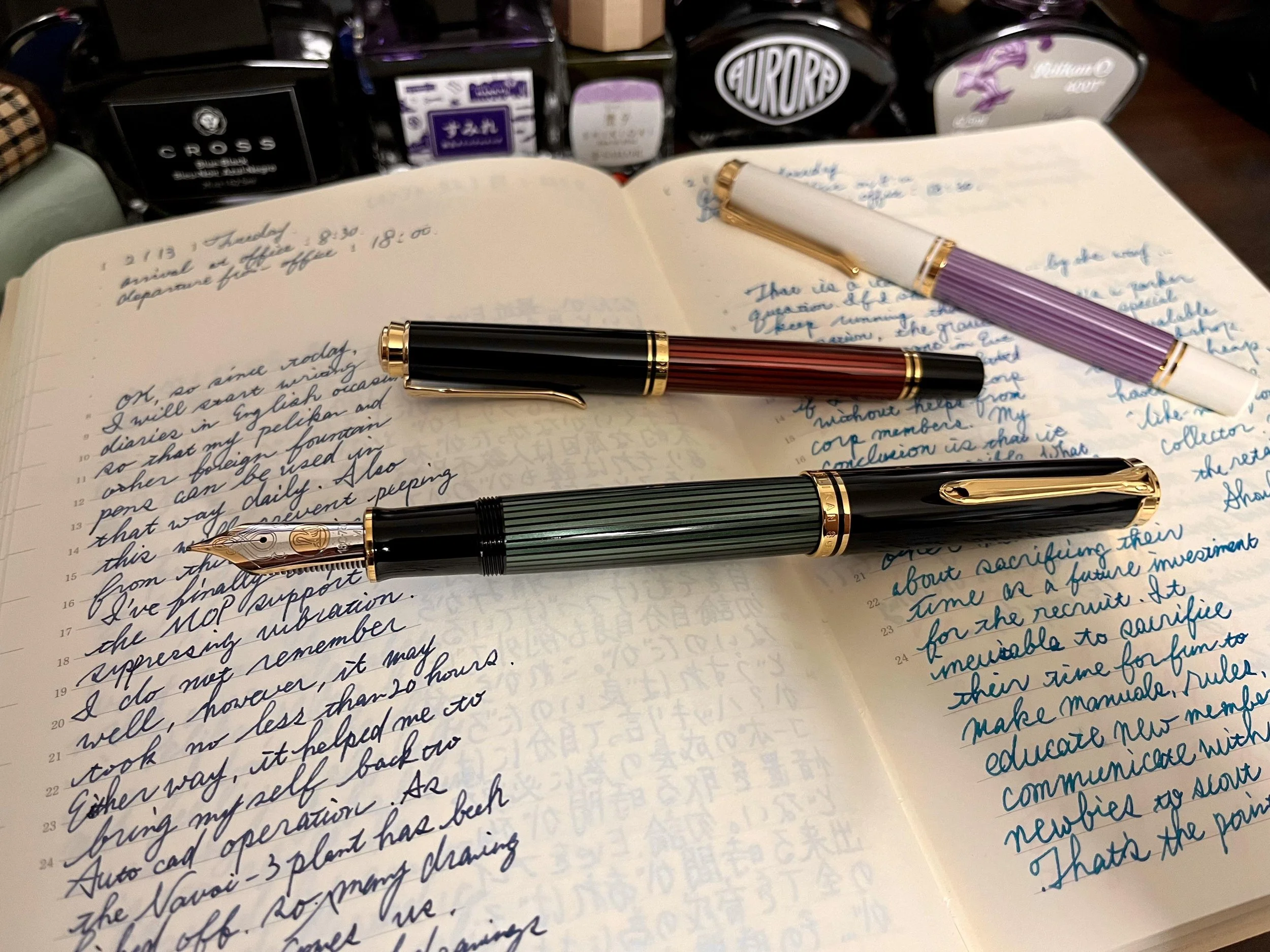
This is where your use of a fountain pen and high-quality stationery becomes especially significant. The sensory benefits are not decorative extras; they can meaningfully enhance the practice. A fountain pen changes the tempo of writing. It glides rather than scratches. It asks for posture, angle, pressure, and care. Good paper receives ink with subtle resistance and fidelity. The line dries with slight variation. The page has weight, texture, even sound. These physical qualities create a ritual frame around thought. They signal that the act matters. In behavioral terms, this is important because ritual increases adherence. People return more faithfully to practices that feel rewarding, coherent, and personally meaningful.
The sensory pleasure of excellent tools also promotes embodied attention. Much of modern work happens in abstract digital space: glass, light, speed, frictionless editing. Writing with a fountain pen restores friction in the best sense. You feel the cap unscrew, the nib touch paper, the ink flow, the hand move, the wrist tire slightly, the page turn. This sensory richness grounds the mind in the body. That grounding can be calming. It resembles, in a modest but real way, the principles behind mindfulness practices that anchor attention in direct sensory experience. The weight of the pen and the texture of the paper help gather scattered awareness. They bring the writer into the room, into the hand, into the sentence.
There is also an aesthetic dimension that should not be underestimated. Beauty can foster care. A handsome notebook, creamy paper, and a well-tuned pen can invite a seriousness and tenderness that a disposable medium can’t quite match. Many writers and thinkers have intuitively known this. The materials of intellectual life shape the feeling of intellectual life. High-quality stationery can make journaling feel less like a task and more like a privilege. That emotional association matters because habits are sustained not only by discipline but by affection. If the page welcomes you, you are more likely to return to it.
The fountain pen in particular encourages a form of attentiveness that suits reflective writing. Because it rewards a measured pace and can make haste physically less comfortable, it nudges the writer away from careless acceleration. The variability of ink, line, and pressure also creates a subtle feedback loop between emotion and inscription. A hurried or agitated state may appear in the script; a calmer state may emerge as the writing settles. In this way the page becomes not only a record of thoughts but a trace of nervous system state. Many journal keepers find that their handwriting itself becomes diagnostic. It reveals when they were tired, grieving, hopeful, impatient, or at peace.
Sensory ritual has another benefit: it dignifies privacy. In a digital environment, personal writing can feel provisional, easily deleted, interrupted by notifications, or mentally adjacent to work and media. A physical journal occupies protected space. It is bounded. It closes. It can be kept, shelved, revisited. The use of beautiful materials reinforces the sense that inner life deserves a dedicated container. That has psychological value. When people feel that their thoughts are worth preserving, they may relate to themselves with greater respect and curiosity. Journaling then becomes not only expressive but affirming: a practice that says my interior life is worthy of attention.
From the standpoint of stress management, journaling can act as a pressure release valve. Studies on expressive writing have linked written emotional disclosure, in some populations and contexts, to reductions in stress-related symptoms and improvements in aspects of well-being. Journalistic accounts in high-profile publications such as The New York Times, The Atlantic, and Harvard Business Review have often translated this research for broader audiences, emphasising journaling as a tool for processing challenge, building resilience, and increasing self-command. While the effects are not universal or identical for everyone, the overall evidence suggests that writing can help people metabolise difficult experience rather than merely ruminate on it. The difference lies in structure. Rumination loops; journaling externalises and can transform.
That transformation often occurs through meaning-making. Psychologists who study trauma, adversity, and resilience frequently note that recovery involves not only feeling emotion but integrating it into a story that can be lived with. Journaling helps construct such narratives. A painful event first appears as chaos: fragments, symptoms, unanswered questions. Through repeated writing, a person may begin to identify chronology, consequence, lesson, loss, and continuing value. They may not find a simplistic moral, but they often find shape. Shape is powerful. It reduces helplessness. It makes room for complexity. It allows grief and gratitude, anger and understanding, regret and resolve to coexist in language.
Journaling also supports goal attainment and behavior change. Research on self-monitoring consistently shows that tracking behaviour increases the likelihood of modification. When people write down what they intend, what they did, and what got in the way, they become less opaque to themselves. This is why journals are so often used for habit formation, fitness, creative output, financial discipline, and professional development. Executive coaches know that accountability is strengthened by specificity, and specificity thrives on paper. “Be more focused” is weak; “Tomorrow from 8:30 to 10:00 I will draft the proposal before opening email” is actionable. A journal can hold intentions at the right level of granularity.
For creative people, journaling is equally important as a generative practice. Many writers recommend morning pages, notebooks, commonplace books, and observational diaries because writing without immediate public purpose liberates originality. On the private page, sentences can fail safely. Fragments can coexist. Unfinished ideas can accumulate until connections form. The journal becomes compost for creative work. It stores overheard dialogue, images, questions, reading notes, anxieties, ambitions, and stray metaphors. Because nothing need be publishable, the pressure to perform recedes. This freedom often produces better work precisely because it protects the conditions under which authentic work begins.
The social benefits of journaling are less obvious but substantial. Writing privately can improve how one relates publicly. By processing reactions before expressing them, people often communicate more effectively. They become less likely to discharge unexamined emotion onto colleagues, partners, or friends. They can write the angry version first and speak the wiser version later. They can identify what they truly want from a conversation. They can discern whether they seek understanding, apology, boundary, repair, or simply witness. In this way journaling improves interpersonal intelligence. It refines response.
Another important dimension is values clarification. Many people are busy enough to be carried by momentum rather than conviction. Journaling interrupts momentum long enough to ask harder questions: What matters to me now? What kind of person am I becoming through my routines? Where am I betraying my own standards? What am I tolerating that I should change? What success am I pursuing, and at what cost? High-profile writers on leadership and personal development often return to this reflective territory because effectiveness without self-knowledge can become emptiness. A journal is one of the best places to conduct a private audit of one’s life.
What makes journaling uniquely powerful is that it is endlessly adaptable. It can be expressive, analytical, spiritual, logistical, artistic, therapeutic, or archival. One day it may hold grief, another day project plans, another gratitude, another a single sharp observation about light on a wall. This flexibility helps explain its longevity across professions and personalities. It meets people where they are. A chief executive can use it to review decisions. A therapist can use it to note countertransference reflections. A novelist can use it to catch an image. A patient can use it to track symptoms. A parent can use it to remember a child’s phrase. The practice scales to the life.
Still, the deepest importance of journaling may be that it restores conversation with the self. In a noisy culture, many people live reactively, speaking outward more than inwardly listening. Journaling reopens an interior commons. It allows a person to encounter themselves not as a brand, a role, or a task manager, but as a consciousness unfolding through time. That encounter can be uncomfortable, but it is also humanising. It reveals fear, vanity, longing, contradiction, tenderness, fatigue, conviction, and growth. It teaches that the self is not fixed but written and rewritten through attention.
And when that attention is mediated through a fountain pen on high quality paper, the practice acquires an additional magic. The nib, the ink, the paper, and the hand collaborate to slow time just enough for perception to deepen. The sensory pleasure is not superficial; it is part of the cognitive and emotional architecture of the practice. Fine tools invite reverence, and reverence sharpens attention. Attention enriches thought. Thought, given language, becomes understanding. Over months and years, that understanding accumulates into wisdom: not abstract wisdom, but lived, particular, handwritten wisdom, preserved in ink.
So the importance of journaling lies in its remarkable breadth. It supports emotional regulation, mental clarity, self-knowledge, resilience, memory, creativity, leadership, decision-making, values alignment, and personal meaning. It is endorsed in different ways by psychologists, executive coaches, and writers because it addresses a central human need: the need to process experience rather than merely endure it. Studies in respected journals, insights from clinical practice, and reflections from accomplished thinkers all converge on the same broad conclusion. Writing things down changes our relationship to them. It can calm, clarify, reveal, and transform. And when done with care, by hand, with instruments that engage the senses, journaling becomes more than a method. It becomes a way of inhabiting one’s life more consciously.
Why the Best Leaders have Little Fear of Failure or Being Disliked

In public, leadership is often described in flattering language: vision, confidence, influence, inspiration. In reality, it is just as often an exercise in discomfort. To lead well is to make decisions before certainty arrives, to take responsibility when outcomes are unclear, to absorb criticism without collapsing into defensiveness, to speak truth to power and to disappoint people who would have preferred an easier answer. This is why some of the most effective leaders in business are not those who are most universally liked, nor those with the neatest record of uninterrupted success. They are the ones who have learned to tolerate two things that derail lesser leaders: failure and disapproval.
That does not mean great leaders seek failure, or treat other people’s concerns with contempt. Quite the opposite. The strongest leaders are often deeply conscientious. They care intensely about standards, people, outcomes, and trust. But they understand something essential: if you are trying to build, change, reform, or protect anything meaningful, you will occasionally get it wrong, and you will inevitably upset someone. The question is not whether leadership can be made safe from these experiences. It cannot. The question is whether a leader can remain principled, clear-minded, and effective when things are not going to plan.
This is more than a matter of temperament. It is supported by management research, organisational psychology, and the real histories of high-profile companies and executives. Harvard Business Review has long emphasised the role of candour, learning, and adaptive decision-making in leadership. The Economist has repeatedly focused on the realities of leading under uncertainty, where risk cannot be eliminated and difficult trade-offs are unavoidable. Psychologists from Carol Dweck to Albert Bandura to Brené Brown have shown, from different angles, that resilience, self-efficacy, and growth depend on how people interpret setbacks and social judgment. And popular interest in “The Courage to Be Disliked” by Fumitake Koga and Ichiro Kihimi speaks to a growing recognition that freedom, responsibility, and approval can have a relationship built on tension.
The best leaders do not fear failure or being disliked because they understand that both are often side effects of doing the job properly. Their task is not to preserve an image of flawless competence or universal approval. Their task is to move the organisation toward reality, learning, and long-term value. In practice, that means choosing truth over comfort, experimentation over paralysis, standards over popularity, and mission over ego.
Leadership Is Not the Same as Popularity
Many leadership failures begin with a simple confusion: mistaking being well-liked for being effective. These are not the same thing. A popular leader may be charming, agreeable, reassuring, and generous with praise. An effective leader may sometimes be those things too. But effectiveness demands more. It demands judgment, clarity, accountability, and a willingness to make decisions that not everyone will welcome.
A leader who wants to be liked by everyone is vulnerable to avoidance. They postpone difficult conversations. They soften feedback until it becomes useless. They leave poor performance unaddressed because confrontation feels unpleasant. They drift toward consensus even when consensus is wrong. They preserve short-term harmony at the expense of long-term trust.
This is one of the enduring lessons of serious management thinking: people do not ultimately trust leaders because they are pleasant; they trust them because they are fair, competent, and clear. Teams can tolerate an unpopular decision more easily than they can tolerate hidden standards, evasiveness, or silent dysfunction. In fact, a leader’s refusal to address what everyone else can already see is often more damaging than the hard decision itself.
That is why one of the central insights associated with “The Courage to Be Disliked” feels so relevant to leadership. As the book puts it, “It’s that you are disliked by someone. It is proof that you are exercising your freedom and living in freedom, and a sign that you are living in accordance with your own principles.” Taken literally, that line can be misused; not every disliked person is principled. But in the context of leadership, it captures something true. If you are setting direction, allocating scarce resources, saying no to some priorities in order to protect others, and holding people accountable, some degree of disapproval is inevitable.
Leadership is not a popularity contest. It is a responsibility.
Why Fear of Failure Shrinks Leadership
Fear of failure damages leadership in a different way. It makes people smaller. Leaders who are ruled by the fear of getting things wrong become cautious in the least productive sense. They avoid risk not because they have carefully judged it to be unwise, but because they cannot bear the psychological cost of visible error. They choose defensible decisions over bold ones. They protect themselves rather than the mission.
The result is not excellence but stagnation.
This is especially dangerous in environments shaped by uncertainty, innovation, or change. In such settings, waiting until every decision feels safe means waiting too long. New products, new strategies, new business models, and cultural transformations all involve incomplete information. If leaders demand certainty before acting, they eliminate the conditions that enable learning.
Amy Edmondson’s work is especially useful here. The Harvard Business School professor has distinguished between blameworthy failure and what she calls intelligent failure. An intelligent failure occurs in new territory, where the outcome cannot be fully known in advance, where the effort is thoughtful, and where the learning can improve future performance. This idea is crucial because it rescues leadership from a simplistic binary. Not all failure is good. But not all failure is bad either. Some failures are tuition.
The strongest leaders understand this. They do not glorify mistakes, but they do not turn every setback into shame. They ask: What did we assume? What did we learn? What should we change? That orientation matters not just strategically, but culturally. Teams quickly notice whether their leader treats error as information or as humiliation. In the first culture, people speak up early, surface risks, and experiment responsibly. In the second, they hide problems, protect themselves, and allow small mistakes to become big problems.
So the issue is not whether great leaders fail. Of course they do. The issue is whether failure becomes a source of fear or a source of intelligence.
What Psychology Says About Setbacks and Approval
The psychological foundations of this idea are strong. Carol Dweck’s work on mindset has shown that people who believe abilities can be developed are more resilient in the face of setbacks than those who see ability as fixed. One of her most memorable formulations is: “Becoming is better than being.” That sentence captures the essence of why fear of failure can be so destructive. If every mistake is interpreted as a verdict on identity, then failure becomes unbearable. But if mistakes are part of growth, then leaders can remain open, adaptive, and persistent.
Albert Bandura’s theory of self-efficacy adds another layer. Self-efficacy is not blind confidence. It is the belief that one can act effectively and respond to challenges. Leaders with high self-efficacy are not immune to doubt, but they are less likely to freeze under uncertainty because they trust their capacity to cope, learn, and recalibrate. This matters enormously in leadership, where certainty is often unavailable.
There is also an important motivational dimension. Self-determination theory, developed by Edward Deci and Richard Ryan, argues that human beings function best when their motivation is rooted in autonomy, competence, and relatedness. Leaders who depend too heavily on external approval become psychologically fragile because their internal state is governed by reactions they cannot control. Leaders with a stronger sense of autonomy can hear criticism without becoming controlled by it.
Brené Brown has brought these ideas into mainstream leadership language through her work on vulnerability and shame. Her widely cited line captures the emotional reality of leadership with unusual precision: “Vulnerability is not winning or losing; it’s having the courage to show up when you can’t control the outcome.” That is leadership in a nut shell. To lead is to show up in conditions where success is not guaranteed and applause is not assured. A leader who cannot endure that vulnerability will either avoid responsibility or perform certainty while privately shrinking from it.
These psychological perspectives converge on the same conclusion: resilient leadership depends less on eliminating setbacks and criticism than on changing one’s relationship to them.
The Business Case for Not Needing to Be Liked
In business, the costs of approval-seeking can be enormous. Companies do not usually fail because nobody in leadership cared. They fail because leaders avoided reality. They delayed hard choices, protected underperforming structures, failed to challenge assumptions, or allowed political comfort to outweigh strategic necessity.
This is why so much executive thinking, especially in forums like Harvard Business Review, returns to the value of candour. Honest feedback, clear accountability, and transparent trade-offs are not signs of harshness. They are the architecture of trust. A leader who says what needs to be said, even when it is unwelcome, gives the organisation a chance to adapt. A leader who smooths everything over in order to be liked leaves the organisation blind.
Kim Scott’s framework of “radical candour” expresses this elegantly: care personally, challenge directly. The first part matters because leadership without care becomes brutality. The second part matters because care without challenge becomes indulgence. Teams do not grow from being comforted into mediocrity. They grow from being respected enough to hear the truth.
This is one reason weak leaders are sometimes liked at first and resented later. Their agreeableness feels pleasant in the short term. Only over time does the cost become visible: low standards, unclear expectations, tolerated dysfunction, and a culture in which nobody is quite sure where they stand.
The strongest leaders know that temporary discomfort can be a form of service. The hard conversation, done well, are often kinder than the avoided one.
Famous Business Leaders Who Understood the Trade-Off
Steve Jobs is one of the clearest examples of a leader who was not governed by the need to be liked. He was demanding, often abrasive, and impossible to mistake for a consensus-seeker. Not every aspect of his style deserves imitation; many do not and there was definitely something of the megalomaniac about him at times. But his example remains useful because it reveals how much leadership at the highest level involves the willingness to disappoint people in the service of clarity and excellence.
Jobs once said, “People think focus means saying yes to the thing you’ve got to focus on. But that’s not what it means at all. It means saying no to the hundred other good ideas.” There is a leadership philosophy inside that sentence. Focus is not merely preference; it is disciplined exclusion. And exclusion always creates friction. If you cannot bear disappointing people, you cannot focus.
He also said, “I’m convinced that about half of what separates successful entrepreneurs from the non-successful ones is pure perseverance.” Perseverance is impossible if failure is interpreted as humiliation. Jobs was publicly fired from Apple, the company he co-founded. That experience would have permanently diminished many leaders. Instead, it became part of the larger arc of his development.
Jeff Bezos has institutionalised a similar attitude toward failure, though with a different style. His oft-cited observation, “If you know it’s going to work, it’s not an experiment” is more than a clever remark. It is a philosophy of organisational learning. Innovation requires a tolerance for initiatives whose outcomes are uncertain. If every decision must focus on minimising reputational damage, experimentation dies.
Satya Nadella offers a striking contrast to both Jobs and Bezos. His leadership at Microsoft is widely associated with empathy, humility, and cultural renewal. But it would be a mistake to read that as softness. Nadella’s emphasis on a “learn-it-all” rather than “know-it-all” culture required confronting deeply embedded habits. It meant challenging defensiveness, status behaviour, and certainty-as-identity. Culture change at that scale is impossible without a willingness to endure skepticism and resistance.
Indra Nooyi likewise showed that strategic leadership requires comfort with disapproval. Shifts in portfolio, health strategy, performance systems, or capital allocation do not produce unanimous enthusiasm. Yet large institutions cannot be transformed by leaders who require universal reassurance before acting.
In very different ways, these leaders point to the same truth: serious leadership demands the capacity to remain steady when not everyone agrees, approves, or applauds.
The Courage to Be Disliked… and to Fail
The appeal of “The Courage to Be Disliked” lies partly in its challenge to one of modern life’s deepest anxieties: the need to be validated. For leaders, that need can be especially dangerous because status makes approval both more available and more addictive. Praise, influence, and visibility can create an illusion of authority while weakening the capacity for independent judgment.
One of the book’s most useful ideas is that freedom and approval are often in tension. To act from principle is sometimes to invite resistance. Another relevant line is: “A healthy feeling of inferiority is not something that comes from comparing oneself to others; it comes from one’s comparison with one’s ideal self.” That is a better standard for leadership. The crucial question is not, “Do they all like me?” It is, “Am I acting as the role requires? Am I meeting the standard I claim to serve?”
The book also stresses the possibility of change in the present. “No matter what has occurred in your life up to this point, it should have no bearing at all on how you live from now on.” For leaders, that is an important reminder that failure need not become identity. A failed strategy, a bad hire, a public mistake, even a dismissal: none of these has to become destiny. The best leaders metabolise failure rather than worship or deny it.
This Adlerian lens is powerful because it reframes disapproval. Being disliked is no longer automatic evidence of wrongdoing; it can simply be the cost of autonomy, standards, and truthfulness. Again, that does not excuse arrogance or insensitivity. A wise leader remains open to feedback and deeply curious about dissent. But after listening and thinking, they still must choose. Leadership requires ownership, not endless emotional negotiation.
Why Teams Need Leaders Who Can Bear Discomfort
There is also a systemic reason this matters. Teams need leaders who can tolerate discomfort because groups are often bad at metabolising tension on their own. Organisations drift naturally toward avoidance. People delay awkward conversations, preserve failing projects because too much pride is invested in them, and soften language until hard realities disappear behind euphemism.
A leader who cannot bear disapproval makes this worse. If every sign of tension is treated as danger, it becomes emotionally expensive to tell the truth within their organisation. Decisions get postponed. Standards become inconsistent. Informal resentment grows underground while formal communication becomes bland and useless.
By contrast, a leader who can bear temporary dislike becomes a stabilising force. They can say:
This initiative is ending.
This behaviour is unacceptable.
This strategy is no longer working.
This role must change.
This feedback is difficult, but necessary.
In the short term, such leadership may feel less comfortable. In the long term, it is usually far more trustworthy. Teams do not need leaders who make every moment pleasant. They need leaders who can help the organisation face reality without panic or denial.
The Freedom at the Centre of Leadership
The best leaders do not fear failure or being disliked because they understand what leadership asks of a human being. It asks for action without certainty, candour without cruelty, conviction without rigidity, and resilience without self-deception. It asks people to expose their judgment to risk, to hear criticism without becoming captive to it, and to keep acting in service of a mission larger than their own image.
Fear of failure makes leaders defensive, cautious, and performative. Fear of being disliked makes them vague, conflict-averse, and manipulable. Neither fear can be fully eliminated. But both can be put in their proper place.
The leader who is free from domination by these fears becomes more useful to others. They can experiment without recklessness, listen without surrendering judgment, care without indulging dysfunction, and decide without needing to be adored. They become capable of the rarest and most valuable kind of steadiness: not the steadiness of certainty, but the steadiness of responsibility.
This is why the deepest lessons from psychology, business, and philosophy converge. Growth requires setbacks. Learning requires candour. Freedom requires accepting that not everyone will approve. Trust requires standards. And leadership, at its core, requires the courage to be seen trying, failing, adjusting, and leading anyway.
That is not the glamorous version of leadership. But it is the real one. And in the end, it is what makes great leadership possible.
Artificial Intelligence and the Environment

The blogosphere is filled with people singing the virtues of Artificial Intelligence, selling courses, giving advice and of course pretending they didn’t use it to write their last article. However, I’ve seen very little on here about the impact AI is having on the environment so I thought that was worth discussing alongside all the positives.
Artificial intelligence depends on a sprawling physical infrastructure of data centres, networks, and devices whose environmental costs are only starting to be openly discussed. These impacts extend well beyond the abstract “cloud” and into very tangible demands for electricity, water, land, and minerals.
A growing body of work in academia and policy has framed this as a serious, if still poorly measured, environmental issue. At a recent panel hosted by New York University’s Institute for Public Knowledge, media scholar Benedetta Brevini noted that “the unprecedented increase in energy and water consumption driven by the rise of generative AI has made it nearly impossible for the industry to continue avoiding this draconian problem.” The panel’s focus was not only on data‑centre footprints but on how “communication, data capitalism and the climate emergency” are now tightly intertwined.
Electricity use is one of the most visible pressures. Training and running large neural networks requires vast computing power concentrated in data centres. Industry estimates synthesised by analysts suggest that by 2024, AI workloads could account for roughly 15–20% of total data‑centre energy consumption worldwide. As AI adoption accelerates, this creates a risk that, without rapid decarbonisation of power grids, AI expansion will lock in substantial additional greenhouse‑gas emissions.
The Digital Decarb Design Group at Loughborough University in the UK produced the Data Doomsday which predicts that by 2033, there may not be enough global electricity produced to power all the data centres in the world. “Something has to give.”
The big tech companies know their need is growing. Microsoft has signed a deal to restart the infamous Three Mile Island Nuclear Generating Station (the location of one of America’s worst nuclear accidents). Amazon are investing in a new generation of small, modular nuclear power stations.
Some critics argue these fears are overstated, pointing out that many headline figures are extrapolated from early, less efficient models and that markets can drive efficiency and substitution. But even sceptical economic commentators concede that “LLM models do use considerable amounts of electricity,” and that their demand is set to rise with scale.
Water is a second, less visible but increasingly contentious cost. Data centres need water both directly, for cooling, and indirectly, through the water used at power plants. Analyst Sergey Tereshkin collates expert estimates suggesting that AI systems alone consumed between 312 and 765 billion litres of water up to the end of 2025. Corporate disclosures hint at how quickly this burden is growing: after the launch of large‑scale generative AI services, Microsoft reported that global water consumption by its data centres surged by 34% in 2022, to around 6.4 billion litres, while Google reported a 20% year‑on‑year increase in its data‑centre water use. Yet, as Tereshkin notes, the true picture remains opaque; Google has explicitly acknowledged that it does not include water used at third‑party power plants in its figures. This lack of transparency has prompted experts to call for “stringent reporting standards” and mandatory disclosure of energy and water use specifically attributable to AI workloads.
“For every chat GPT query you make, it takes one pint of water to cool the system”. Professor Tom Jackson, Loughborough University
Beyond operational electricity and water use, AI’s environmental footprint extends across the whole supply chain. The chips that power modern AI are built on intensive mining and processing of metals and rare earths, with associated habitat disruption, pollution, and local water stress. The global network of fibre‑optic cables, undersea links, and edge infrastructure depends on concrete, steel, and plastics, along with the energy to manufacture and maintain them. Scholars such as Nicole Starosielski, whose work traces “the subsea cables that carry almost 100% of transoceanic internet traffic,” have shown how digital systems tie remote ecologies into a single extractive infrastructure. From this vantage point, AI is not an ethereal intelligence but another accelerating layer of demand on already strained material systems.
High‑profile figures within the tech industry have begun to acknowledge these tensions. Microsoft’s Brad Smith has warned publicly that, in the rush to scale up AI, “we have to recognise we’re placing new pressures on energy systems and water resources,” arguing that without careful planning, AI could “compete with communities for limited water in regions already facing drought.” Environmental researchers working with companies like Intel and the Green Software Foundation, such as Tamara Kneese, have similarly stressed that if AI continues to expand on its current trajectory, efficiency gains alone are unlikely to offset absolute growth in resource use.
There are, however, credible pathways to reduce harm. Studies brought together by analysts such as Tereshkin show that careful siting of data centres, improved cooling technologies, and using low‑carbon, low‑water electricity can cut both water and carbon footprints by 70–85%. Proposals from environmental and policy experts converge on several priorities: transitioning data centres to renewable or otherwise low‑carbon power; investing in more efficient chips and software; building water‑reuse and dry‑cooling systems into new facilities; and, crucially, enforcing transparency and accountability over AI‑related energy and water use, which is currently a world of opacity. Without such measures, the growth of AI risks deepening the climate and ecological crises it is sometimes advertised as helping to solve. With them, it may be possible to constrain AI within planetary boundaries but only if environmental costs are treated as central design constraints rather than an afterthought.
In a world where resources are already scarce, with temperatures and sea levels rising, AI’s true costs have the potential to shape geopolitics in ways that global leaders need to consider before it’s too late.
Making the transition from do-er to leader
Stepping into your first senior leadership role is exciting, but it can also feel exposing.
Overnight, your success is no longer just about your own performance; it’s about how well you enable others to perform. Executive coaching for new leaders exists precisely to bridge that gap, turning promising individual contributors into confident, grounded leaders.
As Marshall Goldsmith famously puts it, “What got you here won’t get you there.” The skills that made you successful as an expert doer are not the same as those required to lead, influence and develop a team. A structured coaching relationship helps you build that new skill set faster, in a safe environment, and with far greater self-awareness.
Why executive coaching matters for new senior leaders
Research from the International Coaching Federation (ICF) consistently shows that coaching improves leadership effectiveness, decision quality and resilience. But for new leaders, the impact isespecially pronounced. You are forming habits and mental models that will shape your leadership for years and, frankly one doesn’t know what one doesn’t know!
Harvard Business Review notes that high-potential leaders often “derail” not because of lack of intelligence, but because of “interpersonal weaknesses, failure to build a team, and inability to adapt to change.” Executive coaching addresses exactly these areas:
· Clarifying your leadership identity and style
· Developing emotional intelligence and influencing skills
· Building confidence in tough conversations and decisions
· Learning practical tools to align, motivate and hold people accountable
As Peter Drucker wrote, “Management is doing things right; leadership is doing the right things.” A good coach helps you do both from day one.
The main challenges new senior leaders face
While every situation is different, most new leaders experience a common set of challenges when they first step up.
1. Shifting from “expert” to “leader:” You’ve been promoted because you’re good at your job. The temptation is to keep proving that by doing more of the work yourself, rather than enabling others. This leads to overwork, micromanagement and frustration on all sides.
Daniel Goleman, whose work on Emotional Intelligence transformed leadership thinking, notes that “effective leaders are alike in one crucial way: they all have a high degree of emotional intelligence.” That includes being able to let go of control, trust others, and redefine your value as a leader.
Coaching helps you:
· Redefine success from “I solved it” to “my team solved it.”
· Build trust and set clear expectations so delegation feels safe.
· Learn to coach your team, not just instruct them.
2. Managing relationships with former peers: One of the most emotionally delicate transitions is moving from being “one of the team” to leading the team. Power dynamics change overnight. Colleagues may test boundaries or expect special treatment. You may feel torn between being liked and being respected.
John Kotter, leadership professor at Harvard, has observed that “most people don’t lead because they’re afraid of losing friends and making enemies.” New senior leaders can feel this acutely.
A coach can help you:
· Plan how to reset relationships and clarify your new role.
· Practice language for tricky conversations (“I’m still me, but my responsibilities are different now…”).
· Balance approachability with authority in an authentic way.
3. Having difficult conversations: Performance concerns, missed deadlines, attitude issues, these conversations are uncomfortable, especially when you’re new. Many first-time leaders either avoid them (creating bigger problems later) or come in too strongly (damaging trust).
Kim Scott, author of Radical Candor, says, “Care personally, challenge directly.” The sweet spot is clear, direct feedback grounded in genuine concern for the person.
Coaching supports you to:
· Structure difficult conversations so they’re firm but fair.
· Regulate your own emotions and anxiety beforehand.
· Anticipate reactions and respond calmly in the moment.
4. Balancing strategic thinking with day-to-day pressure: As an individual contributor, your horizon was mostly task-level. As a leader you must look up and out: priorities, risks, stakeholders, long-term goals. The challenge is doing this without dropping the ball on day-to-day delivery.
Stephen R. Covey’s famous distinction between “urgent” and “important” becomes very real. “The key is not to prioritise what’s on your schedule, but to schedule your priorities.”
An executive coach will help you:
· Clarify what truly matters in your role and your team’s purpose.
· Build systems for prioritisation, time-blocking and delegation.
· Develop the habit of regular reflection instead of constant reactivity.
5. Managing your own confidence and imposter feelings: New leaders often feel they are “acting the role” rather than being it. Imposter syndrome can be triggered by more senior exposure, board presentations or leading more experienced team members. I recently wrote a piece on imposter syndrome which can be found here.
Herminia Ibarra, a leading expert on leadership transitions, writes: “We are not one true self, but many selves, and the key to becoming a leader is to embrace the process of becoming.” Coaching makes this identity transition conscious and constructive rather than anxiety-driven.
With a coach, you can:
· Normalise doubts and reframe them as growth signals.
· Separate facts from fears and build realistic confidence.
· Design a personal leadership narrative that feels authentic.
Leading techniques used in executive coaching
Modern executive coaching blends evidence-based approaches with highly personalised work. Common techniques you might encounter include:
· 360-degree feedback and stakeholder interviews. To build a grounded picture of how you’re currently perceived and where you can grow.
· Strengths-based coaching. Based on research from Gallup and others showing that developing strengths is more effective than obsessing over weaknesses. You learn to lead from what you naturally do best.
· Cognitive-behavioural techniques. To identify unhelpful thought patterns (e.g., “If I don’t do it myself, it won’t be done properly”) and replace them with more constructive beliefs.
· Emotional intelligence development. Using models from Goleman and others to build self-awareness, self-regulation, empathy and social skills.
· Leadership frameworks and practical tools. For example, situational leadership (adjusting your style to the person and task), coaching conversations models (like GROW), and decision-making frameworks. As the ICF summarises, “Coaching is partnering with clients in a thought-provoking and creative process that inspires them to maximise their personal and professional potential.”
How I can help you make the step up
An executive coaching partnership with Antony Harvey Executive is designed specifically to support leaders at critical transition points; none more important than your first senior role.
While each engagement is tailored, support for new managers typically focuses on:
1. Clarifying your leadership identity and goals. You’ll begin by exploring:
· What kind of leader you want to be.
· The expectations of your organisation and stakeholders.
· The specific outcomes you want from your first 6–12 months in role.
This creates a clear coaching agenda: practical, measurable and aligned with your career ambitions.
2. Building core leadership skills, fast. Through structured sessions, real-life practice and reflection, you work on:
· Delegating effectively without losing control.
· Running impactful 1:1s and team meetings.
· Giving feedback and having difficult conversations.
· Prioritising and managing time at a leadership level.
The focus is always on your real situations, not abstract theory, so you can immediately apply what you learn.
3. Developing emotional intelligence and resilience. My coaching will help you:
· Recognise and manage your own stress triggers.
· Stay composed under pressure or scrutiny.
· Understand different personality styles and how to adapt your approach.
· Build confidence and a grounded presence as a leader.
This inner work is what enables you to lead consistently, even when circumstances are challenging.
4. Navigating your organisational landscape. My approach to coaching also supports you in:
· Managing upwards and sideways, not just downwards.
· Positioning your team effectively within the wider business.
· Handling politics and influencing stakeholders ethically and confidently.
The goal is to help you become not only an outstanding leader of people but a credible, trusted player in the broader organisation with your new peers.
5. Creating a sustainable development plan. Beyond the initial transition, I can help you map:
· The capabilities you’ll need for your next step (e.g., leading leaders, cross-functional responsibility).
· Learning experiences and stretch assignments to build those capabilities.
· A realistic plan to continue growing without burning out
As leadership thinker Warren Bennis wrote, “Becoming a leader is synonymous with becoming yourself. It is precisely that simple, and it is also that difficult.” My coaching style is about making that difficult journey structured, supported and far more effective.
Coping well: principles to carry with you
To summarise, new leaders who thrive tend to:
· Seek support early – from a coach, mentor or sponsor, rather than trying to prove themselves in isolation.
· Treat leadership as a skill – something to be learnt, practiced and refined, not an innate trait you either have or don’t.
· Reflect regularly – asking “What worked? What didn’t? What will I do differently next time?”
· Invest in relationships – with team members, peers and senior stakeholders; leadership is fundamentally relational.
· Stay curious and grounded– confident enough to decide, humble enough to listen and adapt.
With the right coaching partnership, your first leadership role becomes not just a test, but a powerful launchpad for a long and successful leadership career.
If this resonates with you, I’d like to offer you something simple: a one‑off, 30‑minute, free confidential conversation (Teams/Zoom or in person where possible) purely as protected thinking time.
There’s no sales pitch and no obligation. You bring whatever is on your mind, I’ll bring structured, challenging but supportive coaching and an understanding of how new senior leaders can get the best out of themselves.
If you want to proceed with a course of meetings, I’ll design a bespoke coaching course to meet your unique needs
Imposter Syndrome: Understanding, Challenging and Transforming a Leadership Barrier

I meet a lot of high achievers in the course of my coaching work and many of them talk about feelings of Imposter Syndrome. This article on my Substack page explores the origins and nature of Imposter Syndrome, its impact on senior leaders and some evidence-based approaches to addressing it.
Imposter Syndrome has become one of the most widely discussed psychological challenges in modern professional life, particularly among senior executives and non-executive directors. Despite visible success, influence and status, many leaders privately experience a persistent fear of being exposed as a “fraud.” This inner conflict is more than a personal discomfort, it can distort decision-making, limit strategic impact, undermine resilience and quietly erode leadership effectiveness.
Henley Business School and other leading institutions have increasingly incorporated Imposter Syndrome into their executive and leadership development programmes, recognising it as a critical, and often hidden, barrier to sustainable performance, authentic leadership and wellbeing.
Given its seemingly increasing prevalence, I wanted to explore the origins and nature of Imposter Syndrome, examines its particular impact on senior leaders, and look at some evidence‑based approaches to addressing it.
Origins and Definition of Imposter Syndrome
The concept of Imposter Syndrome was first described by clinical psychologists Pauline Clance and Suzanne Imes in their seminal 1978 paper, “The Impostor Phenomenon in High Achieving Women.” Studying high‑performing professionals and academics, they noticed a recurring experience: despite objective success, many individuals were convinced that they did not deserve their achievements and that others had somehow overestimated their abilities. Clance and Imes defined the experience as:
“The internal experience of intellectual phoniness that appears to be particularly prevalent and intense among a select sample of high achieving women.” (Clance & Imes, 1978)
Subsequent research has made clear that Imposter Syndrome is not confined to women, nor to any particular function, sector or geography. In executive education and leadership development programmes, it is observed across genders, cultures and career stages. Valerie Young, another leading expert in this field, later broadened the definition as:
“A pervasive feeling of self‑doubt, insecurity, or fraudulence despite often overwhelming evidence to the contrary.” (Young, 2011)
Across these perspectives, three core features consistently appear:
1. Persistent self‑doubt about one’s abilities or legitimacy.
2. Attribution of success to external factors, such as luck, timing or others’ misjudgement.
3. Fear of exposure – a belief that sooner or later, others will “find out” that one is not as capable as they think.
These experiences are not fleeting nerves before a big presentation; they are recurring and deeply internalised patterns of thinking and feeling.
Antony Harvey - The C-Suite Suite is a reader-supported publication. The remainder of this article is only available to my paid subscribers so please sign up to read on for the price of a cup of coffee per month, you’ll also get access to all my other paid only articles. Alternatively, become a Founding Member and receive access to all my paid articles plus further exclusive articles, materials, templates, bespoke advice and 20% off a bespoke course of coaching sessions.
The Prevalence of Imposter Syndrome in Leadership
Leading business schools, including Henley, INSEAD, London Business School and others, regularly find that Imposter Syndrome is prevalent among participants on MBA, EMBA and executive programmes. When the topic is raised and normalised in the classroom, it is common for a substantial portion of the cohort to recognise themselves in the description.
Research published in the International Journal of Behavioral Science suggests that as many as 70% of people will experience Imposter Syndrome at some point in their lives (Sakulku & Alexander, 2011). Among high achievers, the incidence may be higher, not lower. Executive‑level roles, with their increased visibility, complexity and scrutiny can intensify these feelings.
Henley’s own work on leadership identity, authenticity and resilience consistently finds that many senior leaders privately struggle with feelings of inadequacy even while being publicly regarded as confident and capable. The higher they rise, the more acute the fear can feel: “Now I’m really going to be found out.”
This paradox is captured neatly by organisational psychologist Tomas Chamorro‑Premuzic, who has written extensively on leadership, confidence and competence:
“If anything, real incompetents rarely suffer from imposter syndrome because they lack the self‑awareness to question their ability. It is often the most talented people who underestimate their talent.” (Chamorro‑Premuzic, 2019)
For boards and executive teams, this creates a subtle but important risk: the people with the greatest potential impact may be the very ones holding back, second‑guessing themselves, or over‑striving in unsustainable ways.
How Imposter Syndrome Manifests in Senior Leaders
While the core pattern of Imposter Syndrome is similar across levels, it takes on distinct forms in senior leadership roles. Several manifestations are commonly observed in executive coaching and leadership programmes:
i. Over‑preparation and perfectionism: Leaders who fear being “found out” often respond by working harder than anyone else. Every board paper, investor presentation or strategic update must be flawless. They rarely delegate fully, review every detail and struggle to feel “ready.”
Young describes this as a variant of the “Perfectionist” imposter type:
“Perfectionists set excessively high goals for themselves, and when they fail to reach a goal, they experience major self‑doubt and worry about measuring up.” (Young, 2011)
In a senior leaership role, this can become a misuse of time and attention – focusing on micro‑detail at the expense of strategic, relational or governance priorities.
ii. Reluctance to own authority and voice: Non‑executive directors and board members are expected to provide challenge, scrutiny and independent judgement. Imposter feelings can make this difficult. Leaders may hold back from asking questions or offering views for fear of “revealing” ignorance or being judged.
Amy Cuddy, known for her work on presence and power, notes:
“Impostorism steals our power and suffocates our presence. It leads us to speak less, question ourselves more, and contribute below our capacity.” (Cuddy, 2015)
In the boardroom, this can translate into reduced constructive challenge, weaker oversight and suboptimal decisions. Essentially, this means boards not fully functioning.
iii. Discounting achievements: Executives experiencing Imposter Syndrome frequently explain away their own success:
· “The market was favourable.”
· “My team did all the work.”
· “I was just in the right place at the right time.”
Clance found this pattern across her early research subjects:
“Despite outstanding academic and professional accomplishments… these women persist in believing that they are really not bright and have fooled anyone who thinks otherwise.” (Clance & Imes, 1978)
The same pattern recurs in senior leaders today. They struggle to internalise success as evidence of competence, making it difficult to develop a grounded, stable leadership identity.
iv. Avoidance of stretch opportunities: Paradoxically, highly accomplished leaders can hesitate to pursue new roles, acquisitions, transformations or high‑visibility projects because these represent new domains where “failure” and thus “exposure” feels more likely.
Recent Harvard Business Review work has highlighted how this can affect gender balance in leadership, noting that:
“Capable people, particularly women and people of colour, often underestimate their readiness and overestimate the risk of failure, turning down opportunities they are more than qualified to handle.” (HBR Editors, summarising research on the phenomenon)
In a board or C‑suite context, this can limit both individual and organisational growth.
v. Over‑striving and burnout risk:Imposter feelings often drive unsustainable over‑work, as leaders try to “outrun” their self‑doubt. Henley’s research into burnout and resilience in leadership frequently points to Imposter Syndrome as a contributing factor: the belief that one must constantly prove oneself to justify one’s role.
Brené Brown, whose work on vulnerability and shame is widely used in leadership development, has observed:
“Impostor syndrome is not just a belief that ‘I’m not good enough’; it’s the constant, exhausting effort to outrun that belief.” (Brown, 2010/2018, paraphrased from her discussions on shame and worthiness)
For organisations, this translates into increased risk of attrition, poor health, strained relationships and short leadership tenures.
Psychological Underpinnings: Beliefs, Identity and Context
Modern perspectives on Imposter Syndrome emphasise the interaction between individual psychology and organisational context. It is not simply a “confidence issue” that individuals must fix in isolation.
i. Core beliefs and internal scripts: Cognitive‑behavioural approaches highlight that Imposter Syndrome reflects deeply held beliefs such as:
· “If I don’t know everything, I’m not competent.”
· “If I fail, it proves I was never capable.”
· “Others are more talented; I just got lucky.”
These beliefs form an internal script that shapes how leaders interpret events: success becomes discounted, while any challenge is interpreted as evidence of incompetence.
Psychologist Albert Bandura’s work on self‑efficacy is helpful here. Bandura defined self‑efficacy as:
“People’s beliefs about their capabilities to produce designated levels of performance.” (Bandura, 1994)
When self‑efficacy is low, individuals interpret normal setbacks or learning curves as proof that they cannot succeed; when imposter beliefs dominate, even strong performance does not raise self‑efficacy, because success is not internalised.
ii. Identity transitions and role elevation: Henley and other business schools emphasise the importance of identity work in leadership transitions – for example, stepping from functional leadership into the C‑suite, or from executive to non‑executive roles. In these moments, Imposter Syndrome often intensifies.
Herminia Ibarra, a leading scholar on leadership transitions and identity, notes:
“We become leaders by doing leadership work, not by thinking of ourselves as leaders.” (Ibarra, 2015)
Yet Imposter Syndrome can inhibit that “doing” – making leaders hesitate to step into visibility, experiment with new behaviours or fully inhabit their authority.
iii. Culture, bias and systemic factors: It is also essential to recognise that Imposter Syndrome is not just an internal failing; it can be reinforced by organisational cultures and structural biases. People who are “onlys;” the only woman, person of colour, or person from a particular background in a senior room may face more scrutiny and fewer role models, heightening the sense of not belonging.
As Young highlights: “Impostor feelings are often a reaction to the environments we work in, especially where there is a lack of diversity and inclusion.” (Young, 2011/2020).
For boards and executive teams, this means that tackling Imposter Syndrome is not just about individual coaching; it involves cultivating inclusive cultures, fair processes and psychologically safe environments where questioning, learning and vulnerability are not punished.
Evidence‑Based Approaches to Overcoming Imposter Syndrome
While Imposter Syndrome can feel deeply ingrained, research and practice show that it is highly workable. Business school programmes and executive coaching draw on several complementary approaches.
i. Normalising and naming the phenomenon: The first step is often simply to name it. When senior leaders discover that many of their most respected peers share similar internal doubts, there is an immediate reduction in shame and isolation.
Clance herself noted: “When clients understand that the impostor phenomenon is a common experience among successful people, they begin to reframe their self‑doubt as something that can be understood and changed rather than as an unchangeable flaw.” (Clance, 1985)
In executive and board development, facilitated peer discussions, confidential small groups and reflective exercises can rapidly normalise the experience.
ii. Cognitive reframing and evidence‑based thinking: Cognitive‑behavioural techniques help leaders challenge unhelpful beliefs and reinterpret experience. Instead of accepting thoughts such as “I have no idea what I’m doing; I shouldn’t be here,” leaders learn to ask:
· What is the actual evidence for and against this thought?
· How have I handled comparable situations in the past?
· What would I say to a colleague I respect who expressed this same doubt?
Young emphasises the need to “re‑educate” our thinking: “The goal is not to make our fear disappear, but to learn how to talk back to it, to reframe it, and to move forward despite it.” (Young, 2011)
In the leadership context, this might include structured reflection on key achievements, feedback analysis, or reviewing crisis situations successfully navigated.
iii. Redefining competence: from perfection to learning: A major shift for many senior leaders is moving from a perfection‑based definition of competence to a learning‑based one. Instead of “I must know everything and never fail,” a more sustainable stance is “I must learn quickly, decide responsibly and course‑correct when needed.”
Henley’s leadership frameworks often integrate Carol Dweck’s concept of growth mindset, defined as the belief that abilities can be developed through dedication and effort. Dweck notes:
“In a growth mindset, failure is not a referendum on your ability; it’s an opportunity to grow.” (Dweck, 2006)
Reframing stretch, uncertainty and even mistakes as integral to leadership – rather than as proof of fraudulence – is central to weakening Imposter Syndrome.
iv. Building embodied confidence and presence: Research by Cuddy and others suggests that physical posture, voice and breathing influence not only how others perceive us but how we feel internally. While “power posing” has been contested in terms of hormonal effects, many leadership programmes still find that working with body language, breathing and presence has tangible value.
Cuddy writes: “The very act of making ourselves feel powerful, even when we don’t initially feel that way, can help us actually become more present, more confident, and more authentic.” (Cuddy, 2015)
For executives and NEDs, practical work on presence in the boardroom, with investors, with the media – can reduce the felt gap between internal doubt and external role.
v. Harnessing coaching and mentoring: Executive coaching provides a confidential space to explore imposter feelings, test and challenge beliefs, and experiment with new narratives and behaviours. Coaches draw on psychodynamic, cognitive‑behavioural and systemic lenses to help leaders understand where their imposter beliefs originated and how they play out today.
Mentoring, especially from experienced board members or chairs, also plays a critical role. Exposure to the “behind‑the‑scenes” doubts and learning journeys of respected leaders demystifies senior roles and reinforces the message that uncertainty is normal, not disqualifying.
The Strategic Importance of Addressing Imposter Syndrome
For senior executives and non‑executives, overcoming Imposter Syndrome is not merely about feeling better; it is strategically significant for personal and organisational performance.
i. Better decision‑making and governance. Leaders less constrained by self‑doubt are more likely to:
· Ask difficult questions without fear of looking uninformed.
· Offer contrarian views where needed.
· Disagree constructively with chairs, CEOs or major shareholders.
· Admit what they do not know and seek expertise.
This improves the quality of governance, oversight and challenge in boardrooms and executive teams.
ii. More authentic and trusted leadership: When leaders are not using their energy to maintain a façade of certainty, they can show up more authentically – acknowledging uncertainty, inviting input, and sharing their own learning. Numerous leadership studies (e.g., Bill George, 2003, on authentic leadership) have shown that such authenticity strengthens trust, engagement and performance.
Brown captures this succinctly: “People don’t trust perfect and they don’t trust distant. They trust the real and the vulnerable.” (Brown, 2010)
Leaders who have worked through Imposter Syndrome are often better able to embody this grounded authenticity.
iii. Health, resilience and sustainable performance: Addressing Imposter Syndrome also reduces the risk of burnout, anxiety and disengagement. Leaders who develop a healthier internal narrative are better able to:
· Set boundaries.
· Delegate effectively.
· Recover from setbacks.
· Maintain perspective in crises.
This contributes to leadership longevity and organisational continuity.
iv. Talent, diversity and inclusion:
Finally, addressing Imposter Syndrome is pivotal for diversity and inclusion at senior levels. When emerging leaders from under‑represented groups internalise the message that they “do belong” – backed by development, sponsorship and fair processes – they are more likely to step into, and stay in, senior roles.
Organisations that neglect this risk losing high‑potential leaders who quietly decide that senior roles are “not for people like me.”
How my Coaching Can Help and Why It Matters
For senior executives and non‑executive directors, Imposter Syndrome rarely resolves simply with time or promotion. In many cases, elevation intensifies the pressure. What makes the difference is structured reflection, targeted development and expert support.
Antony Harvey Executive specialises in working with leaders at and near the top of organisations, those in roles where internal doubts are often most hidden and yet most impactful. Through bespoke executive coaching, board‑level development and targeted interventions, we have helped many senior leaders in the following ways:
· Identify their specific imposter patterns and triggers.
· Reframe how they understand competence, success and failure in senior roles.
· Build a grounded narrative of their strengths, track record and distinctive value.
· Practise new behaviours in the boardroom and C‑suite, supported by confidential feedback.
· Develop greater presence, resilience and authenticity under pressure.
Why is this important? Because when senior leaders move beyond Imposter Syndrome, they unlock not only personal ease but organisational value:
· Boards become more challenging, insightful and effective.
· Executive teams take bolder, better‑judged decisions.
· Organisations retain and progress a more diverse, confident leadership pipeline.
· Stakeholders experience leaders who are both competent and deeply human.
In a world of complexity, scrutiny and relentless change, organisations need leaders who are not constrained by unseen self‑doubt. They need individuals who can inhabit their roles fully, question themselves without being paralysed, and lead with both confidence and humility.
Partnering with a specialist coach like me gives senior leaders the space, structure and expertise to do this inner work with rigour and confidentiality; transforming Imposter Syndrome from a private burden into a catalyst for more authentic, effective and sustainable leadership.
Get in touch with us today to book a free discovery session.
Unexpected Challenges of Watching my Wife Recover from Cancer
It's been a brutal period in our lives but there are lessons to be learned and I wanted to share some of them with you

Regular readers will know that my wife was diagnosed with a rare and aggressive form of cancer around 18 months ago. She’s now cancer free after some brutal treatment but there’s been a lot of unintended consequences and I wanted to discuss one she raised on her blog recently as it really resonated with me and some of the challenges I’ve faced since November 2024. Since her diagnosis, I’ve become a qualified coachand learnt many coping strategies through my training which I wanted to share with you.
Supporting my wife through cancer treatment has been the hardest, loneliest and most disorientating experience of my life. I knew cancer would be brutal on her body; I didn’t realise how quietly it would hollow out the rest of our life; our friendships, our sense of belonging, even the way I see myself as a man, a father, husband and friend.
It’s a particular challenge because my parents and older son (with whom I am very close) still live in my native South East of England (I moved to Scotland in 2018) and my friends are spread all over the world; New South Wales, Jakarta, Vancouver, Dublin, Manchester, Wales, Sussex and Croydon. I do have some good friends in Scotland but my long-term close friends are no-longer so close. So support for me comes mainly in the form of a WhatsApp message, the occasional call or FaceTime. We received a few cards when all first started.
What has been useful is that I’m not only living this as a husband and dad; I’m also a Henley‑trained coach. This has been very helpful and also enabled me to develop some experience that will benefit my coaches. Through my training I’ve learnt to treat people as whole, resourceful human beings even in the middle of chaos. Through my experience I’ve developed vital understanding that I need to apply that same stance to myself, not as another thing to “perform” or get right, but as a way to stay intact and humane in the middle of something that often feels unmanageable and slightly surreal.
Kat’s recent blog “I think people are scared of me” really resonated with me. Friends have faded. Some step up in amazing, practical ways; others quietly disappear. I hear the social messaging that men should “reach out,” talk, be open. I do reach out, and sometimes the echo comes back empty. No-one’s listening. People don’t know how to stay with the conversation beyond a single “that sounds tough.” They are, understandably, afraid of the depth of this reality. The result is a particular sort of loneliness: I am doing what I’ve been told is healthy, but the world doesn’t always meet me halfway.
Through my training I’ve learnt that this mismatch, between what I’m encouraged to do and what people can actually cope with, is not a sign that I’m too much. It’s a sign that most people have never been taught how to listen to real pain. As a coach, that’s one of my core skills; as a husband and carer, it’s been a real challenge.
Layered on top of all this is life with our two‑year‑old. Parenting a toddler is relentless even in ordinary times. In this season, it’s a constant negotiation between my love for him and sheer exhaustion. Through my experience I’ve developed vital understanding that I have been robbed of the chance to simply revel in early fatherhood. Every tantrum, broken night and nursery virus lands on top of hospital appointments covering a whole range of subjects from prosthetics through to CT scans. I am often very tired, and yet I’m still needed, constantly.
So how do I coach myself through this? How do I use what I know, not as a mask of professionalism, but as a lifeline?
Through my training I’ve learnt to start from a person‑centred foundation: empathy, unconditional positive regard, and congruence (Rogers). When I turn that towards myself, it looks like this
· I try to name what I’m feeling without editing: rage, jealousy of “normal” families, fear of the future, shame about my limits.
· I remind myself: “Any human in my position could feel this. I’m not defective; I’m human.”
· I practise being honest with myself instead of pretending I’m coping better than I am.
Carl Rogers wrote, “The curious paradox is that when I accept myself just as I am, then I can change.” Through my experience I’ve developed vital understanding that self‑acceptance here doesn’t mean resigning myself to misery; it’s the starting point for any realistic shift. If I deny that I’m tired, I can’t make a plan that respects my actual capacity.
Existential coaching is another lens I lean on. Through my training I’ve learnt that some realities are not fixable: mortality, unfairness, limitation. The question becomes not “How do I eliminate this suffering?” but “Who do I choose to be within it?” I ask myself:
· Given that I can’t control the diagnosis or the timeline, what kind of husband do I want to be today?
· What kind of father do I want my son to remember, even if he’ll only have story‑memories of this time?
· What do I want to stand for: honesty, presence, tenderness, steadiness; even when I feel none of those inside?
Viktor Frankl wrote, “Forces beyond your control can take away everything you possess except one thing, your freedom to choose how you respond.” Through my experience I’ve developed vital understanding that my “freedom” here is tiny but real: the choice to stay in the room emotionally, to tell the truth gently, to take one step toward my values in the most difficult of circumstances.
Practically, I use coaching questions on myself. I journal, or think them through on a walk or in the car after nursery drop‑off:
· What, specifically, is hardest for you today? (Not this year, not this illness – today).
· Which tiny part of this is within your influence in the next 24 hours?
· If a client sat where you are now and told you this, what would you want them to hear first?
Through my training I’ve learnt that bringing things down from global (“my whole life is impossible”) to specific (“tonight I’m afraid of tomorrow’s appointment”) stops me from drowning. Through my experience I’ve developed vital understanding that specificity is an act of kindness: small, defined problems sometimes allow small, defined responses.
Acceptance and Commitment Therapy (ACT) has become a quiet backbone. Through my training I’ve learnt three key moves:
1. Accept what’s outside my control (illness, other people’s reactions, the distance from family).
2. Choose values (love, presence, honesty, care).
3. Act in tiny ways that line up with those values, even while I feel awful.
On a bad day, I might feel detached from my son. A values question then is: “What does a loving father do when he feels empty?” The answer might be: five undistracted minutes of building blocks, or reading one book with my phone in another room. Through my experience I’ve developed vital understanding that values‑based action doesn’t wait for the right feeling; it’s choosing who I want to be in spite of the feeling.
My training also taught me to think systemically, to see myself not as a lone struggler but as part of interlocking systems: family, healthcare, work, friendships. Through my training I’ve learnt to ask:
· What roles am I playing over and over (the strong one, the fixer, the emotional sponge)?
· Where might I gently disturb those patterns in service of everyone’s health?
In practice, this has led me to:
· Be clearer with distant family (they live in my native South East of England, I live in Scotland): “We really need you to visit for a weekend; here are three dates.”
· Ask specific things of friends who are willing: “Can you text me every Thursday?” or “Could we schedule a 20‑minute call once a fortnight?”
· Say no to emotional labour that drains me: cutting short conversations where I end up comforting other people about our situation, this happens far too much.
Through my experience I’ve developed vital understanding that systemic shifts don’t have to be dramatic. A small, clear request or boundary can change a dynamic enough to let some air back into the system.
Self‑compassion work, especially Kristin Neff’s, has been another key methodology. Through my training I’ve learnt that self‑criticism activates the same threat systems as external attack, making it harder to cope. When tings go wrong, I try to run Neff’s three steps:
1. Mindfulness: “This is a moment of suffering.”
2. Common humanity: “Other carers and parents in crisis feel this too.”
3. Kindness: “May I give myself the compassion I need right now.”
It can be as simple as placing a hand on my chest and thinking: “Of course you’re furious and exhausted. You’re not a monster; you’re overwhelmed.” Through my experience I’ve developed vital understanding that this doesn’t make me complacent; it gives me just enough inner safety to take responsibility and, if needed, repair.
Speaking of repair: as a father of a toddler, Winnicott’s “good enough” parenting has been a quiet blessing. Through my training I’ve learnt that children need reliability and repair more than they need flawless parents. When I shout, I apologise. I explain in simple terms: “Daddy was very tired and got cross. I’m sorry I shouted.” Through my experience I’ve developed vital understanding that this models something profoundly human: even in crisis, we can own our impact and reconnect.
Cognitively, I borrow from Cognitive Behavioural Therapy (CBT) when my thoughts spiral. Through my training I’ve learnt to distinguish thoughts from facts:
· Thought: “Everyone has abandoned us.”
· Fact‑check: Who texted or called this week? Who helped in the last month?
· People have their own busy lives to live.
I’m not trying to talk myself into optimism; I’m trying to keep my mind from turning pain into total catastrophe. Through my experience I’ve developed vital understanding that all‑or‑nothing thinking is a red flag that I’m overloaded and need rest, not more rumination.
Narrative coaching ideas help me hold multiple truths. Through my training I’ve learnt to listen for the dominant story and then invite alternative threads. One dominant story might be: “I am failing; I can’t fix anything; I’m not strong enough.” An alternative, equally true story might be: “I am a man who keeps turning up. I am learning to love in a way that doesn’t depend on control or certainty.” I don’t use the second story to erase the first; I let them coexist. Through my experience I’ve developed vital understanding that identity in crisis is layered: I can be terrified and devoted, resentful and loving, depleted and still showing up. I find this very powerful.
As for resources, I’d recommend to myself the books and voices that don’t flinch from reality:
· Viktor Frankl – “Man’s Search for Meaning”: for the reminder that meaning can exist without happy endings.
· Russ Harris – “The Happiness Trap”: for ACT tools that fit messy, real life.
· Kristin Neff – “Self‑Compassion”: for practical exercises on treating myself less harshly.
· Pema Chödrön – “When Things Fall Apart”: for learning to sit with fear and uncertainty.
· Donald Winnicott – essays on “good enough” parenting: to dial down perfectionism as a dad.
· David Drake – “Narrative Coaching”: for re‑framing my story without sugar‑coating it.
Certain quotes become anchors. Frankl’s line about our last freedom. Rogers’ paradox about change through acceptance. Neff’s reminder that “This is a moment of suffering,” not my or my wife’s entire identity, but a moment through which we are moving.
Through my training I’ve learnt that the right sentence at the right time can interrupt a destructive inner monologue. Through my experience I’ve developed vital understanding that I don’t need a shelf of theories in a crisis; I need a handful of phrases I can actually remember at 3 a.m.
Energy and boundaries are perhaps the most concrete coaching “solutions” I apply. Through my training I’ve learnt to notice my own early warning signs of burnout: irritability, numbness, forgetting simple things, fantasising about escape. When those show up, I try to:
· Schedule ideally an hour (even 10 minutes) a day that is only mine: a walk, a coffee, a book.
· Protect one slightly bigger pocket a week (half a day but even an hour will do) where I am not a carer, husband or dad; just a human allowed to exist.
· Say “not today” to non‑urgent requests, even from well‑meaning people.
Through my experience I’ve developed vital understanding that these are not indulgences; they are structural supports that keep me functioning. If a client described my week to me, I would insist they find these pockets; I am learning to extend that same insistence to myself.
Finally, I’ve learnt to be honest about when coaching isn’t enough. Through my training I’ve learnt that there is a threshold where distress becomes clinical; depression, anxiety, trauma and needs medical and therapeutic support, not just reflection and values work. I keep an eye on myself for persistent hopelessness, inability to get out of bed, thoughts of harming myself or simply not wanting to be here at all. Through my experience I’ve developed vital understanding that reaching out to a GP, a therapist, or a cancer carers’ service is not a failure of my coaching skills; it is an extension of them. A good coach knows when to bring in other professionals.
If I could say one straightforward thing to the world from this place, it would be: Don’t be scared of us. You don’t need perfect words. You don’t need to turn our story into a lesson. Just don’t disappear. Ask how she is and stay long enough to hear a real answer. Ask how I am and mean it.
And if there is a second truth, it’s this: Love, in the middle of all this, looks very ordinary. Through my Henley training I’ve learnt that change often comes through small, consistent actions rather than dramatic breakthroughs. Through my experience I’ve developed vital understanding that my job is not to be heroic; it is to keep taking those next tiny, value‑aligned steps; holding her hand, reading to my son, resting when I can, telling the truth when someone is able to listen. It feels small. But it is, right now, the bravest and most honest work I am able to do.
The Five Conversations Every New ExCo/C‑Suite Leader Must Have in Their First 90 Days

Stepping into an ExCo or C‑suite role is one of the most demanding transitions in any career. The spotlight is immediate, the expectations are unforgiving, and the clock starts ticking the moment you sign your contract.
Michael Watkins, in The First 90 Days, calls this period “a crucible for leadership.” European search and leadership advisory firms (such as Egon Zehnder, Russell Reynolds and UK‑based Horton International) make similar points in their guidance to boards: how a leader manages their first three months heavily influences long‑term performance, culture, and retention.
The most successful new executives don’t start with decisions; they start with dialogue. They know that assumptions are dangerous, that informal power often matters more than formal structure, and that trust is their primary early currency.
Across academic research, FTSE/Euro Stoxx leadership case studies, and commentary from senior executives on platforms like LinkedIn and X (Twitter), five foundational conversations consistently emerge. I spend a lot of time with my coaches going through these questions and the themes they raise as they are absolutely crucial to getting newly-hired/promoted executives off to a flying start.
1. The Alignment Conversation with the CEO and Board/Chair: “What Does Success Really Look Like?”
Role ambiguity is a major driver of early derailment. Work by the Centre for Creative Leadership and IMD in Lausanne highlights that unclear expectations from the CEO and board are common features of failed executive appointments.
In the UK, the Financial Reporting Council’s UK Corporate Governance Code places strong emphasis on clear division of responsibilities and board‑level clarity, yet many executives still report that their personal mandate is vague in practice.
Consider recent UK CEO transitions: when Alison Rose became CEO of NatWest Group, she has spoken in interviews about the importance of getting “absolute clarity on priorities” from the board; balancing commercial performance with a continuing transformation and reputational repair mandate. Conversely, some high‑profile European leadership failures in banks and utilities have later been traced, in part, to mismatched expectations between the board and the new leader about the real pace and scale of change required.
You need a structured, explicit alignment conversation with your CEO/board/Chair and these are the questions to explore:
· “If we’re having this conversation in 18–24 months and you’re delighted with my impact, what will have changed?”
· “What are the two or three non‑negotiable outcomes I must deliver?
· “Where do I have full decision rights, and where do I need to consult or seek approval?”
· “How much disruption are you genuinely prepared to tolerate in the first year?”
Follow up with a short, written summary of your understanding if your mandate and success criteria. In both UK and EU boardrooms, this type of disciplined alignment is increasingly seen as best practice—and it gives you a reference point if expectations drift.
2. The Strategy Reality Check with Peers: “What’s Really Working, What Isn’t, and What’s Unsayable?”
European organisations are often complex: multi‑country, multi‑regulatory, with deep legacy systems and brands. Coming in with a “playbook” from a previous employer, especially if it’s a US‑centric model and trying to apply it wholesale is risky.
European leadership research from INSEAD and London Business School stresses that new executives must quickly distinguish between:
· The official strategy (as presented to the market and regulators)
· The “lived strategy” (what actually gets resourced and delivered in Birmingham, Berlin, Barcelona, or Bratislava).
Many executives on LinkedIn describe the importance of a frank, early “reality check” with peers. For example, when Emma Walmsley took over as CEO of GSK, one of the UK’s most scrutinised leadership transitions of recent years, commentary from insiders stressed how quickly she had to understand where the portfolio strategy was working, where it wasn’t, and how the internal consensus masked deep differences of opinion about the future of the pharmaceuticals versus consumer health businesses.
Your conversations with ExCo colleagues should aim to close gaps like these:
· “What parts of our stated strategy are genuinely working on the ground?”
· “Where do you see a persistent gap between our ambition and our capabilities?”
· “If you had to describe our real strategy—not the one in the slide decks—in a few sentences, what would you say?”
In industrials and financial services, where regulatory and political stakeholders exert strong influence, it is also worth asking:
· “Which external stakeholders most constrain our strategic options right now?”
· “Where have we been most conservative in the past, and is that still justified?”
Remember, you are trying to understand both the implicit trade‑offs and the unspoken taboos that will shape what is realistically possible in your first 12–18 months.
3. The Trust‑Building Conversation with Your Direct Team: “Who Are You, What Do You Need, and How Will We Win Together?”
Gallup’s engagement research and UK surveys such as the CIPD’s Good Work Index continue to point to the same pattern: relationship with the immediate manager is the single strongest driver of engagement and discretionary effort.
In UK and European contexts, with more collaborative management norms and, in many sectors, higher expectations of consultation, the way you start with your direct team is especially important. New leaders who arrive with a directive, top‑down style frequently run into quiet resistance.
Several examples show this clearly. Several high‑profile CEO and ExCo appointments in the UK, France, Germany and the Nordics over the past decade have shared a similar story: leaders who invested heavily in early listening with their top teams, and in some cases reshaped those teams within 6–12 months based on evidence rather than first impressions, achieved significantly faster strategic progress. Design a structured series of informal 1:1s in your first 45 days:
· “Tell me your story here—what are you proudest of having built or fixed?”
· “What conditions bring out your best work?”
· “Where is this team at its best, and where does it routinely get stuck?”
· “What do you need from me that you haven’t had from previous leaders?”
Then bring the team together. Many successful UK and European leaders use an early offsite (even if it’s a one‑day working session close to home rather than a resort in the Alps) to:
· Co‑create or refine team purpose and key outcomes.
· Agree decision rights and escalation routes across geographies.
· Set communication rhythms that work across time zones and cultures (for example, London–Warsaw–Milan–Dublin).
· Have some fun.
As one FTSE 250 COO commented in a LinkedIn post reflecting on his first 90 days: “The best thing I did was to stop trying to impress my team and instead learn how they actually got things done in Frankfurt, Manchester and Madrid. Once they felt heard, we could move very fast.”
Harvard’s Amy Edmondson and research from European schools such as ESADE and HEC Paris reinforce this: psychological safety correlates strongly with innovation, safety, and reliability; critical across regulated and high‑tech European sectors.
4. The Culture and Stakeholder Mapping Conversation: “Who Really Matters, and What Do They Care About?”
In Europe, stakeholder complexity is often higher than in other regions: local regulators, works councils, sectoral unions, NGOs, consumer groups and, post‑Brexit, different UK and EU regulatory regimes.
John Kotter’s research on change leadership, and recent European corporate governance reports, warn that executives who focus only on the formal hierarchy miss where power actually resides. You need to map:
· Internal stakeholders: Chair, board, CEO, ExCo peers, influential country MDs, group functions (Risk, Compliance, HR), works councils/unions, staff networks.
· External stakeholders: Regulators such as the FCA, PRA, Ofgem or Ofcom in the UK; key institutional investors; major customers; strategic partners; and, in some sectors, government departments and EU institutions.
In a UK utilities or financial‑services context, for example, your first 90 days may require early meetings with regulators and major investors to understand their expectations and risk appetite. The tone you set there can materially affect your strategic degrees of freedom.
Informal influence is equally important. In many long‑established businesses, employees with 20–30 years’ tenure, local works council members, and unofficial “elders” in functions like Engineering or Operations hold huge sway. Ask trusted insiders:
· “Who are the three or four people, regardless of title, that everyone listens to?”
· “Who reliably blocks change, and what do they care about?”
· “Who are the quiet enablers I should know?”
Edgar Schein’s culture framework is useful here. Look at:
· Artifacts: How people dress and interact in Manchester versus Milan; how offices are laid out; what is celebrated on internal social channels.
· Espoused values: What leaders say about purpose and values in town halls, on intranet, on LinkedIn or Glassdoor.
· Underlying assumptions: What people believe about risk, hierarchy, time horizons, and conflict.
One European tech CEO wrote on Twitter/X about his first months in role: “I stopped asking ‘What’s our culture?’ and instead asked ‘What do people here believe will get them promoted or fired?’ The answers were eye‑opening.”
5. The Personal Contract Conversation with Yourself (and ideally a Coach): “Who Do I Need to Be in This Role?”
By the time you reach an ExCo/C-Suite role, the question is not whether you can do the job technically. It’s whether you can adapt who you are as a leader to the unique demands of this organisation, geography, and moment.
European business schools such as INSEAD (with its work on identity transitions), London Business School, and Oxford Saïd highlight that senior leaders in transition often experience a period of “identity disorientation”: what brought you success as a UK country CEO, for example, may not work in a pan‑European Group role.
The fifth conversation is with yourself and, ideally, with a skilled coach who understands the European corporate and regulatory environment.
Reflect on:
· “What do I want my leadership legacy to be in this role, in this company, in this region?”
· “Which strengths got me here, but might become liabilities if over‑used?”
· “How will I maintain perspective and resilience when operating across multiple jurisdictions and time zones?”
Leadership books such as Herminia Ibarra’s Act Like a Leader, Think Like a Leader and Manfred Kets de Vries’ work on leadership archetypes often highlight the same truth: the most effective senior leaders are those who are willing to experiment with their identity and behaviours early in a new role, while staying anchored in their core values.
Working this through with an experienced 1:1 coach, who can challenge, support, and contextualise your choices, can significantly reduce the “trial and error” period that many executives suffer through in silence and which robs them of that all important early impact.
How Antony Harvey Executive Supports ExCo/C‑Suite Leaders in their new role
For many senior leaders in the UK and Europe, the hardest part of a new ExCo or C‑suite role is that you are expected to have answers while you are still learning the questions across multiple geographies, regulatory regimes and cultures.
Colleagues can support you, but they are also part of the system you are trying to understand and, in some cases, challenge. You need a confidential, experienced partner who understands both the technical and the political realities of senior leadership and brings an important element of independence.
Antony Harvey Executive Limited works with executives who are stepping into high‑stakes roles: Group and Divisional CEOs, CFOs, CHROs, COOs and other ExCo/C-Suite as well as Chairs and board members. We understand the reality from all angles and can bring multiple perspectives to a conversation.
Through tailored 1:1 coaching, we help new leaders:
· Clarify their mandate in a UK/European governance context. Turn broad expectations from the CEO, board and (where relevant) regulators or works councils into a concrete, aligned 90‑day and 12‑month agenda.
· Decode complex organisational and stakeholder landscapes. Navigate HQ–country dynamics, functional versus regional power structures, and the nuances of working with UK and EU regulators, unions, investors and media. In many cases we have relationships with regulators developed through our executive search experience and can provide some unique insight on developing your own relationships with them.
· Accelerate trust with teams and peers across borders. Design and rehearse the critical conversations with your direct team, ExCo/C-Suite colleagues and key influencers in London, Dublin, Amsterdam, Paris, Frankfurt and beyond striking the right balance of authority, humility and cultural sensitivity.
· Strengthen leadership presence and resilience. Work on how you show up in boardrooms, on calls, all‑hands meetings and union or regulator discussions, while protecting your energy and maintaining perspective.
· Build a personal leadership roadmap that fits your context. Align your values, strengths and ambitions with the specific strategic and cultural demands of your organisation and market(s), so you can lead with clarity and authenticity from day one.
Our meetings are always pragmatic and outcome‑focused. Sessions are scheduled around your reality.
If you are stepping into a new ExCo/C‑suite position or preparing for one the first 90 days will shape your credibility and long‑term impact. The five conversations outlined above provide a robust framework; 1:1 coaching with Antony Harvey Executive Limited ensures you navigate them with clarity, courage and a deep understanding of what you are looking to achieve.
Five Lessons we can Learn from Rory McIlroy
As he begins his defence of his US Masters title, I examine the lessons we can learn from his approach to golf and life.

Those of you who know me know that I’m a huge sports fan and have a particular love for golf; I was even quite good at it at one point in my life. I also believe that top sportsmen and women can teach us a huge amount about life, whether that be in business or how we conduct ourselves at home. Today, Northern Ireland’s Rory McIlroy begins his defence of the US Masters at Augusta National in Georgia, USA and I think this is a great place to begin my occasional series of lessons we can learn from those at the very top of a wide variety of sports.
Rory McIlroy’s career has unfolded in full public view: child prodigy, world No. 1, major champion, heart‑breaking near‑misses, and (most recently) the completion of the career Grand Slam at the Masters. Because he has been so open about both success and struggle, his story is unusually rich in lessons for people in business and in their private lives.
Having watched Rory since he burst on the scene at a young age, I’ve been analysing his career for years and five key lessons stand out:
1. Resilience: how to lose publicly and still move forward
2. Growth mindset: keep rebuilding, even from the top
3. Perspective: redefining success around values and relationships
4. Authentic leadership: telling the truth, not the script
5. Long‑term thinking: playing the “career” game, not the “day” game
Let’s look at each of these lessons in some more detail
Resilience: how to lose publicly and still move forward
McIlroy’s most famous early failure was the 2011 US Masters. Leading after three rounds, he shot 80 on Sunday in front of a global audience. Many careers could have been psychologically broken by that kind of collapse.
Two months later, he won the U.S. Open at Congressional by eight shots.
Writers have returned to this pattern again and again. Alan Shipnuck has described McIlroy’s career as a “rollercoaster lived in HD,” but what impresses him most is how often McIlroy comes back from pain and embarrassment instead of retreating behind excuses.
McIlroy himself has repeatedly articulated a simple resilience philosophy. Speaking about his habit of staying in contention even after painful losses: “You just keep showing up. If you keep putting yourself there on Sunday, eventually it goes your way.”
Former tour pro Brad Faxon, who has worked closely with McIlroy on putting and mindset over recent times, has emphasised that the hardest thing in elite golf isn’t a single great week, but sustaining the willingness to compete hard after both wins and losses. He echoes Jack Nicklaus in saying the real test is what you do after the big emotional spikes. McIlroy has shown he will absorb the blow, do a clear‑eyed review with his team, and go back to work.
Leading golf journalist, Dan Rappaport has also highlighted this in his writing and TV work: McIlroy has taken a decade’s worth of major‑championship heartache: near‑misses at Augusta, Sunday disappointments at The Open and PGA and somehow turned them into fuel rather than scars.
Business and personal takeaway
In business, “shooting 80 on Sunday” might look like:
· A disastrous product launch
· A public PR mistake
· Being passed over for a promotion you were expected to get
In private life, it might be:
· A relationship ending badly
· Failing a critical exam
· A move or venture that simply doesn’t work out
McIlroy’s example suggests three concrete practices:
1. Face reality without sugar‑coating. He never pretends a collapse was “fine.” In post‑round interviews he’ll say, in effect, “I didn’t handle it well,” then explain why. In business, call failures what they are. That honesty is the foundation for any fix.
2. Separate identity from outcome. McIlroy’s self‑worth doesn’t rise and fall entirely with each result. That allows him to learn from bad days without feeling destroyed by them.
3. Return quickly to constructive action. After the 2011 Masters, he and his coaches analysed what went wrong, then he used that information to dominate the U.S. Open. After your own bad “Sunday,” do a short, sharp review:
· What was in my control?
· What wasn’t?
· What, specifically, will I do differently next time?
Resilience in McIlroy’s world isn’t inspirational talk; it’s a repeatable cycle of reflection and response. That same cycle underpins durable careers and healthy personal lives.
Growth mindset: keep rebuilding, even from the top
One of McIlroy’s defining qualities is his willingness to change things even when they’re “good enough.” That’s rare in any high performer. Over the years he has:
· Switched swing coaches and technical approaches
· Changed equipment deals and configurations
· Overhauled his fitness and body composition
· Re‑designed his schedule once he became a husband and father
These decisions are risky. Switching coaches or equipment when you are already a major champion can cause a short‑term performance dip. Yet, as many analysts on the Golf Channel and in outlets like Golf Digest and Golfweek have noted, McIlroy seems more interested in becoming better than in staying comfortable.
After finally winning the Masters and completing the career Grand Slam, his comments showed that same mindset. As reported by Golfweek when he returned to Augusta as defending champion, McIlroy said: “I think after you do something like that, you’ve got to make your way back down, and you’ve got to look for another mountain to climb.”
And, reflecting on his story, he told reporters (as quoted by The Guardian): “I think the story as it relates to me is ‘what do I do from now onwards?’”
He instinctively reframed the biggest achievement of his career as a pivot point, not an ending.
Journalists like Dan Rappaport have also pointed out how McIlroy’s game has evolved: adding nuance to his wedge play, working seriously on putting (historically his weakest area), and adjusting his course strategy instead of relying solely on power. All of this reflects a mindset that assumes there is always another level.
Business and personal takeaway
For organisations:
· Treat success as a staging area, not a museum piece. After a big year, major deal, or successful exit, ask McIlroy’s question: “What do we do from now onwards?”
· Build in a “post‑success review,” not just a post‑mortem on failures:
o What worked so well that we want to formalise it?
o What needs upgrading before the next phase?
For individuals:
· Periodically reinvent your strengths. Even if you’re already good at sales, coding, leadership or teaching, assume those skills will need retooling. Like McIlroy changing parts of his swing at world No. 1, you may need to unlearn and rebuild pieces of your game.
· Plan beyond the big milestone. Ahead of big life goals: promotion, house purchase, professional qualification. Ask:
o “Who do I want to become after this?”
o “What ‘next mountain’ will keep me growing?”
McIlroy’s constant evolution shows that long‑term excellence comes less from defending today’s status than from repeatedly earning tomorrow’s.
Perspective: redefining success around values and relationships
A striking shift in McIlroy in recent years has been his deeper perspective on golf’s place in his life. Fatherhood and family have changed his centre of gravity.
In Masters‑week coverage, including pieces in The Guardian and the Palm Beach Post, McIlroy spoke about his young daughter and his father, Gerry. Talking about playing practice rounds at Augusta with his dad, he said: “Every time I get to play golf with my dad, it’s a blessing.”
That’s not the voice of a man whose identity stands or falls purely on his scorecard. It reveals a broader definition of what “matters.”
Reflecting on how it felt to return to Augusta as defending Masters champion, he admitted: “For the past 17 years I just could not wait for the tournament to start. And this year I wouldn’t care if it never did.”
He immediately clarified that this didn’t mean he wasn’t motivated. He doesn’t feel “any less motivated to go out there and play well and try to win the tournament,” but he is “a lot more relaxed about it.”
The long‑pursued Masters victory had lifted a mental burden. As Golfweek reported, McIlroy said it felt like: “a big weight off my shoulders.”
He also noted that fans had shifted from asking, “When are you going to do this?” to talking about him potentially going back‑to‑back. His key line: “I know that I can do it now, so that should make it a little easier for me to go out and play the golf I want to play.”
Journalists, including Dan Rappaport, have observed how this change in perspective, grounded in family life and in having “proved” to himself that he could win at Augusta, has made McIlroy at once more relaxed and still fiercely competitive.
Business and personal takeaway
Two big lessons stand out for people in demanding careers:
1. External trophies can’t be your only foundation. Whether your “Masters” is a title, bank balance, or public recognition, it cannot be your sole source of identity. If it is, you’ll either:
· Feel crushed if you don’t get it, or
· Feel disturbingly empty if you do.
2. Relationships stabilise performance. Because McIlroy now sees time with his daughter and father as “blessings” equal to, or greater than, trophies; no single tournament can define him. That reduces fear and pressure, which ironically helps him play better.
Practical applications:
· Name your non‑negotiables. Decide what truly matters besides work; family, health, service, creativity and design your schedule to protect them. You can’t “fit in” what you treat as optional.
· Use success to create space, not more pressure. When you achieve a major goal, ask: “How can I use this to buy more time and presence with the people and pursuits I value?” McIlroy using his Masters win to relax and enjoy golf more is a good model.
In short, he shows that success is more sustainable—and more enjoyable—when it is held within the larger frame of a meaningful life.
Authentic leadership: telling the truth, not the script
If there is one trait that journalists and peers consistently mention about Rory McIlroy, it’s his candour. In an era of media‑trained answers, he is unusually willing to:
· Express genuine opinions on controversial issues in golf (this has got him into trouble from time to time but, so what?)
· Admit to nerves, doubt, burnout or disappointment
· Reflect publicly on his own growth and misjudgements
Writers like Ewan Murray in The Guardian and broadcasters like Dan Rappaport have repeatedly highlighted that McIlroy often acts as the “conscience” or “voice” of the modern PGA Tour because he’s willing to say what others think but won’t articulate.
This authenticity is not without cost. McIlroy has had:
· Tense exchanges with journalists (including a notorious “f off” directed at writer Alan Shipnuck, which Shipnuck later said McIlroy regretted)
· Public disagreements with fellow professionals during the tumultuous years of the PGA–LIV split
Yet his willingness to later say, in effect, “I didn’t handle that well” shows another dimension: he is not just frank; he’s capable of self‑correction.
Coaches and team‑room colleagues at Ryder Cups have often described him as an emotionally open leader; someone who will cry after a loss, take responsibility, and then rally others. When Europe lost heavily at Whistling Straits in the USA, McIlroy was in tears in the TV interview. Later, when Europe won at Marco Simone in Italy, that vulnerability made the joy feel deeper and more authentic.
Leadership research often shows that people follow leaders they perceive as real and consistent more readily than those who are perfectly polished. McIlroy fits that pattern; players and fans may not always agree with him, but they rarely doubt that he believes what he’s saying.
Business and personal takeaway
At work:
· Explain decisions in plain language. When McIlroy talks about his game or the state of golf, he avoids jargon. Leaders can emulate this by replacing corporate buzzwords with clear reasoning people can understand.
· Own your feelings and your role. Saying “I’m disappointed in this quarter; here’s where I misjudged things, and here’s what I’ll do differently” earns more trust than spin.
In your private life:
· Be congruent. Align what you say with what you actually believe and do. Friends, partners and children can tell when you’re hiding behind a script.
· Repair when you misstep. If you snap in an argument or make a poor call, follow McIlroy’s pattern with Shipnuck: accept that you handled it badly, apologise, and behave differently next time. We all make mistakes.
A simple practice for “McIlroy‑style” authenticity:
Before a tough conversation, at work or at home, answer these two questions on paper:
1. What is the honest core of what I need to say?
2. How can I say that with as much respect and clarity as possible?
Sticking to that core builds a reputation for straight dealing, which is an enormous long‑term asset in any field.
Long‑term thinking: playing the “career” game, not the “day” game
Golf, like business and life, is a long game made up of many short ones. McIlroy has increasingly learned to see himself as playing the longest game of all: his career and life, not just today’s round or this season.
When he returned to Augusta as Masters champion, his comment, reported by The Guardian and others, that for 17 years he “could not wait for the tournament to start” but now “wouldn’t care if it never did” was revealing. It didn’t mean he no longer cared about the Masters; it meant the burden of a single, all‑defining goal had lifted.
Similarly, when he said, via Golfweek: “I know that I can do it now, so that should make it a little easier for me to go out and play the golf I want to play,” he was describing a shift from outcome obsession to process focus. Once you know you’re capable, you don’t have to grip so tightly.
Analysts, including Dan Rappaport, often point to McIlroy’s underlying metrics; driving, ball‑striking, strokes‑gained as evidence that he is always around the top. He doesn’t win every week or every major, but he gives himself many chances. Over a career, that is how probabilities work in your favour.
Coaches like Brad Faxon also emphasise that when they work with McIlroy, they don’t chase instant fixes so much as build habits that will hold up over years. That’s true in putting strokes, but it applies equally to decision‑making and emotional regulation.
Business and personal takeaway
For organisations:
· Optimise systems, not headlines. Focus on building pipelines, processes, and cultures that create consistent opportunities: good products, strong customer relationships, adaptable teams. Not every product or campaign will be a hit, but the system will keep delivering chances to win.
· Avoid overreacting to short‑term noise. One bad month, quarter, or PR cycle is like a bad nine holes. Review and adjust, but don’t abandon a fundamentally sound strategy because of one wobble.
For individuals:
· Think in seasons and arcs. A bad week at work, a slow year, or even a misjudged job move doesn’t define your whole career. Ask:
o Am I generally moving toward more skill, more integrity, and more alignment with my values?
o What story will this look like in five years?
· Make five‑year‑smart decisions. Before big choices, use questions borrowed from McIlroy’s long‑term orientation:
o “If this were written about me in five years, would I be proud of it?”
o “Does this move fit the kind of person and professional I’m trying to become?”
By mentally expanding the time frame, you reduce the pressure on any single day to be perfect. That’s exactly what has happened with McIlroy: once the Masters stopped being a “career verdict” and became “one chapter” in a longer story, he could finally win it… and enjoy it.
Bringing the five lessons together
From Rory McIlroy’s very public journey, five interlocking lessons emerge for people in business and in their private lives:
1. Resilience – You will fail in front of others if you aim high. The crucial question is whether you keep “showing up,” learning and trying again.
2. Growth mindset – Even from the top, keep asking “What’s the next mountain?” and be willing to change what’s already working to reach it.
3. Perspective – Let family, relationships and meaning widen your definition of success so that no single result controls your identity.
4. Authenticity – Speak plainly, own your views and your mistakes, and accept that being believed is more important than being universally liked.
5. Long‑term thinking – See your career and life as a multi‑chapter story; build habits and systems that will serve you not just this quarter, but for years.
McIlroy’s own reflections at Augusta distil the shift that many people eventually need to make. For years, his story was framed around a “what if?”—what if he never won the Masters? Once that question became “what now?” he was free to think, live and play differently. After his victory last year, he immediately talked about his newfound freedom telling a TV interviewer, “I’m playing with house money now.”
In business and in life, moving from “What if I fail?” to “What will I build next?” is precisely the pivot that separates short, intense bursts of success from sustained, meaningful achievement.
The Executive Coaching Element of my Portfolio
...and why you should contact me if you're looking for an executive coach to get the very best out of yourself, your team and your organisation.

I run Antony Harvey Executive Limited as a specialist executive‑coaching and leadership‑development practice. I’ve been talking a lot lately about my approach to coaching and I thought I’d go into a little more detail today.
I work primarily with:
· C‑suite and senior executives
· Directors and partners in professional services
· Founders and scale‑up leaders
· High‑potential future leaders in larger organisations
My focus is on helping you:
· Clarify your strategy and priorities
· Lead people and change more effectively
· Build emotional intelligence and resilience
· Make better decisions in ambiguity and pressure
· Align your work with your values so you stay motivated and fulfilled
In line with respected coaching thinking (John Whitmore, Richard Boyatzis, Daniel Goleman and others), I don’t see coaching as advice‑giving. Instead, I treat it as a structured, outcome‑focused partnership where we raise your self‑awareness, broaden your leadership range, and translate insight into disciplined action that makes a measurable difference.
What Kind of Business Coach am I?
A Pragmatic, Evidence‑Informed Executive Coach
I position myself as a business‑focused, evidence‑informed executive coach rather than a generic life coach. That means our work together is:
· Explicitly tied to your organisational outcomes: performance, engagement, leadership bench‑strength, succession, culture, growth.
· Informed by well‑researched frameworks such as:
o The GROW model (Goal, Reality, Options, Will)
o Emotional Intelligence and leadership styles
o Systems thinking and organisational dynamics
o Adult development and vertical leadership growth
I work at the intersection of:
· Business strategy – what your organisation is trying to achieve
· Leadership capability – what you must be able to do
· Personal development – who you need to become to lead at that level
Commercially Savvy, Psychologically Astute
Research in executive coaching shows that the most effective coaches combine business acumen with psychological insight. That’s what I aim to offer.
Commercially savvy:
· I understand organisational politics, P&L responsibility, market pressures, stakeholder complexity.
· I’m comfortable working with metrics, KPIs, performance dashboards and board‑level scrutiny.
Psychologically astute:
· I draw on coaching tools informed by cognitive‑behavioural, systemic and positive‑psychology approaches.
· I pay attention to mindset, emotional regulation and identity, not just skills and tasks.
My style is robust but supportive. I will challenge your thinking, assumptions and habits – while maintaining a high‑trust, confidential relationship.
A Partner in Thinking, not a “Guru.”
I see myself as:
· A thinking partner who helps you slow down, reflect and gain perspective.
· A sounding board for complex, politically sensitive issues you can’t safely test in the open.
· A mirror who reflects back patterns in your behaviour, communication and decision‑making.
I’m not there to impress you with clever answers. I’m there to help you find – and implement – better answers of your own.
How I Work With People
Typical Engagement Process
Although I tailor every engagement, my process follows best‑practice structures described in executive‑coaching research and professional guidelines.
1. Chemistry and scoping conversation
· We clarify your goals: what would make coaching a success?
· We explore fit: personality, style, expectations.
· We agree the boundaries: confidentiality, reporting lines, HR/line‑manager involvement where relevant.
2. Diagnostic and contracting phase
· Where appropriate, I use 360 feedback (interviews or survey) and/or psychometrics.
· We review your role, context and performance feedback.
· If your organisation sponsors the coaching, we create a three‑way contract (you, me, sponsor) to align on outcomes.
3. Coaching sessions (typically 60–90 minutes)
· We focus on real, current challenges: strategy, team issues, stakeholder management, resilience, career transitions.
· I combine structured models (such as GROW) with open, reflective dialogue.
· We end each session with clear commitments and experiments to run before we next meet.
4. Support between sessions
· Short check‑ins by email or message where appropriate.
· “Just‑in‑time” coaching around high‑stakes meetings, board prep or negotiations when needed.
5. Review and closure
· We periodically review progress against the original goals.
· Where there is an organisational sponsor, we share high‑level progress (never breaching agreed confidentiality).
· In the closing session we focus on what has shifted and how you will sustain progress.
My Style in the Room
My coaching style is shaped by the core professional competencies of the major coaching bodies and contemporary coaching psychology. Typically, clients experience me to be:
· Challenging and empathetic – I will ask difficult questions, hold silence and name patterns, but always in a safe, respectful way.
· Structured yet flexible – I use models as scaffolding, not as rigid scripts.
· Action‑oriented – every conversation is designed to lead to behaviour change, not just insight.
· Reflective – I will often invite you to journal, debrief key events and notice how you are thinking and feeling.
The Three Forms of Coaching I Use
I blend three primary forms of coaching, depending on your goals and context:
1. Executive/Leadership Coaching
2. Business Performance and Strategic Coaching
3. Developmental / Transformational Coaching
Executive/Leadership Coaching:
Focus: How you lead yourself, others and the organisation. This is classic executive coaching. Together we might work on:
· Leading and motivating teams
· Navigating politics and stakeholders
· Influencing boards and investors
· Handling conflict and difficult conversations
· Building your leadership brand and presence
Methods on which I often draw:
· The GROW model and similar structures
· Stakeholder mapping and political‑landscape analysis
· 360 feedback and qualitative interview data
· Emotional‑intelligence development (self‑awareness, empathy, self‑management)
The goal is to increase your leadership effectiveness and impact, using your live business challenges as the learning laboratory.
Business Performance and Strategic Coaching:
Focus: Turning strategy into disciplined execution and results. This form of coaching sits at the bridge between executive coaching and performance consulting. We look at how you:
· Clarify strategic priorities and trade‑offs
· Translate strategy into clear objectives, metrics and accountabilities
· Strengthen your decision‑making (scenario planning, risk assessment, time horizons)
· Build an execution rhythm: meetings, dashboards, governance
In practice, this often means:
· Working through your current strategic or commercial issues in depth.
· Examining how you think about risk, opportunity and time.
· Identifying where personal habits – avoidance, perfectionism, over‑control – are blocking execution.
I’m not there as a strategy consultant to “give you the answer”. Instead, I use a coaching approach to make your strategic thinking more rigorous, creative and actionable.
Developmental/Transformational Coaching:
Focus: Shifting assumptions, identity and mindset – not just behaviours. This deeper work is informed by adult‑development theory and transformational coaching practice. It becomes especially relevant when:
· You’re stepping into a much bigger or more complex role.
· The formula that made you successful in the past is no longer working.
· You feel you’ve hit a plateau where more effort isn’t delivering more impact.
Together we might:
· Surface and test deeply held beliefs about leadership, success and failure.
· Explore the stories you tell yourself about your capabilities and limitations.
· Build more capacity for ambiguity, paradox and constructive conflict.
· Revisit questions of purpose, values and legacy.
My aim is to make this developmental work practical and grounded in your real responsibilities, not abstract or theoretical.
Why Work with Me?
I Align With Research‑Backed Best Practice
Research and professional guidelines are very clear about what tends to make coaching effective:
· Clear contracting and goals
· A strong working relationship (trust, rapport, respect)
· Coach experience in comparable contexts
· Evidence‑based methods, not fads
· Focus on both performance and well‑being
I design my work around those principles. Specifically:
· I invest time at the outset to contract well and get clear on what you and/or your organisation truly want from coaching.
· I work hard to build a safe, candid relationship where you can bring the real issues.
· I draw on direct experience with senior leadership realities: pressure, scrutiny, politics, risk.
· I use tools and approaches that are grounded in organisational psychology and coaching research.
· I look at sustainable performance – I’m as interested in how you are, as in what you achieve.
The Benefits You Can Expect
Clients usually see impact in three domains: self, team and business.For you personally:
· Sharper clarity about your role, priorities and what “success” really means for you.
· Increased confidence, presence and ability to handle pressure.
· Greater emotional intelligence – reading situations and people more accurately.
· More effective habits around time, focus and energy.
For your team and stakeholders:
· Clearer communication and alignment.
· More empowered, accountable team members.
· Less unproductive friction, more constructive conflict.
· Stronger engagement and reduced risk of burnout.
For your organisation:
· More consistent execution of strategy.
· Stronger leadership bench and better succession readiness.
· A more reflective, feedback‑rich leadership culture.
· Tangible improvements in business metrics that can be linked to leadership shifts.
My USP: What Makes Me Different
There are many capable coaches in the market. Here is what I see as distinctive about my offer all of which is based on a twenty-year career in executive search, interviewing board and C-Suite level candidates, reviewing board performance, interrogating clients at these levels to ensure I get the best out of a search. This is combined with five years spent in Big Four management consulting, learning what truly makes big organisations tick and the importance of exceptional leadership.
Board‑Level Perspective With Psychological Depth
Many coaches lean either towards:
· Business experience (ex‑executives who coach), or
· Psychological expertise (ex‑therapists or organisational psychologists).
I bring both commercial and psychological depth. I can:
· Talk fluently about strategy, performance, stakeholders and risk, and
· Go deeper into mindset, patterns, identity and the “inner game” of leadership.
That allows us to move seamlessly between your external challenges and your internal operating system – which is often where the biggest leverage lies.
Rigorous, Outcome‑Focused, Yet Human
I’m known for combining a clear, outcome‑focused approach with a very human way of working.
· Rigorous: I’m comfortable linking our work to KPIs, 360 data and business outcomes. I don’t like leaving impact vague.
· Human: I keep jargon to a minimum, speak plainly and recognise that senior leaders are people first – with families, fears, health concerns and aspirations.
You should feel both stretched and supported. Research repeatedly shows that this combination – high challenge, high support – is where the most powerful developmental work happens.
Integrated Coaching: Three Modes in One Relationship
Instead of forcing you into one “model”, I integrate:
· Executive / leadership coaching
· Business performance and strategic coaching
· Developmental/transformational coaching
This means our work can evolve as you do. We might:
· Start with a concrete performance issue (“My team isn’t performing”, “The board isn’t aligned”).
· Move into systemic analysis and new leadership behaviours.
· Then go deeper into the mindset and identity shifts needed for your next level of leadership.
You don’t have to change coaches to change focus. We can travel that entire arc together.
A Trusted, Confidential Partner in High‑Stakes Roles
If you’re in a senior role, there are usually things you can’t fully say to colleagues, direct reports, or sometimes even family:
· Fears of failure or impostor feelings
· Political manoeuvring or ethical dilemmas
· Doubts about the current strategy or board expectations
I take confidentiality extremely seriously. Over time, this creates a rare space where you can:
· Test ideas and rehearse difficult conversations before they happen.
· Decompress after high‑stakes events.
· Acknowledge uncertainty and vulnerability without reputational cost.
Many of my clients value me as the one person around whom they don’t have to “perform”.
Contact me if you would like to set up a free initial conversation for either yourself or members of your team.
Becoming an Entrepreneur at 46: My Journey Amid Personal Challenges and Financial Pressures

Starting my unexpected second act at the most difficult and stressful time in my life and making it successful in a very short space of time.
Starting a business is a journey filled with excitement and potential, but it can also present significant challenges, especially for those of us who embark on this path later in life. At 46, I really wasn’t expecting to set up a business and for it to take off so quickly. In a way, I had no choice.
I founded Antony Harvey Executive Limited in late 2025 while navigating personal obstacles that tested my resilience to is very limit (and maybe beyond), twelve months before, my wife was diagnosed with a rare and aggressive form of cancer. Not a regular cancer, this was something none of us saw coming in our wildest dreams (we easily had better odds of winning £100milion on the Euromillions) - instead, we came very close to losing a funny, caring, kind, generous and very beautiful woman just a couple of months after her 40th birthday. A 22 hour operation to remove the tumour which had rapidly grown to the size of a grapefruit (probably slightly bigger) was a success but both radiotherapy and chemotherapy would follow along with a year of recovery, and then a 15 hour initial reconstruction operation. Oh, and our son had just turned 10 months’-old when she was diagnosed and I had to face the very real prospect of becoming a single parent.
You can read my wife’s Substack here.
Work were helpful and generous but I had to take a year off and over that time, started thinking about life beyond being employed. Doing something for myself, taking charge of my own life, the hours I work and what I do during those hours.
I had minimal startup capital but working from home didn’t have too many overheads and I’d just win some work, I’m well connected in both the public and private sectors. Easy! Clearly, I have a high risk appetite; my wife and friends put it less politely.
The Case for Mid-Life Entrepreneurship
When I decided to become an entrepreneur, I was aware that I was part of a larger trend. According to the Global Entrepreneurship Monitor, individuals aged 45 to 64 represent an increasing share of new business owners. In fact, a report from King’s College London revealed that 35% of UK businesses are started and run by people over 50 (I’d just turned 46 when I founded Antony Harvey Executive). Hearing that statistic helped fuel a passion that age can be an asset in entrepreneurship; wisdom, experience, and a vast network.
My Background and the Reality of Starting a Business
Before starting my own firm, I had a successful 20 year career in executive search, where I specialised in identifying and placing top executives in various industries ranging from the private sector, through to central government and higher education. Career coaching, advice on building teams and helping senior executives get the very most out of themselves and their teams was very much part of the job; especially the four years I spend in management consulting at PwC.
My entrepreneurial journey was not easy. I’ve done the whole thing so far with the usual issues that come with starting a business accompanied by my wife’s cancer treatment/recovery, a major lack of funds and a very energetic young man hitting his “terrible twos.” Balancing all these demands is probably the biggest challenge I’ve ever faced but I did my best to face it with a smile on my face. Sometimes I managed to keep it there. I spend a lot of time feeling completely exhausted. But I wouldn’t turn back for all the tea in Fortnum & Mason.
One of the most unexpected challenges I faced was the financial pressure of waiting for clients to pay invoices. Despite legislation like the Small Business, Enterprise and Employment Act 2015, which mandates larger companies to report their payment practices, the reality I encountered was that many clients delayed payments.
According to the British Retail Consortium, late payments lead to approximately £38 billion in outstanding bills, contributing to the closure of 38 small businesses every day. This was a harsh reality I had to navigate, as I needed to maintain cash flow to support my family and my newly established business. We are still waiting to be paid on invoices that date back to December last year and this is putting serious pressure on both my business and my family lives.
Learning on the Job
As I worked to establish the business, I quickly realised that I needed to learn new skills on the job. I had to build a website from scratch, which was an entirely new experience, set up email addresses and get on top of IT issues. I watched countless tutorials, read articles, and asked for advice from friends in various industries. The learning curve was steep, but I was determined to create an online presence that reflected my expertise and services. Additionally, I had to familiarise myself with accounting basics to manage my finances effectively, ensuring that I could keep track of expenditures and revenue streams as well as ensuring HMRC deadlines were met, thank you Xero!
The steep learning curve was not unique to my experience. Many mid-life entrepreneurs face similar challenges. Research indicates that adults launching businesses later in life often grapple with technology and business management tasks that they may not have encountered in their previous careers. Embracing these new responsibilities can be daunting, but it can also be incredibly rewarding. I’m a curious person anyway and enjoyed looking at and playing around with some interesting products. I don’t want to build an empire so I’ll never need to learn the more complex stuff.
Rapid Diversification and Meeting Client Needs
As I began to establish my business, I quickly discovered that my clients were looking for more than just traditional executive search and coaching services. Many requested my assistance in ghostwriting blogs and proposals, which opened up a new avenue for revenue. This rapid diversification allowed me to expand my offerings and tap into different income streams. I enjoy writing anyway and have lots of experience when it comes to proposals so I’ve been able to add some serious value.
I’ve also been asked by several organisations to give talks on mid-life entrepreneurialism as well as resilience, based open my experience with establishing Antony Harvey Executive, my wife’s health and toddler. This is something I really enjoy and hope to do a lot more. Get in touch if you’re interested.
I took to platforms like Substack and LinkedIn to share my insights and commentary on industry trends. This has also been a crucial step in building my personal brand and an unexpected success; the demand for engaging content led to a lot of the opportunities I’ve just outlined. In today’s digital landscape, where online content is essential for building a brand’s reputation, this pivot became a surprising and quickly essential part of my business strategy.
The coaching aspect of my business also took off quickly. I began offering coaching sessions to executives and professionals seeking guidance in their careers, and through word-of-mouth referrals, I quickly built a reputation for delivering valuable insight and putting people at ease. I found that my existing contacts were instrumental in helping me gain traction; I could establish a solid client base while managing the complexities of my personal life.
Strategies for Success
Despite the myriad challenges, I implemented several strategies that contributed to my rapid success:
Leveraging Experience and Networks: Drawing on my professional background, I tapped into my established network to secure clients. My experience in executive search proved invaluable in understanding market needs and positioning my services effectively.
Fundraising Initiatives: To alleviate some of the initial financial pressures, I set up a GoFundMe page. This decision was not easy, but it demonstrated the power of community support and provided necessary financial backing that motivated me to persevere in my entrepreneurial journey. I’m yet to hit my ambitious target so please donate if you can.
Focused Branding: Establishing a clear brand identity centred on personalised service within the business advisory and executive search industry allowed me to attract clients.
Continuous Learning: Embracing ongoing education became crucial in an industry shaped by rapid technological advancements. Staying abreast of new tools and methodologies helped enhance my service delivery and client satisfaction.
Be flexible: If clients are asking me to ghostwrite blog posts, articles, proposals etc or do motivational talks to staff, then be open to those options if they’re financially viable.
Building a Support Network: Surrounding myself with fellow entrepreneurs, mentors, and advisors provided critical support and guidance. Networking opened doors to further opportunities and connected me with individuals who shared their experiences and offered invaluable advice. Plus of course having a great family including two fantastic sons, a toddler and a teenager, and a great bunch of mates.
Reflecting on my journey, I can confidently say that becoming an entrepreneur at 46 is both challenging and fulfilling, especially when personal circumstances add layers of complexity. My experience in founding Antony Harvey Executive Limited amidst my wife’s health challenges and caring for a young child underscores the resilience and determination that characterise late-in-life entrepreneurship; I know I’m not alone in this respect.
Although I faced additional challenges like limited startup capital and the pressures of delayed client payments, my resourcefulness and commitment have shown me that it is possible to pursue my passion and build a meaningful business. As I continue to navigate this entrepreneurial landscape, I hope my story inspires others to consider the immense potential that lies in starting a business, regardless of age or personal circumstances.
As I mentioned above, I’ve been invited by a number of organisations in business, not for profit and the public sector to give talks on subjects like entrepreneurialism, following your dreams and personal resilience. If you are interested, do please contact me.
Psychological Safety

Psychological safety sits at the intersection of performance, health, equality and the law. In the UK, courts and tribunals have steadily clarified that employers, public and private, cannot ignore foreseeable psychological harm, hostile cultures or discriminatory dynamics. At the same time, research and expert commentary underline that diverse, inclusive and psychologically safe teams perform better.
Psychological Safety in Government: More Than a Management Fashion
Psychological safety – “a shared belief that the team is safe for interpersonal risk‑taking” (Prof Amy Edmondson, Harvard Business School) – is often presented as a cultural aspiration. In high‑stakes government work, it is closer to an operational and legal necessity. If civil servants cannot do the following:
· Challenge assumptions.
· Raise risks
· Flag discrimination or bullying.
· Admit uncertainty or mistakes.
Edmondson’s research in hospitals, published in Administrative Science Quarterly, showed that teams with higher psychological safety reported more errors initially (because they felt safe to speak up) and fewer serious errors over time, as learning kicked in. That pattern – early candour, later improvement – is exactly what complex government systems need.
Legal Framework: Stress, Harassment, Equality and Voice
Psychological safety is not a statute, but several strands of law intersect around it: duty of care for mental health, protection from harassment, and equality.
Duty of care and stress‑related psychiatric injury
Courts in the UK’s two jurisdictions (England & Wales, and Scotland) have repeatedly held employers liable where psychiatric injury from workplace stress was reasonably foreseeable and not properly managed.
Key authorities include:
Walker v Northumberland County Council (1995)
A senior social worker suffered two nervous breakdowns due to excessive workload. After the first breakdown, the council returned him to essentially the same conditions. The High Court found the employer liable for the second breakdown. Once the first episode occurred, further harm was plainly foreseeable, and reasonable steps (e.g. reducing caseload, increasing support) were required.
Hatton v Sutherland (2002):
Often cited as the leading stress case, Hatton put forward practical guidance. The Court of Appeal held that employers are generally entitled to assume employees can withstand normal job pressures, unless the employer knows of particular problems or vulnerabilities. To establish foreseeability, “the indications of impending harm to health arising from stress at work must be plain enough for any reasonable employer to realise that he should do something about it.”
Easton v B&Q Plc (2015):
The High Court applied Hatton, confirming that the core test remains foreseeability – but also that once a stress‑related illness has occurred, the bar for foreseeability of further harm is lower. Knowledge of an employee’s fragility imposes a greater duty of care.
Barber v Somerset County Council (2004):
A teacher’s workload increased substantially after reorganisation; he later developed depression. The House of Lords held the council liable, criticising its failure to act when faced with clear signs of distress. Lord Walker observed that psychiatric injury at work is not a matter of “weakness or lack of moral fibre”; employers must respond to warning signs reasonably.
Together, these cases send a clear message to public and private employers: ignoring evident stress, overload and distress – particularly when repeatedly raised – is no longer defensible.
Secrecy, retaliation and hostile culture
Tribunal decisions also show that secrecy and retaliation around mental health or complaints can be costly.
A review of tribunal cases by Salusphere Global, for example, highlights the case of Nicola Griffiths, a social worker, who was awarded £150,000 after what the tribunal characterised as the devastating impact of workplace secrecy and mishandling of mental‑health issues. While the facts are specific, the broader lesson is not: when concerns about mental health, workload or treatment are suppressed or ignored, tribunals may view this as aggravating, not mitigating, behaviour.
The Equality Act 2010 prohibits harassment related to a protected characteristic and victimisation of those who complain or support complaints. A culture where staff fear raising discrimination, bullying, or workloads that are damaging their health is inherently risky.
Governance, regulators and professional bodies
Beyond individual claims, regulators and professional bodies (including the Health and Safety Executive and, in some contexts, professional societies) expect robust management of psychosocial risks. Recent appellate decisions such as Dr MacLennan v The British Psychological Society (2024) (dealing with employment status issues) illustrate how tribunals scrutinise organisational structures and duties; similar scrutiny can extend to how organisations handle complaints, governance and culture.
Diversity, Inclusion and Psychological Safety: Two Sides of the Same Coin
Psychological safety and diversity & inclusion (D&I) are deeply interconnected: diverse teams underperform if people do not feel safe to speak, and a lack of inclusion often shows up as low psychological safety for some groups.
Evidence that inclusion drives performance
A growing body of evidence links inclusion, voice and organisational outcomes:
· McKinsey & Company (in reports such as Diversity Wins) have repeatedly found correlations between diverse, inclusive leadership teams and better financial performance. Correlation is not causation, but supportive research suggests mechanisms: broader perspectives, greater challenge to groupthink, and richer problem‑solving.
· Harvard Business Review articles such as “Why Diverse Teams Are Smarter” (Rock & Grant) note that heterogeneous teams are more innovative and accurate – if and only if they can surface their different perspectives without fear.
· The CIPD and ACAS in the UK both emphasise that inclusion is not merely representation; it is about whether people are “respected, involved, and able to contribute and speak
Psychological safety is the felt manifestation of that inclusion in day‑to‑day work.
Unequal psychological safety: who feels safe?
Research consistently shows that not everyone experiences the same level of psychological safety:
· Edmondson’s later work and follow‑up studies in Journal of Applied Behavioural Science and Harvard Business Review point out that women, ethnic‑minority staff, people with disabilities and junior grades often report lower psychological safety. Power dynamics and past experiences of bias shape what “risk‑taking” (e.g. disagreeing, raising a concern) feels like.
· A UK‑based study in British Journal of Management found that employees from marginalised groups were more likely to stay silent about problems, partly because they anticipated negative stereotyping or retaliation.
The US professor of social work and leadership researcher Brené Brown notes:
“We can’t expect people to bring their whole selves to work if doing so means they’ll be punished for their differences.”
In practice, this means a team may look inclusive on paper but still feel unsafe to those whose perspectives are most needed.
Legal overlay: discrimination, harassment and victimisation
The Equality Act 2010 imposes duties that intersect with psychological safety:
· Harassment: unwanted conduct related to a protected characteristic (race, sex, disability, religion or belief, sexual orientation, age, etc.) that creates a hostile, degrading, humiliating or offensive environment.
· Victimisation: subjecting someone to a detriment because they raised, or supported, a discrimination complaint.
If people fear that the following will damage their career, then psychological safety is low and legal risk is high. Tribunals frequently examine the culture around how complaints are handled. A pattern of dismissing or minimising concerns can be as damaging as the original incident.
· Questioning a biased remark.
· Flagging an exclusionary practice.
· Requesting reasonable adjustments.
Psychological Safety in Government: Specific Pressures and Barriers
Government is a special case:
· Hierarchy and tradition: strong grading structures and respect for seniority can inhibit junior or under‑represented voices.
· Political and media scrutiny: the fear that acknowledging difficulty will be spun as incompetence encourages over‑optimism and silence.
· Constant change and crisis response: “hurry sickness” leaves little time for reflection or genuine consultation.
Staff testimony to inquiries and select committees has often referenced being “afraid to speak truth to power” or worrying that questioning ambitious political timetables would be seen as disloyal.
As one senior official told a parliamentary select committee (paraphrased): “There was an unspoken norm that you didn’t say ‘no’ – you just tried to make it work. People learned quickly which kinds of challenge were welcome and which weren’t.”
This is, in Edmondson’s terms, a low‑psychological‑safety environment – with direct implications for risk, ethics and equality.
Relevance to the Private Sector: Same Principles, Different Pressures
Everything above applies, with slight variations, in the private sector.
Legal parity
Private‑sector employers face the same framework:
· Common‑law duty of care for psychiatric injury (Hatton, Easton, Walker, Barber).
· Statutory duties under the Equality Act 2010.
· Health and safety obligations, including management of psychosocial risk (HSE Management Standards).
Tribunal awards in private companies for stress, harassment, discrimination or victimisation routinely reference failures to respond adequately to known concerns – in other words, failures of psychological safety.
Business case: innovation, retention, reputation
Leading companies explicitly tie psychological safety and inclusion to strategy:
· Google’s Project Aristotle: their in‑depth study of high‑performing teams identified psychological safety as the single most important factor. Without it, talent and diversity under‑perform.
· A 2026 NAMI–Ipsos poll in the US found that a large majority of employees expected their employers to actively support mental health and safety at work, and were more likely to stay with organisations that did so.
· Articles in Harvard Business Review (“The Role of Psychological Safety in Diverse Teams”) and the Center for Creative Leadership stress that in fast‑moving markets, organisations that stifle voice and dissent are more vulnerable to scandal, customer harm and strategic blind spots.
Reputational risk is also stark: hostile cultures now surface rapidly through social media, whistleblowing and regulatory scrutiny.
AI, data and culture in corporates
Private‑sector firms are often earlier adopters of AI‑driven people analytics:
· Sentiment analysis of engagement surveys and open‑text comments.
· “Listening platforms” that pulse employees in real time.
· Pattern detection in sickness absence, turnover and complaints.
These tools are powerful – but as the OECD and professional bodies warn, they must be used transparently and ethically to avoid chilling effects on trust. If employees suspect surveillance or covert individual profiling, psychological safety drops.
The same design principles that apply in government – clear purpose, aggregate reporting, no back‑door identification, dialogue not surveillance – are equally important in the private sector.
Evidence‑Based Practices to Build Psychologically Safe, Inclusive Teams
Drawing on Edmondson’s work, HBR and CCL guidance, ACAS and CIPD advice, and inquiry findings:
Leadership behaviours
Leaders in both public and private sectors can:
· Frame work as learning, not judgement: “We’re tackling a complex, uncertain problem. We need everyone’s perspective, especially dissenting ones.”
· Model fallibility and openness. Admit your own mistakes and uncertainties. As Edmondson puts it, leaders must “frame their own fallibility as normal” to invite candour.
· Respond skilfully to bad news and challenge. Focus first on understanding and solutions, not blame. One hostile reaction can silence a team for months.
Structuring voice
· Introduce regular, structured opportunities for risk‑raising: e.g. “one concern, one opportunity” rounds.
· Use “red teams” or devil’s advocates for major decisions.
· Ensure junior and specialist voices are explicitly invited and not overridden by hierarchy.
Embedding diversity and inclusion (D&I)
· Set clear expectations around respect, anti‑harassment and inclusive behaviours – and enforce them, even for high‑performing offenders.
· Train managers to recognise micro‑aggressions and subtle exclusion and to intervene early.
· Monitor psychological safety and inclusion by demographic group (where lawful and ethical) to detect unequal experiences.
As inclusion expert Vernā Myers has says:
“Diversity is being invited to the party; inclusion is being asked to dance.”
Psychological safety is when you can dance your way, give feedback on the music, and say when something about the party is wrong, without fear of being thrown out.
AI and Data: Supporting, Not Undermining, Safety and Inclusion
Used carefully, AI and analytics can reinforce psychological safety and D&I:
· Aggregated sentiment analysis to identify hotspots of fear, bullying or overload.
· Pulse surveys that track voice and inclusion over time, enabling targeted interventions.
· Learning recommendations personalised to managers who, for example, have low scores on “my manager listens to my views.”
But safeguards are crucial:
· Clear communication about data use.
· Strong anonymisation and aggregation.
· No disciplinary action based solely on algorithmic inferences.
· Combining quantitative indicators with qualitative listening – e.g. focus groups, listening circles.
As global mental‑health expert Dr Vikram Patel points out, technology should “amplify human care, not replace it.” The same is true for organisational listening.
The Role of Coaching and Organisations Like Antony Harvey Executive
Coaching is where the abstract ideas of law, research and policy meet the lived behaviour of individual leaders.
From awareness to habit change
Evidence from the International Journal of Evidence Based Coaching and Mentoring and leadership psychology journals shows that coaching can:
· Increase leaders’ self‑awareness and empathy.
· Improve their ability to give and receive feedback.
· Support them in managing their own stress and reactivity – a precondition for creating safety for others.
In practice, coaches help leaders:
· Notice when they shut down debate or become defensive.
· Practise more constructive responses to challenge.
· Understand how status, identity and power affect who speaks and who stays silent.
What Antony Harvey Executive can offer
For government and private‑sector clients, we can:
· Provide confidential coaching to senior leaders under intense pressure, helping them balance delivery, legal/ethical duties and team wellbeing.
· Use 360‑degree feedback and climate assessments to reveal how safe and included people actually feel.
· Run group coaching or facilitation for leadership teams on psychological safety, equality, and learning from failure.
· Help organisations align leadership behaviours with legal duties (duty of care, anti‑harassment, equality) and strategic objectives (risk management, innovation, retention).
An anecdotal example
A senior leader in a regulatory body, praised for “getting things done,” discovers via 360 that many staff see him as unapproachable, with women and ethnic‑minority colleagues reporting particularly low safety. Through coaching, he experiments with new meeting norms, explicit invitations to dissent, and more transparent handling of complaints. Over a year, staff survey scores on “I feel safe to speak up” rise significantly, grievance rates fall, and a near‑miss incident is caught early because a junior inspector feels able to escalate concerns.
Conclusion: Psychological Safety as Shared Responsibility
Whether in Whitehall or a FTSE‑100 boardroom, psychological safety is not a luxury:
· Legally, ignoring foreseeable mental‑health risks, discrimination or harassment is increasingly costly.
· Ethically, it is central to upholding public values and corporate responsibility.
· Practically, it underpins learning, innovation, risk management and inclusion.
Medical research, case law and organisational studies all converge: when people feel safe to be honest – about workload, mistakes, discrimination, risks – organisations perform better and cause less harm.
For both government and private‑sector organisations, the agenda is the same:
· Ground policy in evidence and law.
· Invest in inclusive, psychologically skilled leadership.
· Use AI and data with care and transparency.
· Support leaders with coaching and development to turn principles into daily practice.
Mental Health, Resilience and Performance in the UK Civil Service: From Awareness to Duty of Care

Mental health in the workplace is no longer a “nice to have” agenda. It is a legal, ethical and performance‑critical issue, particularly in the high‑pressure environment of the UK Civil Service (It’s not quite “The Thick of It” but at times it’s not far off). This article looks at what medical research, case law and expert opinion tell us about mental health at work; how those lessons apply to the Civil Service; and where coaching and leadership development, including work by organisations such as Antony Harvey Executive, can make a practical difference.
What the Medical Evidence Says about Work and Mental Health
Mental health and performance
Medical and occupational‑health research is clear: chronic stress at work impairs performance, decision‑making and physical health.
· A landmark paper in The Lancet Psychiatry reviewed longitudinal studies and concluded that “high job strain is prospectively associated with increased risk of depressive episodes,” with effects strongest in high‑demand, low‑control roles – a pattern recognisable in many public‑sector jobs.
· The Whitehall II Study, one of the most influential longitudinal studies of British civil servants, published in journals such as the British Medical Journal (BMJ), found that low job control and high demand were strongly associated with higher rates of stress‑related illness, including cardiovascular disease and depression.
· The UK Health and Safety Executive (HSE) has consistently reported that stress, depression and anxiety account for around half of all work‑related ill‑health and lost working days. These conditions are particularly linked to “workload pressures, tight deadlines and too much responsibility.”
Neuroscientific research supports these findings. Studies summarised in Nature Reviews Neuroscience show that chronic stress disrupts the prefrontal cortex – the part of the brain responsible for planning, impulse control and complex decision‑making. In other words, the very pressures that civil servants face in crises and high‑stakes policy environments are precisely those that, unmanaged, can erode the cognitive capacities they most need.
The US psychiatrist and trauma expert Dr Bessel van der Kolk, author of The Body Keeps the Score, famously wrote that “being chronically upset… is exhausting and depressing.” In a workplace context, that “chronic upset” often takes the form of relentless email, policy deadlines, restructurings and public scrutiny. Over time, the body and mind register that load.
Beyond productivity: health outcomes
Medical journals have repeatedly linked adverse psychosocial work factors to physical health:
· The Whitehall II Study reported a social gradient in health among civil servants that could not be explained by traditional risk factors alone; psychosocial stressors played a crucial role.
· A meta‑analysis published in the Scandinavian Journal of Work, Environment & Health found that effort‑reward imbalance and job strain were associated not only with depressive symptoms but also with increased risk of coronary heart disease.
These findings underline a central point: mental health at work is not just about “feeling better.” It is about preventing serious, sometimes life‑limiting illness – and about enabling the sustained, clear‑headed performance on which good government depends.
Legal Duties and Court Cases: When Organisations Get It Wrong
Duty of care and foreseeability
UK employers, including government departments, owe a legal duty of care to their employees. Case law has increasingly clarified that this duty extends to psychological as well as physical injury.
In Walker v Northumberland County Council (1995), often cited in discussions of occupational stress, a senior social worker experienced a nervous breakdown due to excessive workload. After he returned to work, the employer failed to provide additional support or reduce demands, and he suffered a second breakdown. The High Court held that the employer was liable; after the first breakdown, psychological harm was foreseeable, and steps should have been taken to prevent a recurrence.
Subsequent cases – such as Barber v Somerset County Council (2004) reinforced this principle. In Barber, a teacher’s workload and responsibilities increased after a reorganisation. He became depressed and later resigned. The House of Lords held that, once warning signs are apparent, an employer must take them seriously. Lord Walker observed that “the days have gone when it was thought that a claim for damages for psychiatric injury… was a sign of weakness or lack of moral fibre.”
These cases, while arising in local government and education rather than Whitehall, are highly relevant to the Civil Service context:
· Workload and organisational change were central factors.
· Psychological harm was found to be foreseeable where warning signs existed.
· Courts looked closely at whether managers took reasonable steps once on notice.
Public‑sector investigations and reports
Beyond individual cases, inquiries and watchdogs have raised concerns about culture and pressure in public institutions:
· Reports by the National Audit Office (NAO) and Public Accounts Committee into major programme failures often reference “over‑optimistic assumptions,” “fear of speaking up” and “unrealistic timescales” – all features of high‑stress environments.
· In some high‑profile scandals across public services (for example, in health and justice), inquiries have heard evidence from staff describing “intolerable pressure,” “fear of blame” and cultures where raising concerns about workload or safety felt career‑limiting.
While these are not “mental health cases” in a narrow legal sense, they highlight the systemic pressures that can erode both wellbeing and ethical decision‑making.
Stories from the Front Line: Human Impact in High‑Pressure Roles
Academic and legal analysis is important, but stories bring the impact to life. Many civil servants will recognise narratives like the following composite examples, based on patterns recorded in research interviews and staff testimony to parliamentary committees:
· A policy lead working on time‑sensitive legislation describes “months of 80‑hour weeks, constant red‑box work and media briefings,” followed by severe insomnia, anxiety and an eventual period of sickness absence. “By the end,” she says, “I was making basic mistakes in submissions that I would never normally make. I was terrified of letting ministers down, but my brain just wouldn’t work.”
· An operational manager in a frontline agency recounts how successive reorganisations left him with responsibility for a larger team and reduced support. “Everyone kept saying ‘just one more push’,” he tells a coach, “but after three years of that, I started dreading Monday mornings. I stopped seeing friends, I snapped at my kids. It was only when my GP signed me off and used the word ‘burnout’ that I realised how bad it had got.”
These stories echo themes from research published in journals such as Occupational Medicine and Journal of Occupational Health Psychology: people often soldier on until a crisis – a breakdown, a major error, or a relationship collapse – forces a reckoning.
The American clinical psychologist Dr Christina Maslach, whose work on burnout is foundational, describes burnout as “an erosion of the soul caused by a violation in the human spirit.” In bureaucratic contexts, that “violation” can be the gap between the ideals that draw people into public service and the daily experience of relentless pressure and limited resources.
Public v Private Sector: Lessons from Corporate Practice
While the Civil Service operates under unique constraints, private‑sector trends offer useful parallels.
· A feature in Harvard Business Review on “Burnout Is About Your Workplace, Not Your People” argues that organisations must tackle workload, control, reward, community, fairness and values – echoing the HSE’s Management Standards.
· A 2026 analysis in Workspan Daily on why mental health should be a workplace strategic priority notes that anxiety, stress and reduced focus are now major contributors to productivity loss and urges employers to move from reactive to proactive strategies.
· The NAMI–Ipsos Workplace Mental Health Poll (2026) in the US found high expectations among employees for tangible mental health support, including access to confidential services, flexibility, and training for managers.
High‑profile corporate leaders have spoken publicly about their own experiences. Former Lloyds Banking Group CEO António Horta‑Osório took a leave of absence due to exhaustion and later described how he had pushed himself beyond sustainable limits. His openness helped normalise conversations about senior‑level mental health and influenced how the bank approached wellbeing.
The Civil Service can draw on such examples to recognise that mental health is not a sign of weakness or lack of commitment, but a predictable response to sustained, unmanaged pressure.
AI, Data and Mental Health: Promise and Peril
AI as an early‑warning system
AI and advanced analytics are increasingly used to understand workforce wellbeing:
· Organisations are beginning to use natural‑language processing to analyse anonymised survey comments, identifying themes such as “workload,” “support,” or “bullying” at scale.
· Some deploy AI‑enhanced “listening” tools to monitor aggregated sentiment over time, enabling earlier interventions before issues crystallise into formal grievances or sickness absence.
The OECD, in its work on AI and the public sector, notes that AI can help governments “better understand workforce needs and risks,” including mental health, provided that strong ethical and governance frameworks are in place.
Digital mental‑health tools
The last decade has seen a surge in digital mental‑health interventions:
· Randomised controlled trials reported in journals such as JAMA Psychiatry, The Lancet Digital Health and BMJ Open show that some app‑based cognitive‑behavioural therapy (CBT) and online programmes can reduce symptoms of mild‑to‑moderate anxiety and depression.
· AI‑powered chatbots now offer 24/7 psychoeducation and coping strategies. While not substitutes for therapy, they can provide early support and signposting.
However, medical and ethical experts frequently caution that:
· Digital tools must be evidence‑based and properly evaluated.
· They must not be used as a cheap replacement for human support in severe or complex cases.
· Privacy, consent and transparency are critical, particularly with sensitive health‑related data.
As psychiatrist Dr Vikram Patel, a leading global mental‑health expert, has argued, technology “can be a powerful amplifier of human care, but it cannot replace the human relationship at the heart of good mental health support.”
For the Civil Service, the opportunity is to use AI and digital tools to augment – not supplant – the care provided by managers, peers, HR and professional services.
Coaching, Leadership and Resilience: A Clinical and Practical Perspective
Coaching v therapy: where they intersect
Executive coaching is not a medical intervention, and coaches should not attempt to diagnose or treat mental illness. However, evidence from the International Journal of Evidence Based Coaching and Mentoring and Consulting Psychology Journal shows that coaching can:
· Improve self‑awareness and emotional regulation.
· Enhance resilience and coping strategies.
· Reduce perceived stress and increase job satisfaction.
In practice, coaching often becomes a crucial “early‑intervention space” where clients first articulate that something is wrong. A skilled coach will:
· Notice signs of potential burnout or distress.
· Encourage medical advice where appropriate.
· Help the client make practical changes (boundaries, delegation, renegotiation of objectives) that support both health and performance.
How Antony Harvey Executive can help civil service leaders
In the Civil Service context, organisations like Antony Harvey Executive can:
· Provide confidential, psychologically informed coaching to senior leaders and high‑potential staff under intense pressure.
· Work with leaders to design sustainable work patterns – building in recovery, reflection and clear boundaries, even in high‑tempo environments.
· Help leaders recognise the impact of their own behaviour on team wellbeing, integrating concepts from organisational psychology (e.g. psychological safety, transformational leadership) with the realities of ministerial and media scrutiny.
· Support departments to frame resilience not as “toughing it out,” but as the capacity to recover, adapt and maintain ethical judgment over time.
Stories from some of my coaching engagements (with identities disguised) often echo clinical and legal themes:
· A senior official on the brink of resignation discovers, through coaching, that perfectionism and a long‑standing reluctance to ask for help are compounding organisational pressures. With support, she renegotiates priorities with ministers, restructures her team, and engages with occupational health. Eighteen months later, she reports feeling “still stretched, but no longer broken,” and her team’s engagement scores have improved.
· A newly promoted director, anxious about “not being up to it,” uses coaching to explore imposter feelings and develop more constructive self‑talk – approaches supported by cognitive‑behavioural research. As his confidence grows, he finds it easier to delegate, which reduces his hours and increases his team’s development opportunities.
Such stories illustrate how coaching can complement medical and organisational interventions, bridging the gap between abstract wellbeing strategies and real behavioural change.
Practical Implications for the UK Civil Service
Drawing together the medical evidence, legal duties, case stories and emerging AI practices, several implications emerge:
Mental health is a core performance and risk issue.
Studies in the BMJ, Lancet and occupational‑health journals show that unmanaged stress damages both health and cognitive performance. Departments that ignore this are not only failing in their duty of care; they are undermining their own effectiveness.
Legal risk is real once warning signs appear.
Cases like Walker and Barber (see above) demonstrate that employers must act once on notice of stress‑related harm. In a modern Civil Service, “we didn’t know” is less and less credible when survey data, HR analytics and direct feedback are available.
Culture and workload design are as important as individual “resilience.”
Medical and psychological research emphasises job design, control, support and fairness. Training individuals to cope, without addressing chronic overload or toxic behaviours, is ethically and empirically inadequate.
AI and data can help – but only with strong ethics and human leadership.
Used well, analytics can spotlight hotspots and trends. Used carelessly, they can feel like surveillance and further erode trust. Clear governance and communication are essential. More on AI and ethical leadership to come in future posts.
Coaching and leadership development are powerful levers.
Coaching, delivered by experienced practitioners such as those at Antony Harvey, can help leaders internalise the evidence, examine their own habits, and develop healthier, more effective ways of leading – with knock‑on benefits for entire teams and programmes.
Conclusion: Towards a Scientifically Informed, Human‑Centred Civil Service
The story emerging from medical studies, court cases, and lived experiences is consistent: sustained, unmanaged pressure at work harms minds, bodies and organisations. For the UK Civil Service, whose decisions affect millions, this is not a peripheral concern. It goes to the heart of capability, ethics and public trust.
By grounding its approach to mental health in robust evidence – from the Whitehall II Study and HSE guidance to legal precedents and contemporary research – and by combining that with thoughtful use of AI and high‑quality coaching, the Civil Service can move from reactive crisis management to proactive, humane leadership.
In the next phase of this series, we can explore how these themes intersect with ethical leadership and decision‑making in government: how mentally healthy, well‑supported leaders are better able to uphold public values, navigate political pressure and steward complex systems over time.
Bad Blogging is Expensive and Damages your Brand

Poorly written blogs and thought pieces do more than fail to impress; they actively work against a business that wants to demonstrate market knowledge, build trust, and grow market share. In a landscape where every company is “doing content,” quality is no longer a nice-to-have, it is the difference between being seen as a serious market voice and being dismissed as background noise.
Good blogging is time‑consuming; bad blogging is expensive and damaging. And that’s exactly the headache Antony Harvey Executive exists to remove: providing unique, well‑researched, high‑quality writing that reflects the depth of your expertise and protects your brand. We ghostwrite several blogs for some high profile businesses in several sectors, add significant value, save time and energy individuals can spend on their core activities and receive excellent feedback for our work.
I’m going to look in some detail at why low‑quality content is so harmful, what the research says about quality vs quantity, and how disciplined thought leadership has become a genuine competitive advantage.
Why writing quality is a proxy for business quality
The American writer William Zinsser put it simply in On Writing Well: “Writing is thinking on paper.”
When your blogs and thought pieces are weak, your thinking looks weak. When they are clear, precise, and insightful, your thinking looks strong. It’s that simple.
Business leaders and buyers intuitively make this connection. In the Harvard Business Review article “The Thought Leader Interview,” the editors note that executives are judged not only by what they know, but by how well they can articulate it. The same applies to brands: the clarity and rigour of your writing shapes how the market assesses your competence.
Key dangers of poor writing:
· Shallow or generic content signals shallow or generic thinking.
· Rushed work where AI apps have clearly been used can look very sloppy.
· Sloppy prose and errors suggest a lack of care and attention to detail.
· Weak arguments and unsupported claims imply a lack of analytical rigour.
· In B2B settings especially, where the stakes and deal sizes are high, these impressions are not cosmetic, they directly affect trust and buying decisions.
What the research says: quality vs quantity in content marketing
Content marketing research consistently points in the same direction: volume alone doesn’t win; quality does. A 2016 study in the Journal of Business & Industrial Marketing on B2B content effectiveness found that perceived informational value and credibility strongly predicted both engagement and purchase intent. In other words, content that is seen as genuinely useful and trustworthy moves the needle; everything else is just noise or worse, AI slop.
Modern marketing practitioners echo this. Farotech, in its piece on “Quality Content vs. Quantity in Modern Marketing,” stresses that:
“High-quality blog content ensures that the information provided is timely, meaningful, and directly applicable to the interests and needs of the target audience… High-quality content plays a crucial role in influencing conversion rates by providing valuable information and building trust with the audience.”
Agile CRM similarly notes in “The ultimate debate in content marketing: Quality vs. Quantity” that:
“If your content marketing efforts focus on high-quality content, your target market will take notice, and your brand will establish itself as an authority in your space… In the era of peak content, marketers need high-quality content to stand out from the crowd.”
The pattern is consistent:
· High‑quality content increases trust, authority, and conversion.
· Low‑quality content at scale does not compensate; it simply clutters channels and significantly dilutes your brand.
Bad blogging is expensive and damaging
Direct and indirect costs
Every piece of content carries a cost:
· Internal time (leaders, subject‑matter experts, marketing).
· External spend (freelancers, agencies, design).
· Promotion and distribution efforts.
· Opportunity cost (what those people could have done instead eg their day job generating revenue for the business).
If the resulting work is shallow, error‑prone, or transparently self‑promotional, those costs are not just wasted, they become an investment in damaging your own brand.
Researchers in the Journal of Marketing Management have described content quality as a “signal of firm capability.” When that signal is negative, it depresses willingness to pay and increases perceived risk. In practice:
· Prospects bounce quickly from your blog, signalling to search engines that your domain is not valuable.
· Thought pieces fail to get shared, referenced, or cited – they vanish without impact.
· Sales teams avoid sending your articles to prospects because they’re not confident they help.
This is bad blogging as a compound cost: you lose the time and money spent, you weaken your search and distribution performance, and you erode the perceived competence of your business.
Reputational harm
In a world where everything is indexed and searchable, being publicly wrong, shallow, or outdated carries long‑tail consequences. Thought leadership that misstates facts or misreads regulations, oversimplifies complex industry trends, relies on clichés and buzzwords rather than analysis becomes a permanent artefact that competitors, investors, and senior buyers can find in seconds.
As management thinker Peter Drucker famously wrote: “The most important thing in communication is hearing what isn’t said.”
When a reader encounters a poorly argued “insight” piece, what isn’t said – but clearly heard is: “We haven’t really done the work.”
Over time, this erodes the very authority you’re trying to build.
The illusion of “fast content”: why good blogging takes time
There is a temptation to treat blogging as a quick, tactical activity; something you can dash off between meetings to “keep the blog fresh.” All the serious evidence on writing, however, points the other way.
John McPhee, one of the great non‑fiction writers, describes the writing process in Draft No. 4: “The way to do a piece of writing is three or four times over, never once. For me, writing is like building a house of cards. You start with the foundation and then carefully add to it, layer by layer.”
Good blogging that truly demonstrates market knowledge is slow, because it requires:
Research: understanding data, regulations, competitors, and customer realities.
Structuring: choosing the right angle, argument, and narrative arc.
Drafting and redrafting: clarifying, tightening, removing the fluff.
Review: fact‑checking, aligning with strategy, getting expert input and proof reading.
Anne Lamott, in Bird by Bird, captures this necessity bluntly: “Almost all good writing begins with terrible first efforts. You need to start somewhere.”
What’s dangerous in business is when those “terrible first efforts” are effectively published as final work. Skipping the hard, slow part; revision, sharpening, and deepening is exactly how bad blogging is born.
Bad blogging as a signal of shallow thinking
High‑quality thought leadership requires more than stylistic polish; it depends on genuine insight. When businesses rush content, common pathologies appear:
· Generic observations that could apply to any market.
· Buzzword stacking (“AI‑driven agile disruption”) in place of real diagnosis.
· Unsubstantiated claims (“Companies that do X grow 300% faster”) with no sources.
· Over‑selling every point as an advert for your product.
The result is what management scholar Theodore Levitt warned against in his classic article “Marketing Myopia”: self‑referential communication that says more about the seller’s needs than the customer’s reality.
Readers, especially senior and technical ones, notice. They may not critique your writing line by line, but they will file your brand under “superficial” or “just another vendor.” That label is hard to shake once formed.
Why good writing is a strategic asset, not a cosmetic extra
Peter Drucker is also credited with the line: “Knowledge has to be improved, challenged, and increased constantly, or it vanishes.”
High‑quality blogs and thought pieces are one of the most visible ways to show that your organisation is actually improving, challenging and increasing its knowledge.
Well‑executed content:
· Clarifies your positioning. It forces you to say what you stand for, and against.
· Arms your sales team. Great articles become tools that shape conversations and answer objections.
· Attracts better talent. Serious professionals want to work where the thinking is sharp.
· Builds long‑term equity. Evergreen, well‑researched pieces continue to attract traffic, links, and mentions for years.
Marketing researchers have described this as building “content assets” rather than “content activity.” Assets appreciate over time; activity disappears the moment you stop doing it.
That distinction only exists at the quality end of the spectrum. Poor content is never an asset; at best, it’s instantly forgotten, and at worst, it continues to undermine you.
How Antony Harvey Executive removes the headache
Recognising that good blogging is time‑consuming and that bad blogging is expensive, many organisations face a simple dilemma:
· They know they need to demonstrate market understanding and insight.
· They lack either the time, the in‑house writing craft, or the perspective to do it well.
This is exactly where Antony Harvey Executive comes in.
Instead of treating content as a fast, tactical chore, Antony Harvey Executive approaches it as a strategic extension of your brand and your market intelligence.
That means:
· Unique, not recycled. A common failing of corporate blogs is “me‑too” content: lightly rephrased versions of whatever already ranks on Google.
We write from your specific viewpoint
· Your market position and competitive landscape.
· Your proprietary data and experience.
· The questions and objections your teams hear every day.
From this, we craft thought pieces bringing unique angles and arguments that genuinely differentiate you, rather than echoing the industry’s loudest voices.
Well‑researched and evidence‑driven
Drawing on academic work, reputable industry reports, and your own data, we ensure your thought pieces can withstand scrutiny. Therefore, instead of vague claims, your content will feature:
· Relevant studies from journals and respected think‑tanks.
· Thoughtfully interpreted statistics and trends.
· Nuanced takes on regulation, technology, and buyer behaviour.
· Challenge to the status quo or received wisdom.
This transforms your blog from a marketing channel into a reference point – something people cite, not just skim.
High‑quality writing that reflects well on your brand
As Zinsser noted: “People read with their eyes, but in their mind they hear your words. If they hear someone trying to impress them, they’re not impressed.”
Our writing focuses on clarity, precision, and authority:
· Clean structure with a clear argument.
· Plain but professional language, tailored to your audience.
· A consistent, credible voice aligned with your brand.
· Rigorous editing to eliminate fluff, jargon, and ambiguity.
The result is writing that feels like it comes from a confident, competent leader because it does, distilled and expressed at its best. Unique and yours to edit, illustrate and publish in your own name.
Fully managed, so your leaders can focus on leading
Good blogging takes time: discovery, interviews, outlining, drafting, revisions. For executives and specialists, this is exactly the time they don’t have.
Antony Harvey Executive removes that friction:
· We interview your experts to extract their insight in a focused, time‑efficient way.
· We turn those conversations into structured, publishable pieces that already feel “on brand.”
· We handle iterations, fact‑checking, and polish, so what lands on your desk is ready to sign off, not start from scratch.
In short: you get the benefits of high‑quality thought leadership without sacrificing leadership time or diluting quality by rushing.
Good blogging is time‑consuming. Bad blogging is expensive. Choose wisely
Across books, journals, and the experience of leading marketers and writers, three conclusions are clear:
· Good blogging is inherently time‑consuming.
· It takes research, thought, drafting, and revision. There is no shortcut that preserves quality.
Bad blogging is expensive and damaging.
· It wastes budget, erodes trust, pollutes your brand, and can weaken your position in search and in the minds of buyers.
High‑quality, well‑researched writing is a strategic differentiator.
· It signals seriousness, builds authority, and supports growth in market share.
· If your goal is to demonstrate market knowledge and insight in order to increase market share, then the question isn’t whether you can afford to invest in high‑quality writing: it’s whether you can afford not to.
Antony Harvey Executive exists precisely to bridge that gap: to take the burden of serious, authoritative writing off your shoulders, and to turn your expertise into content that genuinely strengthens your position in the market.
Our work is truly bespoke, you give us a subject, your viewpoint, a theme, a word limit or anything else you want the article to reflect. We are able to write a series of blogs examining a single theme (you’ll notice we are currently in the middle of one on the Challenges of Hiring and Retaining Top Talent in the Senior Civil Service) or a broader series… anything really.
For more information, contact us at info@ahexecutive.com
Innovative Approaches to Talent Development in the UK Civil Service: Nurturing the Next Generation of Leaders

As the challenges facing the public sector evolve, it has grown increasingly important to cultivate skilled and adaptable leaders capable of navigating complex issues. Effective talent development not only enhances service delivery but also contributes to employee satisfaction and retention. This article explores innovative approaches to talent development within the UK Civil Service, emphasising best practices, current initiatives, the importance of coaching, the growing impact of artificial intelligence (AI), and how an experienced coach (big plug for Antony Harvey Executive) can make a significant impact. It also contrasts these approaches with successful talent strategies in the private sector.
1. The Importance of Talent Development in the UK Civil Service
Defining Talent Development
Talent development is a systematic approach to enhancing the skills, knowledge, and abilities of employees, preparing them for future roles and responsibilities. According to the Civil Service People Survey 2023, around half of civil servants (circa 50–55%, depending on department) report confidence that they can access the necessary learning and development for their role, leaving a substantial proportion (the other half) feeling under‑served. This highlights a pressing need for a more robust, consistent focus on talent development across the Civil Service.
Building Future Leaders
Developing future leaders is essential in the Civil Service, where effective leadership directly affects policy outcomes and public service delivery. Research by the Institute for Government in reports such as “Professional Skills for Government” and “Building a Capable State” have emphasised that investment in leadership and capability is strongly correlated with better organisational performance and programme delivery. Departments that systematically invest in leadership pipelines and capability frameworks report improved outcomes, including more effective policy implementation and higher staff engagement.
In comparison, private sector organisations such as Unilever, Google and IBM have long treated leadership development as a core strategic function rather than a discretionary HR activity. They run global leadership academies, rotational programmes and data‑driven talent reviews, which has contributed to stronger internal pipelines and reduced reliance on external hiring for senior roles.
2. Current Challenges in Talent Development
Limited Resources and Funding
Budget constraints remain a primary challenge for many civil service departments. The Public Accounts Committee and National Audit Office (NAO) have repeatedly highlighted that learning and development budgets are often among the first to be squeezed during spending reductions. This can result in fragmented provision, over‑reliance on generic e‑learning, and insufficient investment in targeted leadership programmes. The austerity years followed by major spending cuts by the current government can’t have helped in this area.
On the other hand, many large private sector organisations (for example, Amazon, Salesforce, Accenture) treat learning and development as a strategic investment. Industry benchmarks from the Association for Talent Development (ATD) suggest high‑performing companies invest significantly more per employee in training than the average, and link this directly to performance and innovation outcomes.
Inconsistent Development Opportunities
Access to development opportunities can vary considerably across different departments and professions. The Civil Service People Survey consistently shows a “patchwork” of experience: some groups report strong access to development (notably parts of the Fast Stream and policy professions), while others – particularly in operational and regional roles – report limited opportunities for progression and structured learning. This inconsistency undermines cohesion and can damage retention. It also has the potential to undermine HMG’s Places for Growth programme and the ability for headhunters to attract top talent in the regions.
Private companies often address this through standardised capability frameworks and enterprise‑wide learning platforms. For example, major multinationals typically offer all employees access to curated learning paths (technical, leadership, functional) via internal academies or partnerships with platforms like Coursera and LinkedIn Learning, reducing variation in access.
Cultural Resistance to Change
Cultural barriers also impede innovative approaches to talent management. Research in Public Administration Review and Public Management Review points to risk aversion, hierarchical decision‑making and “siloed” organisational structures as persistent inhibitors of experimentation in public‑sector HR. Even when new programmes are designed, they can be undermined by inconsistent middle‑management buy‑in, cynicism or legacy performance systems.
In contrast, private sector firms such as Adobe and Spotify have deliberately dismantled rigid annual appraisal systems, moving to continuous feedback and coaching‑orientated performance models. This has helped them embed development into everyday management practice rather than treating it as an annual tick-box event.
3. Innovative Approaches to Talent Development
Leveraging Technology and E‑Learning
Digital learning platforms are a transformative opportunity for talent development. The UK Civil Service already uses the Civil Service Learning platform and the Government Campus model, but there is scope to deepen personalisation, analytics and integration with career pathways.
Research summarised by the Chartered Institute for Personnel Development (CIPD) indicates that organisations using blended and digital learning effectively report better learning transfer and higher employee satisfaction. Internationally, the Organisation for Economic Cooperation and Development (OECD) has highlighted that digital learning can make capability‑building more scalable and inclusive, especially in geographically dispersed public services.
Private sector organisations have gone further in some areas. Companies like IBM and Microsoft use AI‑enabled learning platforms that recommend courses based on role, skills gaps and career aspirations, and track learning impact on performance. This kind of data‑driven approach is increasingly setting expectations among employees about what “good” development looks like.
Mentorship and Coaching Programmes
Structured mentoring and coaching are powerful tools for leadership development. A large body of research in journals such as the Leadership & Organisation Development Journal and Journal of Management Development shows that coaching is associated with improved goal attainment, self‑efficacy, resilience and leadership capability.
Within the Civil Service, mentoring schemes exist in many professions and networks, but coverage and quality can vary. Executive and senior leadership coaching is often reserved for a relatively exclusive group, although demand is growing as the complexity of leadership roles increases.
This is where, organisations like Antony Harvey Executive can significantly enhance the offer. By providing structured, high‑quality coaching that is sensitive to the Civil Service context (ministerial pressure, political cycles, scrutiny from Parliament and the media); we help leaders and high‑potential staff translate general leadership concepts into the specific realities of public service.
Coaching Insights
Antony Harvey Executive’s approach to coaching civil servants typically focuses on:
· Strategic thinking under uncertainty and political constraint.
· Emotional intelligence and managing complex stakeholder relationships.
· Leading through ambiguity, reform and fiscal pressure.
· Building and sustaining high‑performing, engaged teams.
· Managing Ministerial turnover.
· Developing the next generation.
Evidence from executive coaching research (for example, work cited by Harvard Business Review and the International Journal of Evidence Based Coaching and Mentoring) suggests that such interventions can have measurable effects on performance, engagement and retention, especially for leaders in high‑pressure environments.
Cross‑Functional Development Opportunities
Cross‑functional assignments and secondments expose staff to different policy areas, operational environments and professional disciplines. The Institute for Government has repeatedly argued that such mobility is essential for building “system leaders” who understand Whitehall, agencies, local government and delivery partners. On the Whole, the Civil Service is pretty strong in this area, though often the secondment opportunity arises to reduce recruitment fees rather than create a cycle of opportunity for a high-performing individual.
Private sector companies like Procter & Gamble or Johnson & Johnson institutionalise cross‑functional rotations for graduates and high‑potential leaders, viewing breadth of experience as a prerequisite for senior roles. The Civil Service has equivalents (e.g. the Fast Stream, talent schemes, secondments to local government or regulators), but these could be extended and more strongly linked to leadership pipelines.
Inclusive Leadership Development Programmes
Diversity and inclusion remain central to any credible leadership strategy. McKinsey’s series “Diversity Wins” shows a strong correlation between diverse leadership teams and financial outperformance. The Civil Service Diversity and Inclusion Strategy and various talent schemes for under‑represented groups have made progress, but senior representation gaps remain, especially for ethnic minority and disabled staff.
Targeted leadership development, sponsorship and coaching (particularly through external partners like Antony Harvey Executive who can provide challenge and psychological safety) are important tools in closing these gaps. Private sector exemplars, such as Microsoft and Deloitte, combine data‑driven monitoring of progression with dedicated programmes for under‑represented groups, and clear accountability for senior leaders.
Fostering a Culture of Continuous Learning
Creating a culture that genuinely values continuous learning is perhaps the hardest, but most important shift. The CIPD’s Learning and Skills at Work surveys point out that learning cultures are characterised by line managers who coach, regular reflection, and recognition for development efforts.
Some private sector firms (for example, Netflix, IBM and Google) have made “learn it all, not know it all” a cultural norm, offering employees extensive access to learning resources and expecting them to own their development. The Civil Service is moving in that direction with the Government Campus and profession‑led standards, but culture change (especially buy-in and developing the right skills) at line‑manager level remains critical.
4. The Growing Impact of AI on Talent Development
AI as an Enabler of Smarter Talent Strategy
AI is rapidly reshaping how organisations think about workforce strategy and talent development and is pretty hard to ignore in any area. According to guidance and analysis from bodies such as the OECD on “AI in civil service reform”, AI in HR and talent management can:
· Speed up recruitment and internal mobility processes.
· Better target learning and development by identifying skills gaps.
· Support workforce planning through predictive analytics.
· Personalise learning pathways at scale.
AI‑enabled systems can, for example, analyse job descriptions, performance data and learning histories to recommend targeted development activities, suggest career moves, or flag emerging capability gaps across a department. In the public sector, the OECD notes that such tools, when used responsibly, can make HR processes more transparent and efficient, freeing HR professionals and leaders to focus on strategic and people‑centred work.
A separate analysis on “AI for Talent Development” from Arizona State University’s Thunderbird School of Global Management stresses that learning and development functions “must not only upskill their workforce to use AI effectively but also harness AI and learning analytics to enhance their own operational effectiveness.” In other words, AI is both a subject of learning and a tool for making learning itself more intelligent and evidence‑based.
AI, Learning Analytics and Personalised Development
In the private sector, AI‑driven learning platforms are already being used to deliver personalised content. Large firms use recommendation engines similar to consumer platforms to:
· Suggest courses aligned to an employee’s role, current skills and stated aspirations.
· Predict which learning interventions are most likely to close identified skill gaps.
· Track engagement and performance over time and refine programmes accordingly.
This is supported by research in the International Journal of Artificial Intelligence in Education and related literature showing that adaptive learning can increase engagement and improve learning outcomes compared with “one‑size‑fits‑all” approaches.
For the UK Civil Service, integrating AI‑driven analytics into Government Campus and departmental L&D platforms could:
· Help identify critical skills for future policy and delivery (e.g. data literacy, AI governance, digital service design).
· Pinpoint where particular groups or professions are under‑investing in development.
· Enable personalised learning plans linked to profession standards and future roles.
However, public bodies must do this in line with principles of transparency, fairness and privacy. The OECD and national regulators stress the importance of robust governance frameworks to avoid bias, ensure explainability and maintain trust.
AI, Workforce Attraction and the Public Sector Talent Brand
AI is also reshaping how the public sector presents itself to potential recruits. As an article on public‑sector tech talent in “Broadband Nation” highlights, some government initiatives are now reframing public service not as a 30‑year career, but as a high‑impact, time‑limited opportunity to work on mission‑driven AI, cybersecurity and data‑science problems. This mirrors private sector “tour of duty” models and can be attractive to tech talent that might previously have dismissed government as slow or lacking innovation.
Embedding AI‑enabled, cutting‑edge development and project opportunities into talent propositions and being able to evidence them with data will be increasingly important in competing with private firms for in‑demand skills.
The Role of Human Coaching in an AI‑Augmented World
While AI can greatly enhance diagnostics, personalisation and access, it does not replace the human relational aspects of leadership development. In fact, as AI takes over more routine analysis and administration, human coaching and mentoring become even more valuable. Coaches can help leaders:
· Make sense of AI‑generated insights about their strengths, development needs and behavioural patterns.
· Navigate ethical and governance questions around the use of AI in public services.
· Build the “uniquely human” capabilities – judgment, values‑based decision‑making, empathy, political acumen – that technology cannot replicate.
Coaching organisations like Antony Harvey Executive are well‑placed to operate in this blended environment: using data and, where appropriate, AI‑driven assessments to inform coaching, while ensuring that the developmental relationship remains human‑centred, reflective and grounded in the realities of public leadership.
5. The Role of Leadership in Talent Development
Leadership at every level is essential to make these innovations a reality.
Championing Development Initiatives
Senior leaders must consistently signal that learning, experimentation and reflection are integral to good public service, not optional extras. In the private sector, leaders at firms like Apple, Microsoft and Meta frequently and publicly champion learning and talent initiatives, reinforcing that development is a core part of organisational strategy. Civil Service leaders can do the same by modelling engagement with learning, sponsoring cohorts on programmes, and integrating development outcomes into performance conversations.
Setting Clear Expectations and Accountability
High‑performing organisations often make leaders explicitly accountable for the development of their teams. For instance, professional services firms like Deloitte or PwC (processes in which I have been involved) track metrics such as participation in learning, promotion rates and feedback, and use them as part of performance evaluations for partners, directors and senior managers.
Similar expectations can be embedded in the Civil Service’s leadership frameworks and performance systems: line managers should be held to account not only for delivery, but also for building capability and supporting the careers of their staff.
Providing Resources and Support
Finally, leaders need to ensure that time and budget for learning and coaching are protected and not eroded by short‑term pressures. This includes investing in external expertise, such as executive coaching, where it adds value, particularly for senior, high‑potential and under‑represented leaders who can have a disproportionate impact on culture and performance.
6. Coaching through Antony Harvey Executive
Antony Harvey Executive is uniquely positioned to support the UK Civil Service as it navigates these shifts.
Tailored Coaching Programmes
Through tailored one‑to‑one and group coaching, Antony Harvey Executive can:
· Help senior leaders and high‑potential staff clarify their leadership identity and impact.
· Support them in interpreting 360‑degree feedback, psychometrics and, increasingly, data‑driven insights from HR and learning systems.
· Co‑design development plans aligned to departmental objectives and Civil Service leadership frameworks.
· Create an en environment of complete confidentiality and psychological safety.
This mirrors best practice in leading private sector organisations, where bespoke coaching and leadership programmes are reserved for critical roles and pivotal career transitions.
If you feel you could benefit from our approach to coaching, get in touch at info@ahexecutive.com
Leadership Skill Development
Coaching programmes can deepen:
· Strategic thinking and systems leadership.
· Political and stakeholder acumen.
· Emotional intelligence and psychological safety in teams.
· Change leadership and communication, particularly in AI‑enabled transformation.
Research from institutions such as Stanford and multiple executive education providers shows that targeted leadership development of this kind is associated with improved team performance, higher engagement and better organisational outcomes.
Building Resilience and Wellbeing
Given the sustained pressure under which many civil servants operate, resilience and wellbeing are central. The World Health Organisation (WHO) and Health and Safety Executive (HSE) in the UK both highlight stress and burnout as significant risks in public services.
Coaching can provide a confidential space for leaders to reflect on workload, boundaries and coping strategies, and to design healthier ways of leading their teams. This becomes even more important as AI‑driven change programmes inevitably accelerate the pace and complexity of work.
Supporting Diversity and Inclusion
Finally, Antony Harvey Executive can work with departments to design coaching and development offers that explicitly support under‑represented groups and help address progression barriers. This can include:
· Targeted coaching for aspiring leaders from minority backgrounds.
· Group coaching for talent cohorts.
· Support for senior sponsors and allies to play their roles effectively.
These approaches align with both public and private sector evidence that inclusive leadership and targeted development interventions are essential components of a credible diversity strategy.
7. Nurturing the Future of the UK Civil Service
Innovative approaches to talent development are essential for nurturing the next generation of leaders in the UK Civil Service. By:
· Leveraging technology and AI for smarter, more personalised development.
· Expanding mentoring, coaching and cross‑functional experiences.
· Investing in inclusive leadership pipelines.
· Building a culture of continuous learning, supported by accountable leadership the Civil Service can develop skilled, adaptable leaders who are ready for the complexities of modern governance.
There is much to learn from private sector best practice, but also unique strengths in public service: mission, purpose and societal impact that can be harnessed to attract and retain outstanding talent. Human‑centred coaching, provided by partners such as Antony Harvey Executive and underpinned by good data and, where appropriate, AI tools, can be a powerful catalyst in this journey.
The central question for leaders now is not whether to transform talent development, but how quickly and thoughtfully they can do so, to ensure that the Civil Service remains a compelling, modern and effective place for talented individuals to build a career in the decades ahead.
Enhancing Employee Engagement and Retention in the UK Civil Service: Strategies for Fostering a Thriving Work Environment

As the competition for top talent intensifies across sectors, employee engagement and retention have become critical focal points for the UK Civil Service. Engaged employees are more productive, innovative, and committed to their work, directly influencing the quality of public services.
The Importance of Employee Engagement
· According to the Civil Service’s People Survey 2023, the overall engagement score for civil servants stood at 62%, a slight improvement from previous years. Increased engagement levels are associated with higher productivity rates; organisations with highly engaged employees experience 20% higher productivity, as reported by Gallup.
· The Government's People Survey indicates that engaged employees are more likely to deliver excellent public services. A study conducted by the Institute for Government found that positive employee engagement is linked to improved service delivery outcomes. Moreover, in their 2023 report, they highlighted that organisations with a higher engagement index saw a 10% increase in consumer satisfaction levels. Engaged employees are motivated to exceed expectations and provide quality service, making public service more effective.
· There are also positive consequences when it comes to headhunting strong external candidates. Strong candidates want to work in organisations where colleagues are engaged and committed. High staff engagement scores make a real difference when putting together a compelling employer value proposition (EVP).
Challenges to Employee Engagement and Retention in the UK Civil Service
While understanding the importance of employee engagement, it is equally essential to address the challenges that hinder it.
· Bureaucracy and Organisational Culture. A significant challenge to engagement in the UK Civil Service is the prevalent perception of bureaucratic rigidity. The Civil Service People Survey 2023 indicates that 40% of respondents feel constrained by hierarchical structures that limit their ability to innovate. This bureaucratic environment can stifle creativity and disengagement, particularly among younger employees who seek more agility and responsiveness in their roles.
· Workload and stress present formidable barriers to employee engagement. The Institute for Government notes that in the public sector as a whole, around 29% of employees reported feeling overwhelmed by their workload, leading to lower engagement levels. The Health and Safety Executive (HSE) found that 35% of public sector employees experience work-related stress that adversely affects their health and wellbeing. This high stress level can lead to burnout, diminish engagement, and ultimately contribute to higher staff turnover.
· Lack of Development Opportunities. Limited career development opportunities can demotivate employees and lead to higher attrition rates. According to the Civil Service People Survey, only 50% of respondents felt they had access to sufficient training and development resources. This gap in career advancement potential is a significant factor leading employees to seek what they believe are more fulfilling roles elsewhere, particularly in the more competitive private sector where continuous learning and development is more common.
The Importance of Engagement and Retention for Attracting Top Talent from the Private Sector
· For the UK Civil Service to attract high-calibre candidates from the private sector, it is essential to cultivate a reputation for excellent employee engagement and a supportive work environment. As I mentioned above, a strong culture of engagement and staff retention is a very positive factor in building a compelling EVP for a senior role
· The Appeal of the Private Sector. Business is often perceived as being more agile, innovative, and rewarding when it comes to employee development and career growth. A report by LinkedIn indicates that 62% of non-government employees would consider moving to the public sector if they perceived it to offer a better work-life balance and more opportunities for professional growth.
Benefits of a Strong Engagement Culture
· An engaging work environment can change the narrative around careers in public service. The Civil Service must highlight efforts toward modernising workplace practices, implementing flexible working arrangements, and investing in employee development. Studies by the Chartered Institute of Personnel Development (CIPD) confirm that organisations perceived as caring for their employees' well-being and professional growth attract higher-quality candidates.
· Sadly, certain high profile incidents have not helped in this area.
Outcome of Effective Engagement Strategies
· Organisations in the public sector with strong employee engagement strategies can realise lower staff turnover rates and higher productivity, making them more appealing to top talent from the private sector. The People Survey 2023 showed that civil servants who feel heard and valued are 47% more likely to recommend the civil service as an employer of choice.
Strategies for Enhancing Employee Engagement and Retention
Given the relevance of employee engagement and retention for both service delivery and talent attraction, the UK Civil Service should consider several strategies:
1. Foster an Inclusive and Open Culture. Creating an inclusive workplace culture is vital for enhancing engagement. Organisations should encourage open dialogue about challenges and ideas, ensuring that all voices, particularly from underrepresented groups, are heard. Initiatives such as regular feedback sessions or town hall meetings foster a sense of community and belonging. According to the Institute for Government, organisations with high inclusivity scores saw an improvement in employee engagement of up to 18%.
2. Provide Opportunities for Growth and Development. Investing in employee development is crucial for retention. Organisations should offer tailored training programmes, mentorship opportunities and clear career progression pathways. A study from the Learning and Work Institute indicates that 90% of employees report improved engagement levels with access to professional development opportunities. Providing clear career advancement options can mitigate turnover rates significantly. We discussed this in detail in a previous post.
3. Recognise and Reward Contributions. Recognition plays a vital role in employee motivation. Establishing engagement programs that celebrate individual and team achievements can boost morale and job satisfaction. According to Gallup, employees who receive regular recognition are 2.7 times more likely to be engaged in their work. Recognition initiatives can thus serve as a powerful tool for enhancing retention.
4. Promote Work-Life Balance. Supporting work-life balance through flexible working arrangements can enhance employee satisfaction. The CIPD notes that flexible working policies are linked to higher job satisfaction and employee retention. The recent trend towards hybrid working opportunities has enabled the civil service to attract talent by showcasing a commitment to work-life balance. Successful organisations Regularly Assess Engagement Levels and act on their findings.
5. Conducting clear and regular employee engagement surveys helps organisations identify areas needing improvement. The Civil Service People Survey provides invaluable insights into employee sentiment and engagement levels, enabling data-driven decisions to enhance the work environment effectively. Regular assessment ensures that engagement strategies evolve with changing .
Creating a Supportive Environment for Civil Servants
· Enhancing employee engagement and retention is crucial not only for the wellbeing of civil servants but also for the delivery of high-quality public services. By fostering an inclusive culture, providing growth opportunities, recognising contributions, promoting work-life balance, and regularly assessing engagement levels, the civil service can create a thriving work environment that attracts and retains high performers.
· As civil service leaders and stakeholders, the critical question is: How will you prioritise employee engagement and retention to foster a motivated and committed workforce?