Journaling - Ancient, Intimate, Inexpensive, and Consistently Supported by Modern Psychology
Journaling is one of the rare practices that is at once ancient, intimate, inexpensive, and consistently supported by modern psychology. It can be a private laboratory for thought, a tool for emotional regulation, a record of a life, a training ground for better judgment, and a way of making meaning from experience. For some people it is a therapeutic ritual; for others it is a professional instrument. High-performing executives use it to sharpen decision-making and self-awareness. Psychologists study it as a pathway for emotional processing, stress reduction, and cognitive organisation. Writers have long treated it as a workshop for voice, observation, and originality. And for those like me who write with a fountain pen on fine stationery, journaling offers something even richer: a sensory encounter that slows attention, deepens embodiment, and transforms writing from information transfer into an act of presence.
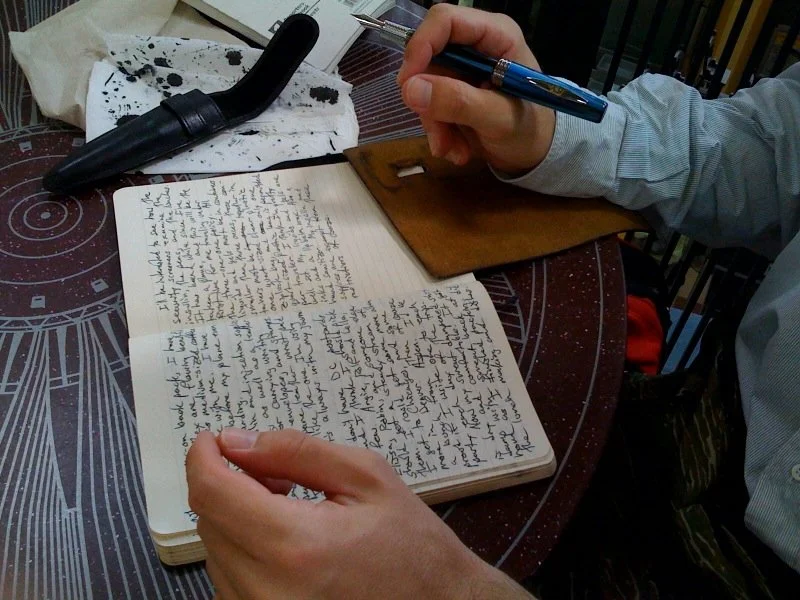
At its core, journaling matters because it helps convert the blur of lived experience into language. Experience alone does not always teach us; reflected-on experience does. Writing is a form of structured reflection. It allows thoughts that feel overwhelming, vague, or contradictory in the mind to become visible, ordered, and examinable on the page. The psychologist James Pennebaker, whose work on expressive writing is among the most influential in the field, showed across multiple studies that writing about emotional upheaval can support psychological and even physical well-being under certain conditions. The broader lesson of that research is not that journaling is magic, but that language can help organise emotion and memory. When people put experience into words, they often gain perspective, coherence, and a greater sense of agency.
One of the most important benefits of journaling is emotional regulation. Human beings often suffer not only from painful feelings but from confusion about those feelings. A journal creates a place where complex internal states can be named without performance or interruption. Research in psychology has repeatedly suggested that affect labeling, the act of naming an emotion, can reduce its intensity and increase regulation. Journaling naturally supports that process. A person who writes, “I am not just stressed; I am resentful, disappointed, and afraid of failing,” has already moved from diffuse distress toward discernment. That distinction matters. Once feelings are differentiated, they become more workable. Journaling can therefore serve as a stabilising practice in times of anxiety, grief, anger, or uncertainty, not by eliminating difficulty but by making it more intelligible.
This emotional clarity is closely tied to mental health. Clinical approaches such as cognitive behavioural therapy often ask people to identify thoughts, beliefs, triggers, and patterns. A journal becomes a practical companion to that work. By writing regularly, individuals can notice recurring cognitive distortions, self-criticism, catastrophising, avoidance, or all-or-nothing thinking. They can also track what improves mood, what drains it, and what environments or relationships repeatedly shape their state of mind. Many psychologists note that self-awareness is a precondition for change. Journaling provides a written map of the self in motion. It does not replace therapy where therapy is needed, but it can deepen therapeutic insight and strengthen the habit of self-observation.
Journaling also improves thinking. Writing is not merely a way to record thought; it is a way to refine it. Executive coaches and leadership thinkers have long emphasised reflection as a cornerstone of professional growth. Marshall Goldsmith’s work on leadership development, for example, repeatedly returns to the power of deliberate self-review: What did I do well? Where did I fall short? What pattern am I repeating? In a similar spirit, coaches working with senior leaders often use journaling prompts to cultivate strategic clarity, values alignment, and behavioural accountability. The page offers distance from immediacy. A rushed meeting, a conflict with a colleague, or a difficult decision can feel obvious in the moment and ambiguous afterward. Writing slows interpretation. It invites the writer to separate fact from assumption, impulse from principle, and short-term emotion from long-term intention.
That slowing function is especially important in leadership. High-profile executive coaching frequently stresses that leaders need not only intelligence and drive but reflection. Herminia Ibarra, writing in leadership contexts including Harvard Business Review, has highlighted the importance of working identity, experimentation, and reflective practice in professional reinvention. Journaling supports that developmental process. It allows leaders to examine how they are perceived, what roles they inhabit automatically, and what shifts they need to make to lead more effectively. It can become a place to process feedback without defensiveness, rehearse difficult conversations, clarify priorities, and test ideas before expressing them publicly. In this sense, journaling is a low-cost, high-yield leadership technology.
A closely related benefit is improved decision-making. Poor decisions are often made in states of reactivity, overconfidence, fatigue, or narrative confusion. Journaling can interrupt these conditions. Decision journals, which have been championed by thinkers in behavioural science and investing such as Annie Duke, help people record what they believe, why they believe it, what uncertainties exist, and what would change their mind. This practice reduces hindsight bias and exposes whether a good outcome came from a good process or simple luck. For professionals making repeated high-stakes choices, journaling can become a record of judgment. Over time, patterns emerge: chronic optimism, avoidance of conflict, susceptibility to urgency, or failure to define success in advance. Few tools offer such a clear mirror.
Journaling is also indispensable for memory and meaning. Human memory is partial and reconstructive. We do not store the past like a video archive; we continually rewrite it. A journal preserves details that would otherwise disappear: the tone of a conversation, the weather on a significant day, a sentence that changed your mind, the precise texture of an uncertainty before it resolved. This archival function has both practical and existential value. Practically, it helps us track habits, health, goals, and growth. Existentially, it creates continuity. A person reading old journals often discovers not only what happened, but who they were while it was happening. That can be humbling, consoling, and illuminating. It reveals change gradually, which is the form in which most real change occurs.
Writers have long understood this. Joan Didion famously described keeping a notebook as a way of remembering what it was to be oneself. That phrase captures something essential. Journaling is not always about facts; it is about consciousness. It preserves the mind’s encounter with the world. Virginia Woolf’s diaries, Anaïs Nin’s journals, Franz Kafka’s notebooks, and the journals of countless writers show how private writing becomes a site of observation, apprenticeship, and identity. For writers, journals are often places where language loosens, where images are caught before they vanish, and where ideas begin in rough form before maturing into essays, stories, or books. The journal is a rehearsal room for attention.
Attention may in fact be one of the deepest benefits of journaling in any field. Contemporary life is fragmented by alerts, feeds, speed, and relentless partial engagement. Journaling trains sustained attention. To write by hand for even ten minutes is to step out of the scroll and into sequence. One sentence follows another. One thought must be completed before the next is begun. This has cognitive and emotional effects. It fosters patience, concentration, and internal signal detection. Many people discover that they do not know what they think until they have written for long enough to get beneath the obvious first layer. Journaling rewards depth over speed. In that sense it is almost countercultural.
There is also growing support for the specific cognitive value of writing by hand. Research comparing handwriting and typing has suggested that handwriting often promotes deeper processing, better conceptual retention, and stronger engagement with material, though the exact effects vary by task and context. Handwriting is slower, and that can be an advantage. Because one cannot transcribe thought as quickly, one must select, condense, and shape it. The hand becomes part of cognition. The movement of forming letters appears to reinforce attention and memory differently from tapping keys. For journaling, this means that handwriting may facilitate a more reflective, less automatic mode of thinking.
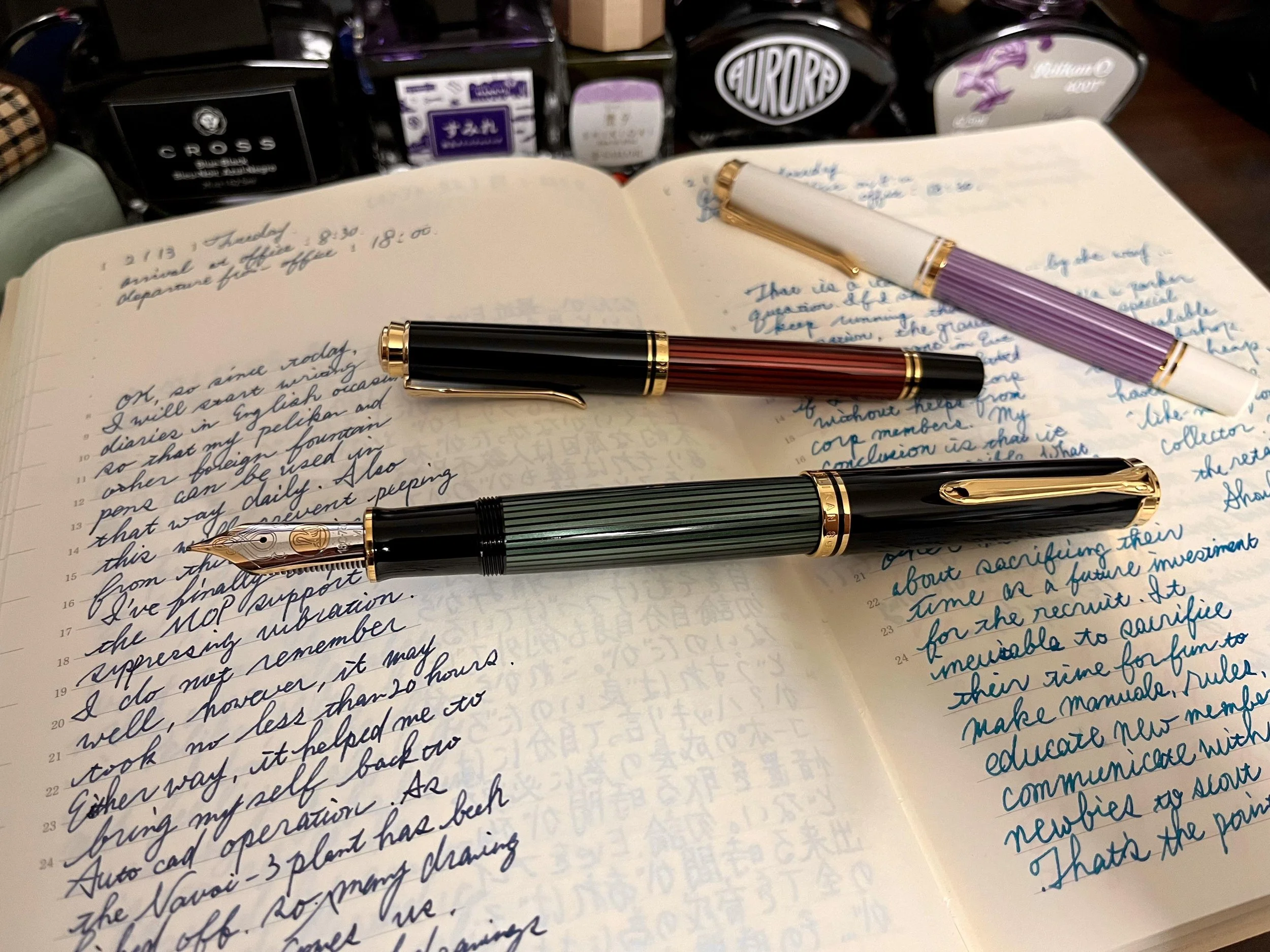
This is where your use of a fountain pen and high-quality stationery becomes especially significant. The sensory benefits are not decorative extras; they can meaningfully enhance the practice. A fountain pen changes the tempo of writing. It glides rather than scratches. It asks for posture, angle, pressure, and care. Good paper receives ink with subtle resistance and fidelity. The line dries with slight variation. The page has weight, texture, even sound. These physical qualities create a ritual frame around thought. They signal that the act matters. In behavioral terms, this is important because ritual increases adherence. People return more faithfully to practices that feel rewarding, coherent, and personally meaningful.
The sensory pleasure of excellent tools also promotes embodied attention. Much of modern work happens in abstract digital space: glass, light, speed, frictionless editing. Writing with a fountain pen restores friction in the best sense. You feel the cap unscrew, the nib touch paper, the ink flow, the hand move, the wrist tire slightly, the page turn. This sensory richness grounds the mind in the body. That grounding can be calming. It resembles, in a modest but real way, the principles behind mindfulness practices that anchor attention in direct sensory experience. The weight of the pen and the texture of the paper help gather scattered awareness. They bring the writer into the room, into the hand, into the sentence.
There is also an aesthetic dimension that should not be underestimated. Beauty can foster care. A handsome notebook, creamy paper, and a well-tuned pen can invite a seriousness and tenderness that a disposable medium can’t quite match. Many writers and thinkers have intuitively known this. The materials of intellectual life shape the feeling of intellectual life. High-quality stationery can make journaling feel less like a task and more like a privilege. That emotional association matters because habits are sustained not only by discipline but by affection. If the page welcomes you, you are more likely to return to it.
The fountain pen in particular encourages a form of attentiveness that suits reflective writing. Because it rewards a measured pace and can make haste physically less comfortable, it nudges the writer away from careless acceleration. The variability of ink, line, and pressure also creates a subtle feedback loop between emotion and inscription. A hurried or agitated state may appear in the script; a calmer state may emerge as the writing settles. In this way the page becomes not only a record of thoughts but a trace of nervous system state. Many journal keepers find that their handwriting itself becomes diagnostic. It reveals when they were tired, grieving, hopeful, impatient, or at peace.
Sensory ritual has another benefit: it dignifies privacy. In a digital environment, personal writing can feel provisional, easily deleted, interrupted by notifications, or mentally adjacent to work and media. A physical journal occupies protected space. It is bounded. It closes. It can be kept, shelved, revisited. The use of beautiful materials reinforces the sense that inner life deserves a dedicated container. That has psychological value. When people feel that their thoughts are worth preserving, they may relate to themselves with greater respect and curiosity. Journaling then becomes not only expressive but affirming: a practice that says my interior life is worthy of attention.
From the standpoint of stress management, journaling can act as a pressure release valve. Studies on expressive writing have linked written emotional disclosure, in some populations and contexts, to reductions in stress-related symptoms and improvements in aspects of well-being. Journalistic accounts in high-profile publications such as The New York Times, The Atlantic, and Harvard Business Review have often translated this research for broader audiences, emphasising journaling as a tool for processing challenge, building resilience, and increasing self-command. While the effects are not universal or identical for everyone, the overall evidence suggests that writing can help people metabolise difficult experience rather than merely ruminate on it. The difference lies in structure. Rumination loops; journaling externalises and can transform.
That transformation often occurs through meaning-making. Psychologists who study trauma, adversity, and resilience frequently note that recovery involves not only feeling emotion but integrating it into a story that can be lived with. Journaling helps construct such narratives. A painful event first appears as chaos: fragments, symptoms, unanswered questions. Through repeated writing, a person may begin to identify chronology, consequence, lesson, loss, and continuing value. They may not find a simplistic moral, but they often find shape. Shape is powerful. It reduces helplessness. It makes room for complexity. It allows grief and gratitude, anger and understanding, regret and resolve to coexist in language.
Journaling also supports goal attainment and behavior change. Research on self-monitoring consistently shows that tracking behaviour increases the likelihood of modification. When people write down what they intend, what they did, and what got in the way, they become less opaque to themselves. This is why journals are so often used for habit formation, fitness, creative output, financial discipline, and professional development. Executive coaches know that accountability is strengthened by specificity, and specificity thrives on paper. “Be more focused” is weak; “Tomorrow from 8:30 to 10:00 I will draft the proposal before opening email” is actionable. A journal can hold intentions at the right level of granularity.
For creative people, journaling is equally important as a generative practice. Many writers recommend morning pages, notebooks, commonplace books, and observational diaries because writing without immediate public purpose liberates originality. On the private page, sentences can fail safely. Fragments can coexist. Unfinished ideas can accumulate until connections form. The journal becomes compost for creative work. It stores overheard dialogue, images, questions, reading notes, anxieties, ambitions, and stray metaphors. Because nothing need be publishable, the pressure to perform recedes. This freedom often produces better work precisely because it protects the conditions under which authentic work begins.
The social benefits of journaling are less obvious but substantial. Writing privately can improve how one relates publicly. By processing reactions before expressing them, people often communicate more effectively. They become less likely to discharge unexamined emotion onto colleagues, partners, or friends. They can write the angry version first and speak the wiser version later. They can identify what they truly want from a conversation. They can discern whether they seek understanding, apology, boundary, repair, or simply witness. In this way journaling improves interpersonal intelligence. It refines response.
Another important dimension is values clarification. Many people are busy enough to be carried by momentum rather than conviction. Journaling interrupts momentum long enough to ask harder questions: What matters to me now? What kind of person am I becoming through my routines? Where am I betraying my own standards? What am I tolerating that I should change? What success am I pursuing, and at what cost? High-profile writers on leadership and personal development often return to this reflective territory because effectiveness without self-knowledge can become emptiness. A journal is one of the best places to conduct a private audit of one’s life.
What makes journaling uniquely powerful is that it is endlessly adaptable. It can be expressive, analytical, spiritual, logistical, artistic, therapeutic, or archival. One day it may hold grief, another day project plans, another gratitude, another a single sharp observation about light on a wall. This flexibility helps explain its longevity across professions and personalities. It meets people where they are. A chief executive can use it to review decisions. A therapist can use it to note countertransference reflections. A novelist can use it to catch an image. A patient can use it to track symptoms. A parent can use it to remember a child’s phrase. The practice scales to the life.
Still, the deepest importance of journaling may be that it restores conversation with the self. In a noisy culture, many people live reactively, speaking outward more than inwardly listening. Journaling reopens an interior commons. It allows a person to encounter themselves not as a brand, a role, or a task manager, but as a consciousness unfolding through time. That encounter can be uncomfortable, but it is also humanising. It reveals fear, vanity, longing, contradiction, tenderness, fatigue, conviction, and growth. It teaches that the self is not fixed but written and rewritten through attention.
And when that attention is mediated through a fountain pen on high quality paper, the practice acquires an additional magic. The nib, the ink, the paper, and the hand collaborate to slow time just enough for perception to deepen. The sensory pleasure is not superficial; it is part of the cognitive and emotional architecture of the practice. Fine tools invite reverence, and reverence sharpens attention. Attention enriches thought. Thought, given language, becomes understanding. Over months and years, that understanding accumulates into wisdom: not abstract wisdom, but lived, particular, handwritten wisdom, preserved in ink.
So the importance of journaling lies in its remarkable breadth. It supports emotional regulation, mental clarity, self-knowledge, resilience, memory, creativity, leadership, decision-making, values alignment, and personal meaning. It is endorsed in different ways by psychologists, executive coaches, and writers because it addresses a central human need: the need to process experience rather than merely endure it. Studies in respected journals, insights from clinical practice, and reflections from accomplished thinkers all converge on the same broad conclusion. Writing things down changes our relationship to them. It can calm, clarify, reveal, and transform. And when done with care, by hand, with instruments that engage the senses, journaling becomes more than a method. It becomes a way of inhabiting one’s life more consciously.