Fake it ‘til you Make it… Or just Fake?
There are phrases that begin life as rough practical wisdom and end as slogans for an entire age. “Fake it ’til you make it” is one of them.
As someone who’s done more than their fair share of sales training in stuffy rooms back in the day, it was always presented as something modest and recognisable. It meant showing confidence before confidence came naturally. It meant entering rooms that intimidated you and refusing, at least outwardly, to shrink. It meant sounding more assured than you felt while you learned, by degrees, to become the person the moment required. In business, and especially in sales, that instinct has long had a use. Sometimes it was the only way through the door.
But like so many fragments of ordinary advice, the phrase seems to have metastasised into something more sinister thanks to the internet and more specifically social media. What was once a technique for surviving uncertainty has become, in some quarters, an ethic of performance so total that it often borders on fraud. What once meant projecting belief while building competence now often means projecting success while building very little at all. What once required courage now requires props.
The difference matters, because a great many people, young people especially, are being trained not to see it. That there is no fakery and that these bros (and it is usually men) have just gone from nothing to millionaires simply by following their “programme,” available to you at a reasonable price.
There is an honourable version of “fake it ’til you make it”, and it should not be sneered at. No one begins fully formed. No founder arrives polished. No salesperson delivers a first pitch with the calm authority of a veteran. Much of adult life consists of acting before mastery arrives: suppressing nerves, borrowing poise, speaking more steadily than you feel, imitating the habits of people who seem to know what they are doing until, eventually, you do know. Confidence often follows the performance of confidence, rather than preceding it. There is nothing shameful in that. It is often simply how growth works.
But there is another version of the phrase, and it is far uglier. This is the version that flourishes in low-trust, high-ego environments. Here bluff is marketed as ambition, exaggeration sold as vision, and deception repackaged as mindset. It is the founder inflating traction, the property guru renting status by the hour, the content creator filming himself in the back seat of a Roller he does not own, the twenty-year-old “mentor” selling freedom through business models he barely understands. In this register, “fake it ’til you make it” no longer means growing into competence. It means simulating outcomes in order to hijack trust.
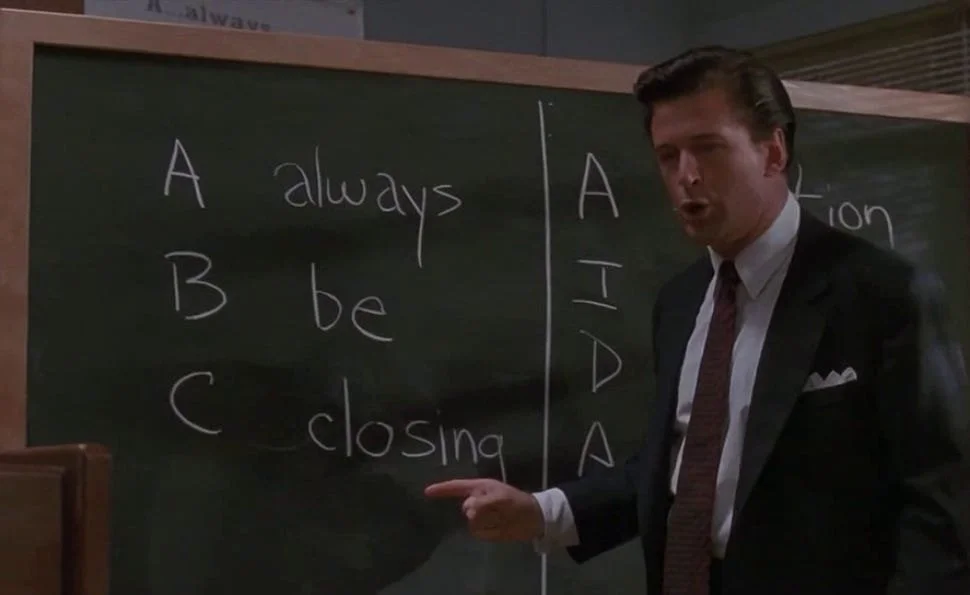
That world did not begin with TikTok. Sales culture has always had a weakness for theatre. “ABC — always be closing.” “Telling’s not selling.” Every generation of high-pressure commerce produces its own little catechism of aggression, slogans that flatter appetite and call it discipline. On one level, they capture something real. Sales does require nerve. It does require resilience, timing, focus, the ability to withstand rejection without dissolving into self-pity. Customers do not buy lectures; they buy clarity, confidence and solutions they can recognise as their own. Good salespeople understand this.
But sales culture has always had a darker edge too. It has always risked confusing persuasion with manipulation, presence with integrity, style with substance. The mythology of the sales floor glorifies a certain type of man: controlled, hungry, verbally agile, incapable of visible doubt. He can dominate a room, steer a conversation, force a deal over the line by sheer force of certainty. Popular culture has spent decades making him look glamorous. Films such as Glengarry Glen Ross, Boiler Room and The Wolf of Wall Street did not invent the type, but they preserved him in cinematic amber: the sharp suit, the hard pitch, the lust for status, the manic excess, the rot beneath it all. They were meant, at least in part, as critiques. But critique and seduction are uneasy companions. A generation of viewers took away the atmosphere and missed the warning thanks to iconic performances from Alec Baldwin, Leonardo DiCaprio and others. These films are now cult viewing for the sales community.
Back in those days though, a lot of sales were done over the telephone, often simply by picking names out of the phone book (ask your parents) and giving them a call; “congratulations, you have been successfully selected…”
That atmosphere did not vanish. It migrated.
Social media inherited not the craft of sales but its swagger. It took the oldest temptation in business, to look successful before you are successful and turned it into a form of mass entertainment. This is partly because real business is rarely picturesque. Real business is contracts, spreadsheets, tax liabilities, hiring headaches, cash flow crises, delayed shipments, insurance, compliance, customer complaints, boring meetings and repeated failure. It is process. It is attrition. It is often deeply unglamorous.
A Lamborghini, by contrast, is extremely glamorous. So is a skyline flat, a Rolex Day Date, a rented desk in a glass-walled co-working space, a screenshot of one day’s revenue stripped of all context, or a solemn young man in a fitted black T-shirt explaining that everyone with a salary has chosen slavery. This is the visual grammar of the hustle economy. It takes the visible leftovers of business; the symbols, trophies and surfaces and passes them off as business itself.
The internet is now thick with boys playing tycoon. They posture beside cars they do not own, preach discipline they do not practise, and sell certainty they have not earned. Some are making money, certainly. But many are making money mainly by telling other people how to make money. Around them swirls a haze of borrowed luxury, inflated revenue claims, bought followers, massaged engagement figures, doctored screenshots, carefully lit routines, and an endless churn of recycled rhetoric about “mindset”, “escaping the matrix”, “abundance”, “leverage” and “freedom”. It is capitalism as cosplay: commerce emptied of substance and reassembled as a lifestyle shoot.
AI is already exacerbating the problem, you don’t even need to rent the Ferrari or the swanky backdrop anymore or even write your own sales patter.
The audience for all this is not stupid. But it is vulnerable and at times naïve.
Young people are especially exposed because social media collapses the distance between aspiration and imitation. Once, fantasies of high-status business masculinity arrived through films (some mentioned above but I’ll also add in Wall Street and maybe even American Psycho), magazines or the occasional local salesman who seemed, to a child, larger than life. Now the performance is in your hand from morning to night, algorithmically tailored and relentlessly repeated. A teenager can absorb an entire philosophy of wealth, domination and contempt for ordinary life before he has learned the difference between turnover and profit.
And that philosophy is not merely financial. It is sexual, social and moral. It has, increasingly, become a script for masculinity.
As The Guardian noted in a recent analysis of the “sigma male” phenomenon, much of this online economy revolves around “the celebration of a particular type of male wealth, characterised by hard work, self-discipline, fitness and grooming”. That seems right. The hustle fantasy is not just investment advice with some expensive props. It is a total aesthetic of male worth. The body, the car, the watch, the apartment, the morning routine, the protein-heavy breakfast, the cold plunge, the unblinking stare, the cultivated contempt for softness; these are sold as one package. Wealth appears not as comfort or security but as proof of rank. There’s definitely a bit of Patrick Bateman about all this.
The same Guardian analysis observed that “the optimised morning routine has become a near-mythical ideal for young people”. Of course it has. Discipline now has to be staged. Waking at 5 a.m. is not enough; it must be filmed. Working hard is not enough; it must be aesthetic. Self-improvement, once a private and often humiliating struggle, has become a public performance conducted under ring lights. Elsewhere, The Guardian described content urging men to “hustle and grind to meet an austere, success-obsessed brand of individualism”. There is something almost theological in that phrase. An austere brand of individualism: one in which the self is both project and prison, eternally optimised and eternally insecure.
The overlap with the manosphere is too obvious to ignore. Not every young man who talks about money online is a misogynist, and not every self-styled entrepreneur belongs to some anti-feminist subculture. But parts of hustle culture sit very close to that world. The emotional grammar is familiar: status anxiety, fear of weakness, contempt for dependence, and the promise that money will restore masculine authority. As the Canadian Museum for Human Rights puts it, “The ‘hustle bro’ approach to life turns other men into opponents and women into objects.” The museum also notes that “pick-up artists have given way to ‘hustle bros’ in recent years” and that such influencers “combine misogynist relationship advice with get-rich-quick schemes.” Research highlighted by the Australian National University makes a similar point, observing that “many men and boys buying into this content have been raised on neoliberal ideas of winners and losers, hustle culture and individual choice,” while manosphere “thought leaders” grow their audiences by tapping into anxieties about “looks, economic futures and ability to attract women”.
Laura Bates, in Men Who Hate Women, captures the human cost of this far better than most institutional language can. “Those most powerfully reinforcing rigid and patriarchal gender stereotypes,” she writes, “are suffocating those who most need to escape them.” That is precisely the paradox of the hustle-manosphere overlap. It presents itself as liberation for alienated young men, but in practice it traps them inside a brittle, joyless and punitive vision of masculinity, in which wealth must be displayed, emotion must be suppressed, and other people exist chiefly as rivals, judges or prizes. What is being sold, then, is not merely a business strategy. It is a worldview.
As another Guardian analysis put it, “These influencers aren’t just showing off their wealth, they claim to offer you, the viewer, the chance to join them.” Exactly so. The display is the sales pitch. The lifestyle is the funnel. The visible wealth may be inflated, rented, selective or entirely notional, but that scarcely matters if it converts. The point is not merely to be admired. The point is to monetise admiration and envy before either has time to curdle into scrutiny.
That is why so much hustle content feels like a cross between revivalist religion, multilevel marketing and soft-focus extortion. The creator performs abundance. The viewer feels lack. Then comes the offer: buy the course, join the private group, subscribe to the mentorship programme, learn the method, access the system, change your life. Louis Theroux captured this pretty well on his recent Netflix documentary on the Manosphere and as The Guardian drily noted, “With hard work and insights (provided by the influencer) you too can succeed, they promise.” The phrase “provided by the influencer” contains the whole racket in miniature. Hope itself has become a subscription product.
Even the more respectable corners of the university world, usually too decorous by half, have begun to say something similar. The UC Davis Graduate School of Management warns that “The dynamism and boldness which startup culture celebrates can be dangerous.” More sharply, it suggests that “fake it till you make it” can become “a license for bad behavior.” That is an admirably calm way of stating the obvious. Once a culture begins to excuse hype as leadership and misrepresentation as vision, it will naturally attract people who are brilliant at seeming and much less interested in being.
And social media is an almost perfect machine for rewarding them.
The platforms do not ask whether someone has built a durable company, mastered operations, treated customers decently, or understands a balance sheet. They ask only whether he can hold attention. Attention favours certainty. Certainty favours simplification. Simplification favours liars. “Here is exactly how I made £10,000 in a week” will always outperform “Here are the tedious, low-margin realities of building a stable business over five years.” The algorithm has no special affection for truth. It has an affection for retention.
The damage here is intellectual as much as financial. A whole generation is being taught to mistake proximity to business content for business knowledge. They acquire the accent of entrepreneurship without its substance. They learn to say “value”, “scale”, “systems”, “distribution” and “leverage” before they understand what any of those words actually mean. They begin to think branding is competence, performance is evidence and confidence is proof.
It is not.
Business is not a vibe. It is not a montage. It is not a collection of luxury cars and aggressive one-liners. It is not a teenager in sunglasses telling exhausted adults that employment is for the weak. Real entrepreneurship is usually much less glamorous and far more demanding than its online evangelists admit. It requires patience, numeracy, stamina, boring skill, delayed gratification and a willingness to do unphotogenic work for a very long time. The hustle economy despises this because none of it clips well.
Meanwhile, startup culture has supplied the whole circus with a moral alibi. In founder mythology, exaggeration is often excused as visionary confidence. Sell the future. Tell the story. Project scale. Back conviction. Up to a point, fair enough. Every enterprise requires some faith in what does not yet exist. But this slides very easily into nonsense, and nonsense, once rewarded, quickly becomes a norm. The New York Times recently captured the absurdity with one excellent phrase, asking which beneficiaries of the AI boom would prove to be “true billionaires and not just paper billionaires”. There, in two words, is the pathology of the age: paper success. Wealth vividly experienced in the public imagination and only uncertainly in reality.
That phrase belongs far beyond Silicon Valley. Much of the online business world now runs on paper status: audiences that do not convert, revenues with no context, valuations with no durability, brands with no depth, confidence with no competence. The image comes first; the audit rarely follows. And once people begin living off the image, the pressure to keep pretending becomes intense.
Patrick Radden Keefe’s account of Zac Brettler in London Falling offers a more tragic version of the same logic. Brettler, a London teenager who died after falling from a luxury apartment building in 2019, had been living what Keefe describes as a fantasy life, posing as the son of a wealthy Russian oligarch. His favourite film was reportedly The Wolf of Wall Street, which feels grimly apt: another tale in which wealth, theatre and self-invention curdle into something darker. Brettler’s case was singular, and should not be flattened into a slogan. Even so, it reads like “fake it till you make it” taken to a tragic extreme: identity itself remade in the image of money, status and belonging. What makes the story so haunting is not merely the deception, but the pressure beneath it. In a culture that treats elite appearance as power, the temptation is no longer only to look successful, but to become, or pretend to become, someone else entirely.
The UC Davis Graduate School of Management makes the structural point with characteristic restraint: “The greater the potential, the more investment, and the heavier the pressure on entrepreneurs and their ventures to live up to their own hype. And this can create a lack of oversight.” Quite. Hype does not merely distort perception. It weakens restraint. If your income depends on the appearance of unstoppable ascent, honesty starts to look like a luxury. If your followers are there for the fantasy, reality becomes a commercial threat.
This is why the phrase “fake it ’til you make it” is now too flattering for much of what it describes. A good deal of it is not faking confidence while learning. It is faking evidence while selling. It is not ambition in costume. It is misrepresentation with flattering lighting.
Still, there is no point falling into the opposite stupidity and pretending that business can function without confidence, narrative or self-invention. Of course it cannot. Many decent people have had to present themselves boldly before they felt ready. Many successful founders have pitched a larger future than current circumstances justified. Many excellent salespeople learned poise by imitating poise. The problem is not confidence. The problem is counterfeit credibility.
That distinction ought to be straightforward, yet our culture keeps blurring it because we remain helpless before surface. We still believe, too readily, in the old visual grammar of success: the suit, the watch, the room, the body, the certainty, the speed. We still want visible wealth to signal visible worth and therefore success. Social media has merely weaponised that weakness and distributed it at industrial scale.
The cost is not confined to the customer who buys a worthless course, though there are many such customers. It is also paid by the young person whose understanding of work is warped before work has properly begun. It is paid by the competent operator drowned out by louder frauds. It is paid by business culture itself, which becomes steadily more cynical as more people conclude, not unreasonably, that enterprise is merely showbiz for narcissists.
And perhaps that is the ugliest consequence. When fakery becomes the dominant style of aspiration, it does not simply mislead. It degrades. It teaches the young to admire the wrong things: not competence but optics, not endurance but display, not service but flexing, not judgement but bravado. It turns enterprise into a branch of personal branding and masculinity into a showroom.
A healthier business culture would not sneer at confidence. It would insist that confidence answer to reality. It would teach people to sell, certainly, but also to build; to present, but also to understand; to be ambitious, but also to be exact. It would remind the young that reading a balance sheet matters more than filming a morning routine, that customer retention matters more than follower count, and that knowing what you are doing matters more than looking as if you do.
There is still a respectable version of “fake it ’til you make it”, and it is worth defending. It is the version in which a nervous beginner straightens his back, does the work and grows into the role. It is the version in which confidence is provisional but effort is real. It is the version in which polish functions as a bridge to competence rather than a substitute for it.
But that is not the version social media has made fashionable.
What it has made fashionable is a culture of props, posturing and monetised illusion: a world in which boys with ring lights play mogul for an audience of the anxious; in which discipline is aestheticised, wealth eroticised, masculinity hardened into ideology, and lying rebranded as vision; a world in which the performance of success has become, for many, more profitable than success itself.
If that sounds harsh, good! It should!
Too much commentary on this subject still speaks as though the problem were only vanity, vulgarity or bad taste. It is not. The problem is moral as well as cultural. A society that teaches the young to confuse image with achievement will produce more frauds, more suckers and fewer serious builders. It will produce people fluent in ambition and illiterate in craft.
So by all means, be bold before you feel bold. Speak clearly before you feel secure. Step into rooms that intimidate you. That is how many people grow, it is certainly how I grew.
But if your entrepreneurship begins with hired luxury, inflated claims, staged authority and a plan to monetise strangers before you have learned anything worth teaching, then you are not faking it till you make it.
You are just faking it.